Most couples first meet their wedding photographer in two situations: the pre-booking call and the wedding day. And the second time, they immediately need to look natural in front of someone they barely know—on the most exciting day of their lives, in front of a hundred guests.
An engagement photo shoot solves this problem. It's an hour or two of walking with the photographer long before the wedding—in a place that means something to you, with no guests, no schedule, and no wrinkle-prone dress. You get beautiful photos for your save-the-dates and wedding website. But most importantly, you get to know the photographer, and they get to know you: how you laugh, which is your "good side," which of you is more reserved in front of the camera, and how to make them feel more relaxed.
This guide covers what engagement photos are and why they're needed, when to take them, why they're the best wedding rehearsal (psychologists have a great explanation), 20 ideas for location and theme, how to pose if you hate posing, what to wear, and what determines the price. And for photographers and videographers, it ends with how to turn an engagement session into the first chapter of a couple's story.
What Are Engagement Photos?
Engagement photos are a couple's photo session after the engagement and before the wedding. Typically, this is a 1–2 hour shoot in one or two locations, often with a change of look. The photos are then used:
- for save-the-date — cards that guests receive many months before the wedding;
- on the wedding website — the first thing guests see when they click the link;
- on invitations, in the program, and in the guestbook — many couples create a guestbook in the form of a photo album with engagement photos, where guests leave wishes;
- on a sign at the reception entrance;
- for announcing the engagement on social media.
Many photographers include an engagement session in their wedding package or offer a discount on it when booking a wedding. Check if yours offers one.
Why Engagement Photos Are the Best Rehearsal for Your Wedding
An engagement session has a benefit that's hard to see in a portfolio: it changes how you look in your wedding photos.
In 1968, psychologist Robert Zajonc described a phenomenon he called the "mere exposure effect" in the Journal of Personality and Social Psychology. In one of his experiments, participants were shown photos of strangers taken from a college yearbook—some faces once or twice, others up to twenty-five times. Then, the participants were asked to rate how much they liked each person. The more often a participant saw a face, the more they liked that person. Nothing happened, no one spoke to anyone—the familiar simply seems more appealing than the unfamiliar.
The same thing works with a photographer. On your wedding day, the person with the camera you saw for two hours during an engagement shoot is no longer a stranger. You know their jokes, and they know yours. Shoulders relax, smiles become genuine. Many photographers say the difference between couples with and without an engagement session is visible within the first few minutes of the wedding shoot.
An engagement session is also a rehearsal in the truest sense:
- You see how you look in the photos, and have time to decide what to change in your hair or makeup for the wedding;
- The photographer sees which angles and poses suit you, and doesn't waste time on them at the wedding;
- You test the editing style on your own faces, not on other people's weddings from their portfolios.
When Should You Take Engagement Photos?
The main guideline is whether you need save-the-date photos.
- If you need them, 10–12 months before the wedding. Save-the-dates are sent out approximately 8–9 months before the wedding, as per our wedding planning checklist. Before that, you need time to edit the photos, design the cards, and print them.
- If they're only for the website and reception, 2–4 months before. This way, you'll also look the same in the photos as you will at the wedding.
- Right after booking the photographer is also a good option: you'll find out how it feels to work with them.
According to The Knot's research, the average engagement in the US lasts about 15 months. This means almost everyone has time—the main thing is not to put off the session until the last minute.
When to Take Engagement Pictures: Time of Day and Season
- An hour and a half before sunset. Soft, warm light, long shadows, no one squinting. Photographers call this time the golden hour.
- Early morning. The light is almost as beautiful, and there are fewer people around—perfect for popular city spots.
- An overcast day. An underrated option: the clouds act as a huge diffuser, keeping the light soft all day.
- Any season. Engagement photos don't have to match the wedding season. If the wedding is in the summer, shoot the engagement in fall leaves or in the snow—this way you'll capture two different moods in one story.
Engagement Photography Ideas
The best location for an engagement shoot is one that says something about you. A beautiful, yet random park will yield beautiful, yet random photos.
- Where you had your first date. If it was a pizzeria, so much the better.
- Your favorite cafe or bakery — it's easier to pose with coffee in hand.
- A park or beach where you walk on weekends.
- At home — mornings with coffee, cooking together, lazy Sundays under a blanket. The most personal and often most beloved shots.
- With a dog or cat. A pet breaks the tension better than any photographer.
- A city at night with lights.
- A field or forest at sunset.
- Your hobby — cycling, a bookstore, rock climbing, pottery.
- Picnic with a blanket, basket, and strawberries.
- Under one umbrella in the rain.
- A farmers' market—colors, flowers, lively bustle.
- Where you got engaged—recreate the moment for the camera.
- Your favorite team's stadium—in jerseys, with popcorn.
- Museum or gallery.
- Dancing in the middle of an empty street or in an empty hall.
- A hike in the mountains—with a view worth the climb.
- A vintage car or your first car together.
- Snow and hot chocolate.
- A boat, kayak, or dock.
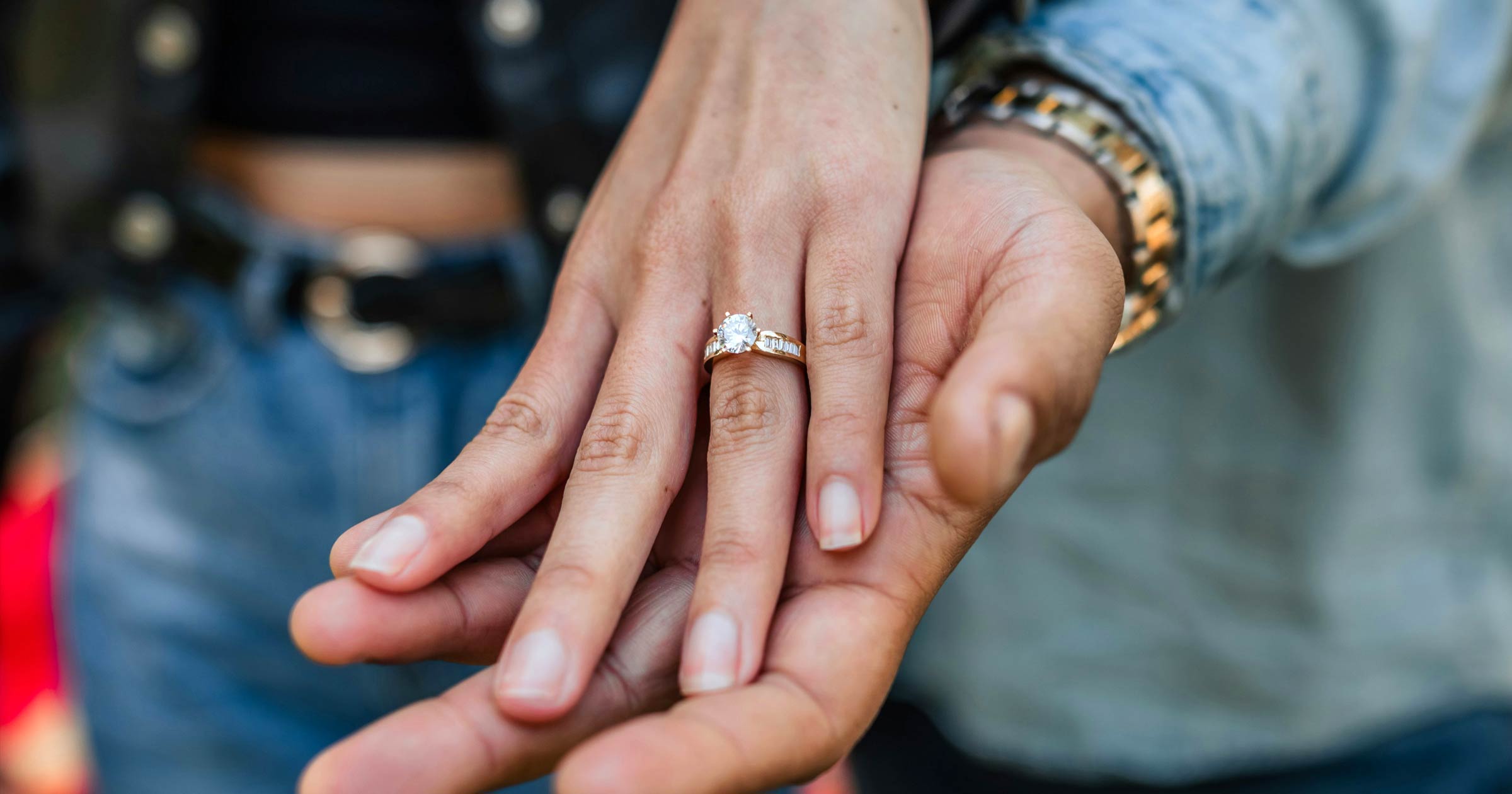
- A shot where the ring is the star. Hands and ring in focus, the two of you blurred in the background.
How to Pose for Engagement Photos
If you're camera shy, we have good news: you don't need to pose. You just need to do something. The best engagement photos aren't about poses, but about the actions the photographer captures.
Why "Smile!" Doesn't Work
In the mid-19th century, French neurologist Guillaume Duchenne de Boulogne studied facial expressions in the most straightforward way: he applied electrodes to people's faces, elicited contractions of individual muscles, and photographed the results. In his 1862 book "The Mechanism of Human Physiognomy," he described how a genuine smile of joy is the work of two muscles: one raises the corners of the lips, and the other, the orbicularis oculi, creates the "crow's feet" around the eyes. We easily control the first. The second, according to Duchenne, is activated when a person is genuinely happy. More than a hundred years later, psychologist Paul Ekman proposed calling this smile a Duchenne smile.
Later, researchers discovered that it's possible to fake such a smile—good actors can do it. Most of us can't. That's why the command "smile" produces a smile with just the lips, while a real smile—with the eyes—occurs when you're genuinely laughing. A good photographer's job is to make you laugh, not to ask you to smile.
Poses That Don't Look Like Poses
- Walk toward each other or together toward the camera. Movement relieves tension better than any command to "relax."
- Talk. Ask your partner to tell you about their day, or recall who texted first after your first date. The laughter will be genuine.
- Touch each other. Hand on waist, forehead to forehead, hug from behind, chin on shoulder.
- Look at each other, not into the camera. You'll want a few looking at the camera, but those won't be the best ones.
- Whisper in each other's ear. Let one whisper something funny or inappropriate—the photographer will catch the reaction.
- Keep your hands busy. Coffee, a blanket, the dog's leash, each other's hands. Empty hands are the main cause of awkward poses.
- Slow dance without music. It's awkward at first—twenty seconds later you're laughing, and those are the best shots of the session.
How to Take Engagement Photos: What to Wear
- Two looks: one casual, one dressier. This way, you can create two different moods from a single session—for example, jeans for a save-the-date and an evening look for a website.
- Coordinate, but don't match. Two or three colors from the same palette look better than "identical white T-shirts."
- No big logos or thin stripes—a logo distracts, and stripes shimmer in photos.
- Texture beats brightness: a knit sweater, linen, and suede look richer in photos than neon.
- Comfortable shoes if you'll be walking a lot. You can bring nice shoes for a couple of shots.
- A manicure—the ring will be in close-up.
- Hair and makeup like on the wedding day, if you want a trial run too. Ask your stylist to do a trial look on the day of your engagement shoot and see how it looks in professional photos.
How to Get Photos That Work for Save-the-Dates and Your Website
Engagement photos are almost always used in design: the card, the website, the sign at the entrance. And there are a few things you should tell the photographer in advance—otherwise, the best shot of the session may simply not fit on the card.
- Ask for shots with room to breathe. A save-the-date requires space for text: names, date, city. A shot where the couple takes up a third of the image, with the rest being the sky, field, or wall, is much more convenient for design than a tight portrait.
- Both horizontal and vertical options are needed. A card is usually vertical, a website cover is horizontal, and Stories are vertical and narrow. A single moment shot in both orientations solves this problem.
- One close-up shot without faces. Hands with a ring, silhouettes at sunset, a view from behind—these shots work well as a background over which text can be read.
- Colors to match the wedding palette. If you already know the wedding colors, clothing and location in the same tones will make the card and website cohesive without any extra design effort.
- Talk turnaround in advance. If cards need to be sent by a specific date, tell the photographer before the shoot, not after. Sometimes the photographer may deliver 5–10 shots for the card before the rest of the gallery.
The Day Before the Session
Checklist for the evening before your engagement shoot:
- Clothes for both looks are ironed and folded, along with shoes.
- The ring is cleaned—every speck of dust is visible in the close-up.
- If you're bringing a dog, bring a leash, treats, and someone to hold it between shots.
- Props, if you have any: a blanket, coffee in pretty cups, flowers, balloons.
- Water and a snack: an hour or two on your feet at sunset is longer than you think.
- Weather forecast and a backup plan in case of rain (or an umbrella—photos under an umbrella are often the best).
How Much Do Engagement Photos Cost?
The price of an engagement session depends on several factors:
- The photographer — their experience, demand, and location;
- Duration — an hour or two;
- Number of looks and locations—each change takes time;
- Travel—if the location is far from the photographer's city;
- Number of edited images included;
- Prints — save-the-date cards, guest book album.
The most cost-effective option is when the engagement session is included in the wedding package or offered at a discount when booking a wedding: many photographers do this because it's beneficial for them to get to know the couple in advance. Ask about this when choosing a photographer. In our photography contract template, the engagement session is a separate item within the package, with its own delivery deadlines. For what a wedding photographer costs and what packages usually include, see How Much Does a Wedding Photographer Cost.
For Photographers and Videographers: The First Chapter of the Story
For a photographer, an engagement session isn't just an upsell. It's the best way to make a wedding easier: you know the couple, they know you, and you're not starting from scratch on the wedding day.
- Treat the session as scouting. What angles work, who's shy, what makes them laugh, how they usually stand next to each other. Write it down—it'll come in handy in six months.
- Talk about the wedding day. The walk is the perfect time to discuss the timeline, the first look, and the family photo list in a relaxed atmosphere.
- For videographers—save-the-date films. A short 30–60 second video of the engagement walk is a popular service that couples send to guests instead of or along with a card.
And one more thought: where to store it all. Engagement photos and the save-the-date video are the first chapter of the couple's story, and the wedding is the second. Deliver them in the same place, and the couple has a single gallery for their entire story—from their first walk to their first dance. In OurStoria client galleries, you can share your engagement session with the couple now, and then add the wedding photos and film to the same gallery six months later—the link stays the same, and relatives don't have to search for two separate emails. Start a 7-day Free Pro Trial—no credit card required.
Before the Big Day
An engagement photo shoot is a rare moment when the two of you share the same frame, without guests, without a schedule, and without pressure. Just you, a place that means something to you, and the person who, in six months, will be photographing the most important day of your lives.
Let this walk be just like your usual ones—just with a camera nearby. The best photos come out that way.
Related articles: