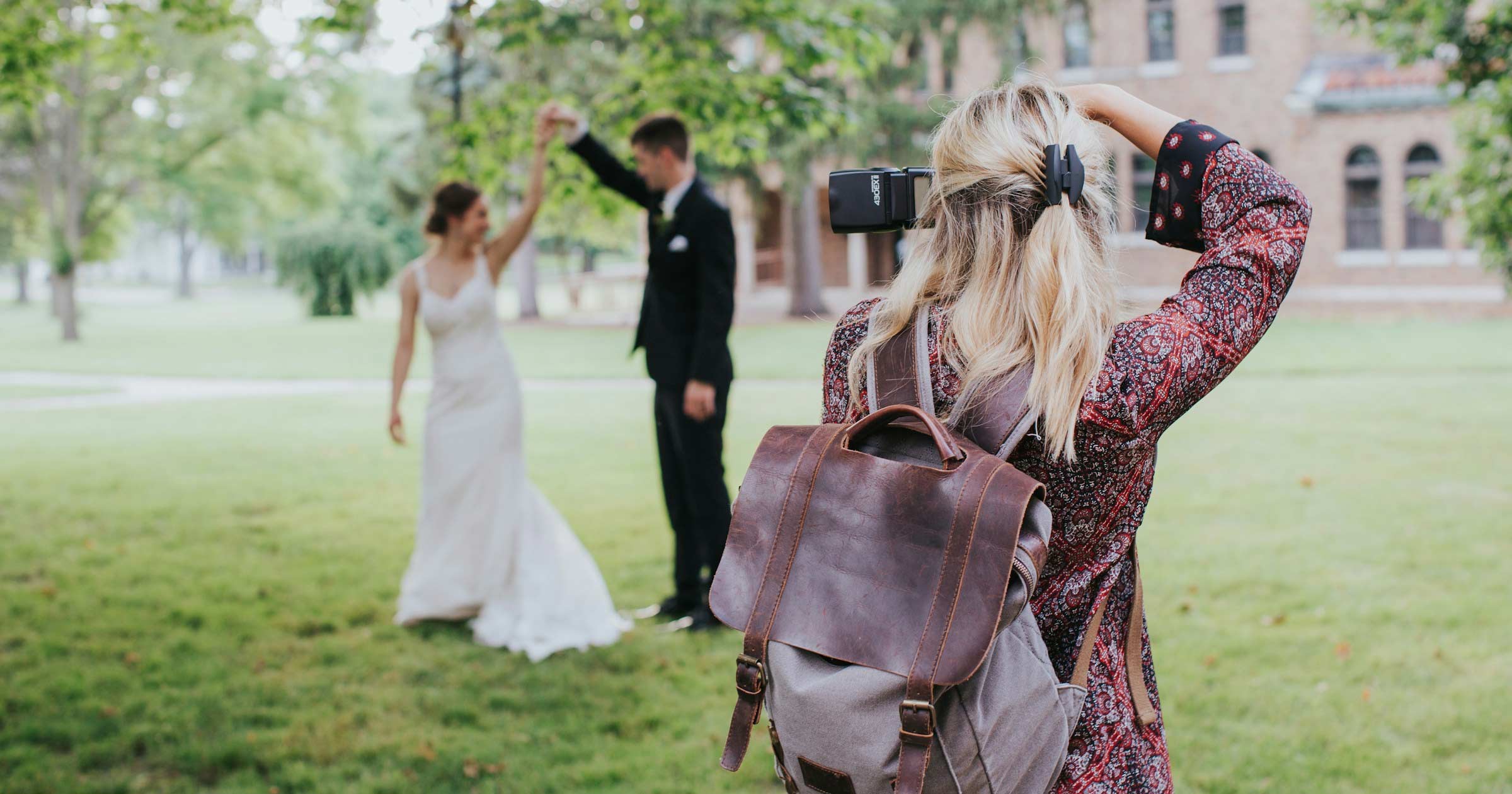
Almost every couple starts the same way: they open Instagram, scroll through other people's weddings, and within an hour, all the accounts merge into one. Golden light. A laughing bride. A groom wiping away a tear. Forty photographers—and they all look beautiful.
The problem is that a portfolio is the top one percent of a photographer's work. But you're not buying the one percent—you're buying everything else: eight hours straight, a dark restaurant hall, the midday sun over the ceremony, relatives scattering before the group photo, and exactly one attempt to photograph you walking down the aisle. There are no retakes.
That's why choosing a photographer is more difficult than it seems. Many people can take beautiful shots. Far fewer can shoot consistently all day, in any light, with real people who aren't posing. And the difference between the former and the latter is almost impossible to discern from an Instagram feed.
This guide gives you a step-by-step way to tell them apart: what styles exist and how to identify your own, how much it actually costs and what factors influence the price, where to look, how to browse galleries, what questions to ask before paying a deposit, and which contract clauses are most important. And if you're a photographer or videographer yourself, there's a section at the end about how couples choose and what that means for your portfolio.
What Is a Wedding Photographer's Role?
On paper, it's simple: a photographer shoots a wedding and hands over the gallery. In reality, their work begins months before the wedding and ends weeks after.
Before the wedding. A good photographer helps plan the day's schedule—not because they're the organizer, but because they know how long a family shoot actually takes (longer than you think) and when the best light is at your location. They compile a list of family groups and important shots, clarify which relatives are divorced and which shouldn't be placed next to each other, and sometimes shoot an engagement session—which also helps you get used to them and to the camera.
On the wedding day. Details (rings, invitations, dress), getting ready, first look, ceremony, couple portraits, the wedding party, family, reception, first dance, cake, toasts. And beyond the shooting, there's directing. Someone has to line up twelve groups of relatives in ten minutes so that no one gets lost and everyone's eyes are open. Someone should notice that the groom's boutonniere is twisted. A good photographer does this so you barely notice.
After the wedding. Culling (out of several thousand frames, a few hundred make the cut), color correction, retouching, previews in the first few days, a full gallery after a few weeks, sometimes an album and printing.
There's also a less obvious role, and it's perhaps the most important: the photographer means you don't have to take the photos yourself.
It sounds strange, but there's a good story behind it. Psychologist Linda Henkel of Fairfield University took students on a tour of the university's art museum. There was one rule: just look at some exhibits, and photograph others. The next day, the students were tested, and it turned out they remembered less of what they'd photographed: fewer of the exhibits themselves, fewer details, and less of a memory of where things were. It's as if the brain decided, "The camera remembers it, so I don't have to try." Henkel described this in the journal Psychological Science and called it the "photo-taking impairment effect."
But this story had an unexpected twist. When the students zoomed in on a detail rather than snapping a photo of the entire exhibit, their memory didn't suffer. All it took was really looking—and it stuck.
There's no need to hide your phone forever, either. Kristin Diehl of the University of Southern California and her colleagues conducted nine experiments with over 2,000 people—on tours, in cafés, on walks—and published the results in the Journal of Personality and Social Psychology. It turned out that taking photos often adds enjoyment: the person with the camera looks more attentively and becomes more engaged. But only as long as the shooting doesn't get in the way: once you're fiddling with gear and thinking about the shot instead of the moment, the enjoyment disappears.
Put these two findings together, and you get exactly what a professional is hired for. The person who does this for work will be the one carefully looking "through the zoom," noticing details, and thinking about the shot. And you simply live your day, without your phone in your hand or thinking, "I should take this." Incidentally, this is why many photographers recommend an "unplugged ceremony"—a ceremony where guests are asked to put away their phones so that the frame captures the aisle, not a wall of screens.
Find Your Style Before You Look at Prices
The most common mistake is starting with the budget. Couples shortlist everyone within budget and then try to find someone they like. It's more logical to do the opposite: style first, price second. A gallery you don't like won't improve with a discount.
Start with a simple exercise. Collect 15–20 wedding photos that truly capture your attention—not the hashtag "wedding inspo," but ones you want to linger on. Then, lay them out and see what they have in common: light or high-contrast? Staged or captured? Close-ups of emotion or wide shots with a landscape? The answer usually becomes obvious within ten minutes.
| Style | What it looks like | Who it's for | What to check |
|---|---|---|---|
| Documentary (photojournalistic) | Minimal staging, the photographer captures real moments: a father's tears, guests' laughter | For those who don't like posing and want "the way it was" | Are there not only moments in the galleries, but also proper portraits of the couple? |
| Classic (traditional) | Well-considered poses, groups, symmetry, "album" shots | For large families where all relatives are important | Do people look stiff and identical? |
| Light & airy | Bright, soft tones, pastels, lots of open space | For daytime, outdoor, and summer weddings | How they handle a dark venue at night—this style struggles in low light |
| Dark & moody | Deep shadows, rich colors, drama | For evening, autumn, and city weddings | Do skin tones look natural, or do faces look muddy? |
| Editorial / fashion | Like a magazine shoot: strong poses, composition, fashion | For couples who value style and image | Are there enough candid moments between the posed shots? |
| Film / film look | Film or film imitation: grain, soft contrast, warm tones | For those who love a timeless look | If it's real film: how many frames, turnaround, price |
One important clarification: editing is easy to change; the eye is not. A photographer can adjust a color preset to suit you. But the ability to see a moment half a second before it happens, find the right light in a dark restaurant, or arrange a group so that the grandmother doesn't end up behind a column—you can't adjust that with a slider.
And one more thing about fashion. In the 2000s, it was fashionable to leave only the bouquet in color in a black-and-white frame (selective color) for wedding photos. Today, you can date those photos at a glance. If you love a very trendy editing style, ask yourself: will you like it in twenty years? The most timeless wedding photos are usually those where the editing doesn't shout over the people.
Set a Realistic Budget
According to The Knot, the average cost of a professional wedding photographer in the US is around $3,000 (based on a survey of over 10,000 couples who married in 2025). This is an average, but the range is huge: from a few hundred dollars for beginners to $10,000 and up for top photographers in big cities. For a full breakdown by region and wedding size, see How Much Does a Wedding Photographer Cost?
The levels look roughly like this (this is our rough breakdown; prices vary greatly by city):
| Level | Approximate Price | What's Typically Included | What to Look for |
|---|---|---|---|
| Beginner | up to $1,500 | 4–6 hours, one photographer, online gallery | Ask for full galleries—quality often fluctuates between shots with beginners |
| Mid-range | $2,000–$4,000 | 8 hours, sometimes a second photographer, gallery, preview | Most common choice; compare package contents, not price |
| Premium | $5,000+ | Full day, two photographers, love story, album | Make sure this photographer will actually shoot your wedding, not a studio associate |
Why $3,000 Isn't "$375 an hour"
Many couples divide the price by eight hours of shooting and get scared: $375 an hour? But eight hours at a wedding is less than a third of the work. Let's do the math for a $3,000 package:
- Consultations, correspondence, and phone calls — 2–3 hours;
- Timeline, shot list, and venue walkthrough — 2–3 hours;
- Wedding day — 8 hours plus travel and equipment preparation — 10–11 hours;
- Copying and backups, initial selection of several thousand shots — 4–6 hours;
- Color correction and retouching of 500–800 final photos — 15–20 hours;
- Previews, gallery assembly, delivery, and answering questions — 2–4 hours.
Total: 35–45 hours. That's roughly $65–85 per hour—before paying for two cameras (a spare is essential: a breakdown on the wedding day is no excuse), lenses, flashes, insurance, software, file storage, advertising, and taxes. So, a suspiciously cheap photographer usually skimps on one of these items—and it's almost never travel time.
What drives the price up and down
- Shooting hours — the most important factor. If you don't need getting-ready coverage, you can save 1–2 hours.
- Second photographer — needed if getting ready happens in two locations or there are more than 120–150 guests. Otherwise, one is enough.
- Date. According to The Knot, fall has been the most popular wedding season in the US since 2015. An October Saturday is the priciest slot and the first to go. Fridays, Sundays, or winter months are often cheaper and easier to book.
- Album and printing — often add hundreds of dollars. You can postpone it: order the album later, after you've calmly chosen the photos.
- Love story / engagement session — sometimes included in the package, sometimes separately. Useful as a rehearsal: at the wedding, you already know how the photographer works.
- Travel—if the venue is far from the photographer's city, plan for travel and, possibly, an overnight stay.
How to Find Wedding Photographers
A good candidate list is compiled from multiple sources, not just Instagram. Each has its own pros and cons.
| Where to look | Pros | Cons |
|---|---|---|
| Friends who recently got married | You've seen the photographer in action and know how they delivered the gallery | Their taste and budget may not match yours |
| Recommended venue list | The photographer knows the lighting, locations, and venue rules | Sometimes people get on the list for a fee, not for quality |
| Your venue's geotag on Instagram | You see your venue in real light and in different weather conditions | These are the best shots, not full galleries |
| The Knot, WeddingWire, Zola | Reviews, prices, date filters | Paid placement elevates some over others |
| Your videographer or planner | They know who's easy to work with | They may have "their own people" |
| Reddit (local and wedding subreddits) | Honest reviews without moderation | One-off opinions; double-check |
The most underrated method is the venue geotag. Open your venue's location on Instagram and scroll through the latest posts. You'll see dozens of weddings in the same hall and garden, at different times of the year, and you'll quickly understand which photographers excel at working with this particular light. Save the ones whose shots stand out—this will give you a ready-made shortlist.
If you already have a videographer, ask them who they enjoyed working with. Photographers and videographers shoot the same day side by side: when two people get in each other's way on the aisle, both results suffer. Our research on photographer-videographer collaboration shows how much coordination affects the final shots.
What to Look for in a Wedding Photographer
Full galleries, not the best shots
The main rule of this entire guide: ask for 2–3 full wedding galleries, preferably similar to yours—same venue or similar lighting, same time of year, similar number of guests. A full gallery is 400–800 photos from a single day, and it shows things that will never make it into a portfolio:
- Consistency. Are the 500th to 600th shots as good as the first 20?
- Challenging lighting. A ceremony in a church where flash is prohibited. A reception in a dark hall. Midday sun without shadows. You won't learn how a photographer handles this from a portfolio.
- Skin tones. Do people with different skin tones look natural? Do faces turn orange or gray with "fashionable" editing?
- Group photos. Is everyone in focus? Are their eyes open? Are feet cut off? It seems like a small thing—until you get the only photo of the whole family, where the grandfather has his eyes closed.
- Moments between moments. The mother's reaction as the bride walks in. A child asleep on chairs. The groom's father secretly wiping his eyes. These are the shots couples come back to for years.
- Reception after sunset. Many photographers are strong during the day and struggle after dark. See what the first dance and the dance floor look like.
If a photographer refuses to show a full gallery, that's a signal. The reasons may be valid (couples ask not to publish), but then they should at least offer a private gallery.
Red Flags
| Red flag | Why it's bad |
|---|---|
| Instagram only, no full galleries | You don't know how they shoot a whole day |
| All the weddings in their portfolio are at the same location and in the same lighting | They may not handle other conditions |
| No contract or "we'll just agree" | No protection if something goes wrong |
| Vague deadlines: "as soon as possible" | You can wait six months for a gallery |
| No plan for illness | No one might be there on the wedding day |
| One camera, one memory card | A broken or malfunctioning card = lost shots |
| "Discount only today" | Pressure instead of conversation is a bad sign for the future |
| Doesn't ask questions about you | Will shoot "the same as always," not your wedding |
Reviews: How to Read Them
Almost everyone reads reviews: in a recent BrightLocal survey, only 4% of people admitted they never read reviews of local businesses. But how you read them matters—and most people focus on the wrong things.
- Look for specifics about the day. "The photos are beautiful" says nothing. "She got our entire huge family together in ten minutes and made everyone laugh" says a lot.
- Watch delivery times. If several reviews mention that the gallery took longer than promised to be delivered, that's a pattern.
- Read the responses to negative reviews. How a photographer responds to criticism is how they will treat you if a problem arises.
- Ask for the contact information of a couple who got married 6–12 months ago. They've already received the entire gallery and can walk you through the whole process—from the first meeting to delivery.
How to Pick a Wedding Photographer
You have a list. Now you need to narrow it down to one person.
Many couples fear that there are too many options and they'll simply be overwhelmed. You've probably heard of the "paradox of choice": when too many options are available, people become overwhelmed and ultimately choose nothing. Sounds logical. But when psychologists Benjamin Scheibehenne, Rainer Greifeneder, and Peter Todd compiled the results of fifty experiments on this topic and published their analysis in the Journal of Consumer Research, the picture was more modest. In some experiments, extra options actually hindered, in others, they actually helped, and on average, the effect was almost nonexistent.
So, a long list of photographers isn't scary in itself. The danger is in comparing them based on obvious factors: the best Instagram shots and price. A short list is needed to ensure there's enough time to compare what's truly important: full galleries, reviews, and live conversations.
Here's a process that works:
- Out of 8–10 candidates, select 4–5—those whose style truly resonates with you and whose price is within your budget (with a 10–15% margin).
- Check dates. Message everyone at once: if the date is booked, there's nothing further to discuss.
- Ask for full galleries and view them with your partner, separately, then compare notes.
- Call two or three finalists. A video call is better than texting.
- Compare contracts and packages—line by line, in a spreadsheet.
- Book with a deposit and a signed contract.
Conversation matters more than you think
You'll spend more time with the photographer than with any of the guests. They'll be in the room while you get dressed. They'll see you cry, get nervous, and laugh. If you're uncomfortable with them, it'll show in the photos: tense shoulders, strained smiles.
It's a good sign if, during a call, the photographer asks more than they talk about themselves. For example: "Who absolutely must be in the photo, but will be hard to capture?" or "Is there anything in the family I should know?" Such a question is the sign of someone who's photographed enough weddings to know that a grandfather in a wheelchair, divorced parents, and an aunt who leaves early aren't small details—they shape half of the family photo session.
Questions to Ask Wedding Photographer Before Booking
The questions themselves can be found anywhere. It's more important to understand the purpose of each one and what a good answer sounds like.
| Question | Why ask | Good answer |
|---|---|---|
| Is our date available? | Saves everyone's time | Yes—and how long they'll hold it without a deposit |
| Can I view 2–3 full galleries? | Portfolio ≠ real work | Yes, here are the links, one at a similar venue |
| Who exactly will be shooting? | In studios, the photographer may not be the one whose portfolio you've seen | Name in the contract |
| How many hours are included in the package and how much is an extra hour? | Weddings almost always run late | A clear hourly rate you can approve on the day |
| Will there be a second photographer? | Needed for two locations or a large wedding | Yes/No — and an honest opinion on whether you need it |
| How many photos will we receive? | So your expectations match | Approximate range (many photographers cite 50–100 processed photos per hour of shooting) |
| When is the preview and when is the full gallery? | Deadlines vary greatly | Specific deadlines are in the contract: for example, a preview within a week and the full gallery in 6–10 weeks |
| How do you deliver photos? | Flash drive, link, or online gallery — there's a big difference | Online gallery with full-resolution downloads |
| How long is the gallery stored? | Links expire | A specific period, plus a reminder before deletion |
| What if you get sick? | The risk is real | They have a network of trusted colleagues, and replacement is in the contract |
| What do you shoot with and how do you store the files? | Equipment breakdown and card loss | Two cameras, dual card slots, multiple backups |
| What is the payment schedule? | Budget and security | 25–50% deposit, balance due before the wedding or on the day of |
| Can I print and publish photos? | Photo rights | Yes, a print release for personal use is included |
| Will you use our photos in your portfolio? | Privacy | Yes, but you can request not to publish them |
Save these questions and ask all finalists the same questions—then you can easily compare their answers.
What to Ask Wedding Photographer About Delivery
The most underestimated question of all is what happens to the photos after they're delivered.
Imagine a scenario that happens all the time. Megan and Josh got married in 2019. The photographer sent a beautiful link to a gallery; they looked at it, showed it to their parents, downloaded a couple dozen favorite shots for social media, and forgot about it. Four years later, for their anniversary, they decided to order an album. The link wouldn't open: the gallery had only been kept online for a year. The photographer had switched services, and the 2019 archive was sitting somewhere on an old drive. Some of the photos were recovered. Some were not.
To prevent this from happening to you, find out three things:
- What resolution will the photos arrive in? Are they full-size for print or just "screen-friendly"? Full resolution is required for albums and large prints.
- How long will the gallery stay online? One year, five years, or forever? And will there be a reminder before deletion?
- Who keeps a backup after that? Almost always, you. Photographers keep archives for a limited time, and that's okay.
So the rule is simple: download all originals on the very first day. And then do what photographers do—they call it the 3–2-1 rule: three copies, on two different media, and one of them away from home. For example: a computer, an external drive, and cloud storage (or a drive at your parents' place).
If you have both photos and videos, it's most convenient to have everything in one gallery with a single link: parents can open the photos on their phone, and the wedding film on their TV, and no one has to search for five different emails. Many studios offer photos and videos in branded galleries—for example, OurStoria galleries, where photos and videos can be viewed on any screen and downloaded in their original quality.
Read the Contract (Yes, the Boring Part)
A contract isn't a formality; it's the only thing that protects you if something goes wrong. A good photographer's contract includes:
- the date, time, and location(s) of the shoot, along with the exact number of hours;
- the package contents: second photographer, engagement session, album, and number of photos (at least an estimate);
- the price, deposit, payment schedule, and the cost of an additional hour;
- cancellation and rescheduling policies for both parties;
- preview and full gallery deadlines;
- delivery method and gallery storage period;
- photo and print rights;
- photographer replacement in case of illness or force majeure;
- what happens if some files are lost.
Who Owns Your Wedding Photos?
It sounds like an odd question: us, obviously—we paid for them. But many couples are in for a surprise. U.S. copyright law (§201) says that the rights to a photograph belong to the person who took it—and they arise the moment the photographer presses the button. This means that your wedding photos are, by default, owned by the photographer.
Don't be alarmed: that's how the entire industry works, and in practice, it almost never creates problems. You're not receiving the rights themselves, but permission to use the photographs—to print, post on social media, send to family, or make albums. And the law allows the copyright itself to be transferred only in a signed written document (§204), and photographers rarely do this: otherwise, they won't be able to show their work to future clients.
This leads to a simple conclusion: everything you want to do with the photos must be written into the contract. A verbal "sure, go ahead and print them" doesn't count. Check three things:
- Make sure the contract includes a print release—permission to print photos for personal use in any quantity and size;
- Check whether photos can be published on social media (usually yes, with a credit to the photographer) and whether they can be edited (photographers usually aren't fans of filters on top of their edits);
- If privacy is important to you, agree that the photographer won't publish your wedding in their portfolio or only posts photos without the kids' faces.
You can see how this looks in a real document in our free photography contract template—there's also a completed example. And before the wedding, give the photographer a list of required shots and family groups: a ready-made version is in our wedding shot list, and how to create family groups without chaos is in the article Wedding Family Photo List.
Your Photographer and Videographer Work as a Team
If you're hiring both a photographer and a videographer, choose them with each other in mind. They stand in the same spots all day: at the head of the aisle, at the altar, in front of the couple during the first dance. When they haven't coordinated, one constantly gets in the other's shot—and you see it on video at the most touching moment.
Ask each: have you worked together before? Do you have any favorite colleagues? A photo-and-video team that has worked together before can coordinate with a glance. If you're still choosing a videographer, we have a detailed guide How to Choose a Wedding Videographer—it follows the same logic, but for video.
For Photographers and Videographers: What This Means for You
If you photograph weddings, this guide is essentially a description of how you're being vetted.
- Have 3–4 full galleries of different weddings ready: day and evening, indoors and outdoors, large and small. When a couple asks to "show the whole day," sending one link within a minute beats any Instagram feed.
- Show how you deliver your work. Couples are increasingly asking about delivery, deadlines, and storage. A beautifully branded gallery with a clear storage period is a selling point that sets you apart from a "Dropbox link."
- Put everything from the questions table above into your contract. This will answer half the questions before the call.
- Ask questions on the first call. Couples remember those who ask about their family, not just the date.
With OurStoria, you can gather photos and videos in a single branded gallery, share it with a single link, and show potential clients the entire wedding, not just highlights. Start a 7-day Free Pro Trial – and see how your next gallery looks through the eyes of the couple.
The Photos Will Outlive the Day
The flowers will wilt by Monday. The cake will be eaten by the evening. The dress will likely be zipped into a garment bag, never to be seen again.
But the photos will remain. Twenty years from now, you won't remember the color of the napkins, but you'll open the gallery and see your dad trying not to cry as he walks you down the aisle. Your children will see their grandmother young and dancing. A guest who's no longer with you will be laughing in a photo by the bar.
So, choose not the one with the most beautiful Instagram, but the one you're willing to trust with your entire day—with all its imperfect, unique moments.
Related articles:
- How to Choose a Wedding Videographer: The Complete Guide (2026)
- Wedding Planning Checklist: A Month-by-Month Timeline (Free PDF)
- Wedding Family Photo List: Every Grouping, in Order
- Wedding Videography Packages: What's Included and What They Cost
- The Photographer-Videographer Dynamic: How Collaboration Quality Affects Both Deliverables
- How Much Does a Wedding Photographer Cost in 2026?
- How Long Do Wedding Photos Take? Timing for Every Part of the Day