Rings are the smallest item at a wedding, and perhaps the most significant. They're chosen for months, will be worn every day for the next fifty years, and on the wedding day, they spend more time in the best man's pocket than on your fingers. And yet, photographing them beautifully is more difficult than it seems.
A ring is a tiny, shiny object that reflects everything around it. Gold acts like a funhouse mirror, reflecting the photographer, the window, and the ceiling. A diamond that was ablaze with colors in the jewelry store suddenly looks like a piece of frosted glass in a photo. And the depth of field in macro photography is so thin that either the stone or the engraving is in focus—but not both.
This guide offers 25 ring photo ideas: details, hands, the ceremony, and a few unusual shots that couples will later share with their friends. Plus why the ring goes on that particular finger, why a diamond sparkles (and why sometimes it doesn't), how to take macro shots with a camera and phone, and when to find time for rings in a busy schedule. And for photographers and videographers, there's a separate section at the end.
Why Rings Matter So Much in Wedding Photos
A little history explains why photos of rings are almost always included in wedding albums.
The tradition of wearing a ring on the ring finger of the left hand is often explained by a beautiful legend: supposedly, the "vein of love," or vena amoris, runs from this finger directly to the heart. The roots of this legend are ancient. In his second-century book, Attic Nights, the Roman writer Aulus Gellius recounted the story of the Egyptian grammarian Apion: Egyptians, dissecting bodies, supposedly discovered a thin nerve running from this finger to the heart. This, Gellius wrote, is why the Greeks and Romans wore rings on this finger. Anatomically, of course, there is no specific connection—the blood vessels of all fingers are structured similarly—and the Latin name "vena amoris" appeared much later. But the idea has survived two thousand years, and we still wear rings on this finger.
Diamonds in engagement rings are a much more recent development. The earliest documented diamond engagement ring is usually considered to be the one given by Archduke Maximilian of Austria to Mary of Burgundy in 1477—though historians are cautious about this "first." For several centuries, such rings remained a luxury for aristocrats. They became a mass tradition in the 20th century, largely thanks to a single advertising phrase: in 1947, copywriter Frances Gerety of the Philadelphia agency N.W. Ayer came up with the slogan "A Diamond Is Forever" for De Beers. In 1999, Advertising Age magazine named it the slogan of the century.
It's no surprise that rings are among the most photographed wedding details. They are a symbol that stays with the couple forever, unlike flowers and cake.
Wedding Ring Photo Ideas: Details
Details are captured in the morning while everyone is getting ready. Here are some ideas, from the classic to something unusual:
- Rings on an invitation or vow card. A classic that connects the rings to the date and names. Works best with thick, textured paper.
- Rings in an open box, with the engagement ring nearby. A story in one frame: a promise and its fulfillment.
- Rings on petals or in the center of a flower from the bouquet. A peony or rose creates a soft, colorful background and a natural "stand."
- Rings on the lace or train of the dress. The texture of the fabric acts as a backdrop, while also adding another important detail to the frame.
- Rings on the groom's tie, cufflinks, or boutonniere. They balance out the bride-side shots.
- Rings on a family heirloom—a grandmother's ring, a parent's old wedding photo, a family Bible. These shots often become the most treasured in a family.
- Rings on a reflective surface—a mirror, water, or glass. The reflection doubles the ring and adds depth.
- Rings with the key to your first home together or honeymoon tickets—a little story about what comes next.
- Rings in the palm of the child who will carry them. A small palm and tiny rings—one of the most touching shots of the morning.
- Rings on a natural detail of the venue—a stone, tree bark, moss, or a shell, if the wedding is on the beach. The shot immediately tells where the wedding took place.
- Rings on the sheet music of your first-dance song or a printout of the lyrics.
- Rings slipped onto a twig or a stalk of wheat—a light, airy shot for a summer wedding.
The Heart-Shaped Shadow: A Little Math in Your Album
A special mention of one shot that couples adore: a ring placed vertically on the spine of an open book, its shadow forming a heart on the pages.
This isn't a trick of the photographer, but a beautiful mathematical phenomenon. Light, reflecting off the inner surface of the circular ring, forms a bright curve—physicists call such curves caustics. The same shape appears at the bottom of a coffee cup when light from a window falls on it. If the light source is positioned correctly, the curve takes on a shape that mathematicians call a cardioid—from the Greek "cardia," meaning heart. The Italian-born mathematician Johann Castillon gave it this name back in 1741.
How to shoot:
- You need one directional light source—the sun from a window, a phone flashlight, or a table lamp. With diffused light, the heart won't appear.
- Place the ring precisely in the "valley" between the pages and move the light source until a clear heart appears. Sometimes tilting the book slightly helps.
- A smooth, polished ring without stones or engravings works best.
- Add meaning: Open the book to a favorite poem, to the Bible page with the passage read at the ceremony, or to the book that brought you together.
Wedding Ring Picture Ideas: On Hands
On hands, rings stop being objects and become part of people. These shots are usually taken during couple portraits after the ceremony:
- Close-up of the couple's hands, fingers intertwined, rings nearby.
- Palm on palm, both hands with rings visible.
- Bride's hand on the groom's cheek or chest — an intimate shot where the ring becomes part of the gesture.
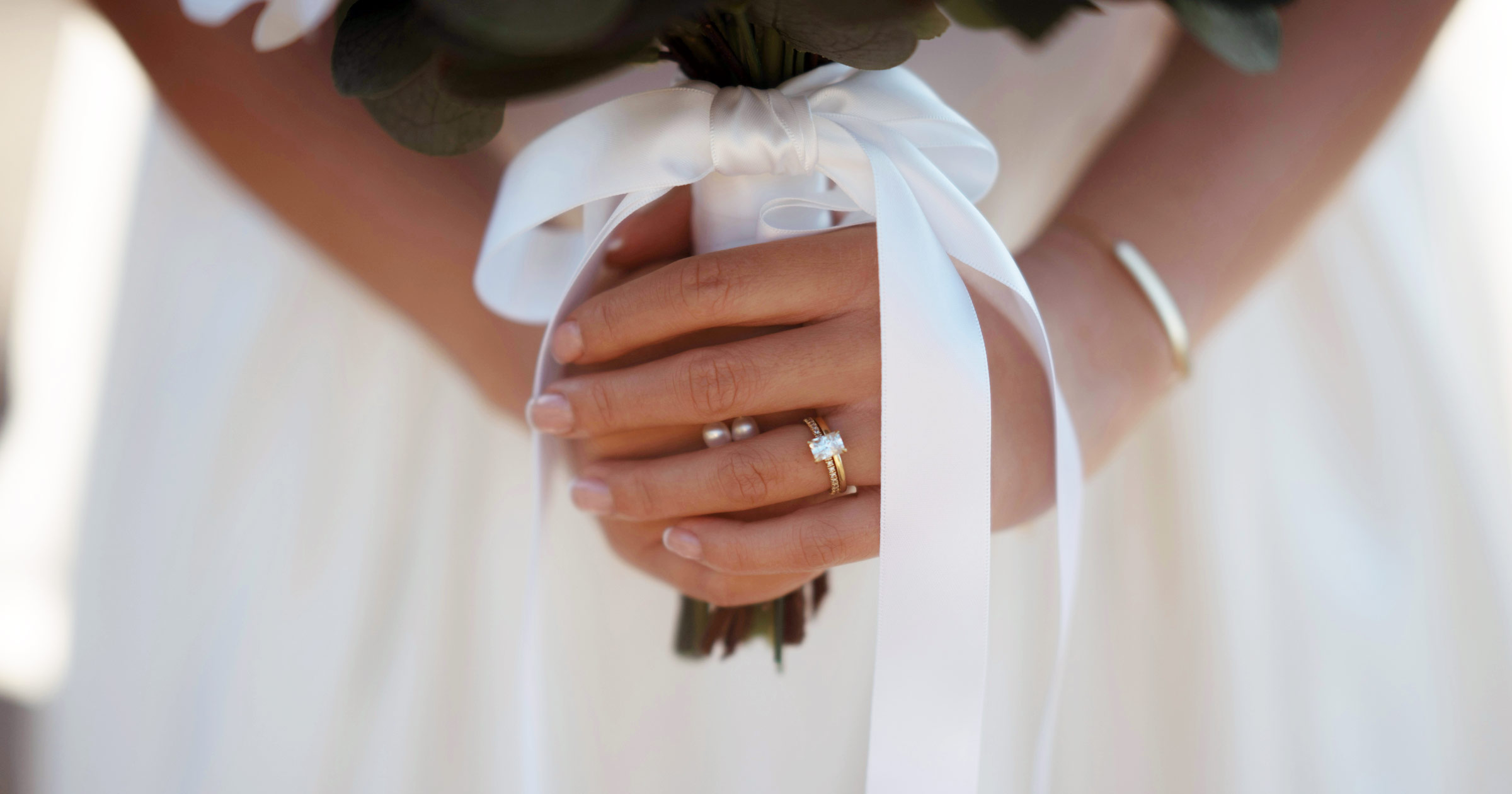
- Hands on the bouquet — rings and flowers in one frame.
- Hands on the railing, shoulder, back of the bench —with the venue in the background.
- Hands of three generations: the couple, parents, and grandparents, each with their own wedding rings. A shot that tells a family story without a single word.
- The couple's rings next to the parents' rings on the same surface – for those who are shy about posing with their hands.
Tip: Before hand portraits, get a simple manicure, and if you have a fresh tan or a watch tan line, let the photographer know. A close-up reveals everything.
Ring Photos During the Ceremony
At the ceremony, rings are photographed not as objects, but as moments—there are no second chances:
- The moment the ring is placed on the finger—close up, from two angles, if there are two photographers.
- The best man or child passing the rings—often a funny moment, especially if the ring gets stuck on the pillow.
- The couple's hands during the vows.
- The first glance at the ring immediately after the ceremony—an emotion that is impossible to stage.
- The rings on the hands during the first dance—with the warm light of the reception in the background.
- The couple's hands raised after "You may kiss…"—a victory shot as they head back up the aisle.
To ensure these shots work, talk to your officiant: have them stand slightly to the side during the ring exchange, rather than directly behind the couple's hands. And ask the couple to hold their hands a little higher and not block them with their bodies—at the rehearsal, this takes ten seconds.
How to Shoot Wedding Ring Photos
Why a Diamond Looks Dull in Photos—and How to Make It Sparkle
A diamond sparkles not because it glows, but because it refracts light so strongly. The refractive index of a diamond is about 2.42, almost twice that of water. Light entering a properly cut stone is reflected multiple times by its facets and exits through the top—this is "brilliance." It also breaks up into colors, like in a prism—what jewelers call "fire."
But for this effect to occur, the stone needs directed light: the sun, a lamp, or a pinpoint light. With even, diffused light—near a large window on a cloudy day or under a softbox—the facets have nothing to reflect, and the diamond looks like frosted glass. Hence the key technique: soft, general lighting for the ring plus a small pinpoint light for the stone. A phone flashlight from the side, a small LED, or a glint of sun—and the stone comes alive.
Metal is a mirror
With metal, it's the opposite. Polished gold and platinum reflect everything around them like a funhouse mirror: the window, the lamp, the ceiling, the photographer. So a photographer shooting rings is really shooting reflections. Here's how to work with this:
- White or light surroundings — a sheet of paper or a piece of white fabric next to the ring creates a clean, bright highlight on the metal instead of reflecting the room.
- A dark stripe on the metal (for example, the reflection of dark fabric) emphasizes the shape of the ring. Experienced photographers add this intentionally.
- Watch for yourself in the reflection. Step back a little or shoot with a long focal length.
Equipment and Settings
- Lens. A 100mm macro lens is a classic: it allows you to shoot at 1:1 magnification and stand far enough away to avoid reflections in the ring. On your phone, use macro mode or 2x zoom from a short distance.
- Depth of field. In macro photography, depth of field is measured in millimeters. Stop down to f/5.6–f/11 to get the entire ring in focus. If you want both background blur and a sharp ring, photographers use focus stacking: combining multiple shots with different focal points into one.
- Focus on the stone. If only one thing can be sharp, make it the stone or the engraving—whatever the couple will be looking at.
- Tripod. In low light and with a small aperture, long shutter speeds are needed, and in macro photography, any shake is immediately visible.
- Cleanliness. Wipe the rings with a microfiber cloth before each shot—every speck of dust and fingerprint is visible in macro photography.
- Background. Simple and neutral: fabric, paper, wood, marble. Details of the wedding itself—the dress, invitation, flowers—work better than any purchased props.
How to Take Ring Photos on Your Phone
Not every ring photo is taken by a professional. Engagements are announced on social media, rings are photographed on the day of the fitting, and a thank-you card shot is sometimes easier to take at home. Here's how to get a good result on your phone:
- Don't get too close. A phone camera often has trouble focusing at the closest distance. Move 6–8 inches (15–20 cm) away and use 2x or 3x zoom—this will improve focus and reduce distortion. If your phone has a macro mode, it will turn on automatically, or you can select it manually.
- Tap the stone on the screen to lock the focus, and slightly reduce the brightness using the slider—metal and stones look better slightly darker, so the highlights don't blow out.
- Shoot near a window, but not in direct sunlight. And to capture the sparkle in the stone, use the flashlight of a second phone on the side.
- Place your phone on a stack of books or lean it against something stable: when shooting close-ups, the slightest shake will blur the frame.
- Remove all unnecessary elements from the background. A sheet of white paper, a piece of linen, or a wooden table work better than a patterned throw or the corner of a room.
- Take a series. Twenty shots with slight changes in angle and lighting—and among them, you're almost sure to find the one.
When to Take Ring Photos: Your Wedding Ring Photoshoot Timeline
Details, including rings, are shot in the morning while everyone is getting ready. Our wedding day schedules allocate 30 minutes for details—dress, rings, shoes, invitations—immediately after the photo and video crew arrives. Of this 30 minutes, 10–15 minutes are usually devoted to the rings.
The most important organizational detail is that the rings must be with the photographer at this time. Most often, they are kept with the best man, who is in another room in the morning. Arrange this in advance: the best man brings the rings to the photographer at the start of the detail shoot and collects them before leaving for the ceremony. It's best to designate one responsible person to personally deliver and collect the rings. Stories of rings left on the windowsill in a hotel room are told at every other wedding.
The best time to photograph rings on hands is during couple portraits after the ceremony or during golden hour—the warm light on the hands and rings looks especially beautiful.
For Photographers and Videographers: Making Rings Work in the Gallery and the Film
- Take a small kit for details: a microfiber cloth, a sheet of white paper, a small LED flashlight, and a piece of dark cloth. This solves 90% of problems with glare and "faded" stones.
- For videographers—a slow move across the details. A smooth movement of a slider or gimbal across the table with the rings, invitation, and flowers is a classic start to a highlight. A glint traveling across the stone as the camera moves brings the frame to life more than any static shot.
- The sound of the ring exchange. If the groom and the officiant are wearing lav mics, you can hear "With this ring I thee wed" in the film—together with a close-up of the ring, this is one of the most powerful moments of the ceremony.
- Shoot details with room to spare. Couples often use a photo of the rings as a gallery cover or a thank-you card—they need both horizontal and vertical options.
And one thing people rarely think about at delivery. Macro photography of rings captures the smallest details: sparkles in the stone, engraving, the texture of the metal. It's these tiny details that suffer the most from video and image compression: when overcompressed on social media or messaging apps, highlights turn into blurry spots. If you deliver the film and photos in an OurStoria client gallery, the couple gets original quality—and that very glint on the stone you moved the flashlight to get. Start a 7-day Free Pro Trial—no credit card required.
Rings are also included in our free wedding shot list—in the "Detail Shots" and "Ceremony" sections: macro shots of the rings on an invitation or in a box and close-ups of the ring exchange, with notes on who shoots each one—photographer or videographer.
Small Rings, Long Stories
In fifty years, the rings will have dulled a little, and they'll have the scratches of life—from gardening, from children's hands, from a thousand little things. And then the photo of them, brand new, on the invitation on the morning of your wedding, will become one of the most touching shots in the album.
Give them fifteen minutes.
Related articles:
- Bridal Party Photos: 25 Ideas, Shot List & Timing
- Engagement Photos: When to Take Them, Ideas & Poses
- Traditional Wedding Vows: Classic Examples From Every Tradition
- How to Choose a Wedding Photographer: The Complete Guide (2026)
- Wedding Day Timeline 4pm Ceremony: Sample Schedules With & Without a First Look