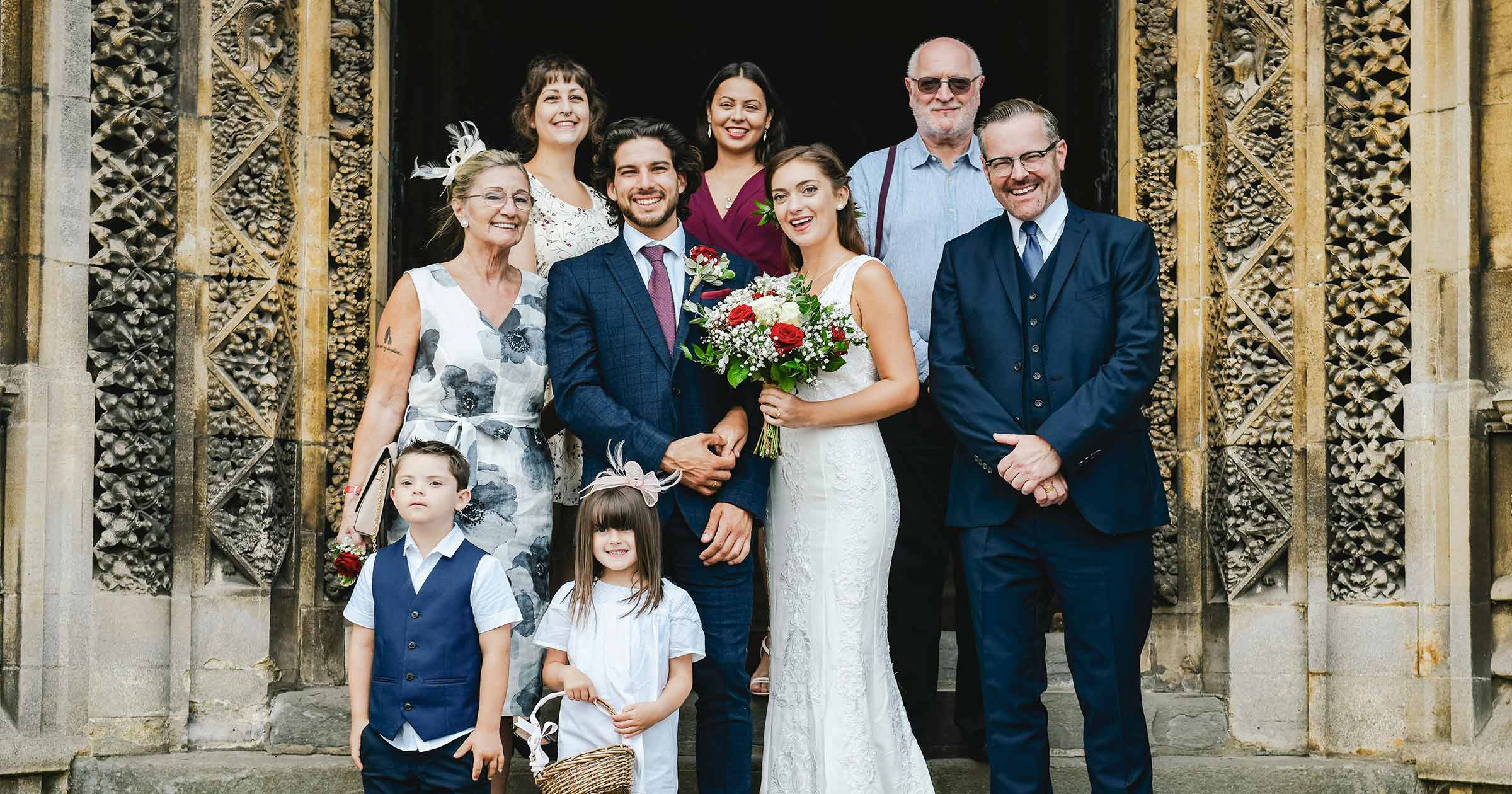
There's one part of a wedding that couples rarely think about beforehand and that almost everyone remembers with mixed feelings. Twenty minutes after the ceremony. Guests are already heading to the bar, the band is playing, everyone wants to hug the couple—and the photographer is standing by the arch, trying to find a cousin who wandered off with a drink.
Family photos are the least festive part of the celebration. And yet, perhaps, the most important. Twenty years from now, no one will be looking back at those tablescapes. But the photo of you standing with your grandparents, your parents, your siblings—that's what will end up framed on the wall. Sometimes it's the last photo of the family in that exact lineup.
The good news: chaos can be almost completely avoided. All it takes is three things: a well-thought-out list, the right order, and one person who knows everyone by sight. This guide includes a ready-made list of 16 groupings, an order that saves more time than any other advice, how long it all takes, solutions for complex family situations (divorced parents, stepparents, large families, small children), and a few interesting facts about why someone always blinks in group photos. And at the end, there's a section for photographers and videographers.
Family Photo Wedding List: 16 Groupings
This list is designed for a couple with parents, siblings, and grandparents on each side. Remove any groupings you don't need and add your own—for example, godparents or a particularly close aunt.
Both Families Together
- Couple with everyone from both families
- Couple with both sets of parents
Partner 1's Side
- Couple with Partner 1's extended family: aunts, uncles, cousins
- Couple with Partner 1's grandparents
- Couple with Partner 1's parents and siblings (including their spouses and children)
- Couple with Partner 1's siblings
- Couple with Partner 1's parents
- Partner 1 with their parents
- Partner 1 with Mom; Partner 1 with Dad
Partner 2's Side
- Couple with Partner 2's extended family
- Couple with Partner 2's grandparents
- Couple with Partner 2's parents and siblings (including their spouses and children)
- Couple with Partner 2's siblings
- Couple with Partner 2's parents
- Partner 2 with their parents
- Partner 2 with Mom; Partner 2 with Dad
If time is short, start with groupings 2, 4, 7, 11, and 14—these are the photos most often printed and framed.
How to Adapt the List to Your Family
A ready-made list is a foundation, not a set rule. Here's what couples most often change:
- Include names, not roles. "Couple with Partner 1's grandparents" won't mean anything to the photographer. "Couple with Ruth and Harold Miller" will, especially if a family helper calls out these names.
- Combine small groups. If you have one sibling without family, groups 5 and 6 become one.
- Add "special" people. Godparents, the aunt who practically raised you, a best family friend—if someone is important, they deserve their own line.
- Think about generations. A "four generations" photo—great-grandmother, grandmother, mother, and the bride—is one of the most touching—and rarest—shots. If such an opportunity exists, don't miss it.
- Don't let the list balloon. Each extra group means another 2–3 minutes you don't spend with your guests. Twenty groups is already about an hour.
Family Photo List for Wedding: The Right Order
Order saves more time than any other tip. The main principle is the "subtraction" method: gather the largest group first, and then people leave the frame one by one. This is much faster than assembling a new group from scratch each time.
Here's how it works in practice:
- Start with both families together. While everyone is in place, this is the quickest shot. After this, most of the relatives can calmly head to cocktail hour.
- Grandparents and small children—first. They have the hardest time standing for long periods, and children get tired and start to act up after twenty minutes. A child's smile in the first minute and a child's tantrum in the twentieth are two completely different photos.
- Shoot one side completely, then the other. This way, the second family can calmly wait, rather than pacing back and forth, trying to figure out whether they're needed right now.
- The couple with their parents — at the end of each side. By this point, there are fewer people, and you can take your time. These are the most personal shots.
- Extended family—save for the reception if the list is long. Aunts, uncles, and cousins are easy to photograph at their tables or on the dance floor—it's a minute instead of five, and the photos are livelier.
Why Someone Will Blink
Any photographer knows: the more people in the frame, the less likely it is that everyone will have their eyes open at the same time. Two Australian scientists from the national science agency CSIRO—physicist Piers Barnes and Nic Svenson—decided to take this seriously. They took into account how often people blink (on average, about 10 times per minute), the length of a blink (about a quarter of a second), and the camera shutter speed, and came up with a simple rule: for a group of up to 20 people, divide the number of people by three in good light and by two in poor light. That's the number of shots you need for a better than 95% chance of getting at least one where no one blinked.
That means for a group of 15 people in the sun, about five shots, and in a dark room, about eight. For this work, Barnes and Svenson received the 2006 Ig Nobel Prize in mathematics—a humorous award for research that "first makes you laugh, then makes you think." But for family photography, their rule is completely serious: that's why a good photographer takes a series of shots of each group, not just one—and why they allocate 2–3 minutes per group, not 30 seconds.
Why Everyone Looks Better in a Group
And more good news for those who don't like having their photos taken. Psychologists Drew Walker and Edward Vul from the University of California, San Diego tested the so-called "cheerleader effect"—the idea that people look more attractive in a group than alone. Participants were shown photographs of people: sometimes in a group with two others, sometimes individually cropped from the same photograph. And the group members were indeed rated as more attractive. The study was published in the journal Psychological Science.
The effect is small—about the equivalent of moving up from 49th to 51st place out of 100. And the explanation is intriguing: when looking at a group, our brain slightly "averages" faces, and we tend to perceive average faces as more pleasing—small imperfections are smoothed out. So if you're camera-shy, family photos are where science is on your side.
How Long Do Family Photos Take?
Allow about 2–3 minutes per group. During this time, you need to gather people, position them, take a series of shots (remember the blink math), and let them go. This works out to be:
| Number of groups | How long | Comment |
|---|---|---|
| 8–10 | 20–25 minutes | Immediate family on both sides—the sweet spot |
| 12–16 | 30–40 minutes | Full list in this article |
| 20+ | 45–60 minutes | Large families; it's best to move some groups to the reception |
When to shoot depends on your schedule:
- With first look — before the ceremony. The couple has already seen each other, so family photos happen early, and after the ceremony the couple goes straight to the guests.
- Without first look — immediately after the ceremony. Ask your officiant to announce at the end who should stay for photos. Hunting for people during cocktail hour is the biggest time sink in any family photo session.
Pre-made schedules with a separate slot for family photos are available in our wedding timeline template: 11 options, including ceremonies at 2, 3, 4, and 5 PM, with or without a first look. Detailed minute-by-minute breakdowns are available for 3 PM ceremony, 4 PM ceremony, and 5 PM ceremony.
Family Wedding Photo List: Special Situations
No family looks like a brochure. Here's how photographers and coordinators solve the most common challenges:
Divorced parents. Don't put them next to each other if it's awkward. Take separate shots: the couple with the mother and her new family, the couple with the father and his new family. Be sure to warn the photographer in advance—otherwise, they might, with the best of intentions, say, "And now all the parents together!" in front of everyone. If the parents get along well, so much the better; a single group photo will be a pleasant surprise for everyone.
Stepparents and the people who raised you. List them by name—in the same group as your parents, or on a separate line. The photographer doesn't know your family history. Let the list tell it for you, so no one will have to awkwardly explain who's who on the spot.
Loved ones who have passed. If you want to honor them, agree on a plan in advance: for example, a family photo with their portrait held by a relative, or a shot with an empty chair and a flower. Tell the photographer not to improvise—this is too delicate a moment for impromptu shots.
Large Families. Narrow the list down to the immediate family, and photograph the rest in one large group, "the whole family," at the very beginning—and then at their tables during the reception. For a truly large group (40–50 people), the photographer may need an elevated platform: a staircase, a balcony, or the venue's front steps.
Small Children. Place them in the first shots, with an adult nearby to reassure them. A child's photo taken on the second try is better than none at all. And don't force a child to "stand still"—a photo of the child in a grandparent's arms is almost always more lively.
Elderly relatives and those who have difficulty standing. Place a chair in the center of the frame—it looks natural and even beautiful. Photograph their groups first. If a grandmother is in a wheelchair, warn the photographer in advance: they will select a spot without steps.
Families who don't get along. This happens. If there's tension between two branches of the family, simply avoid putting them in the same frame and limit the overall "family" shot. Wedding photos are not the place for forced reconciliation.
Why Everyone Says "Cheese"
A quick aside in case your photographer asks everyone to say "cheese." The earliest known mention of this technique is a 1943 article in the Texas newspaper Big Spring Herald. In it, former US Ambassador Joseph Davies recounted how he learned it from a politician he never named: the "chee-e-s" sound stretches the lips into a semblance of a smile.
However, good wedding photographers rarely use this technique. "Cheese" produces stretched lips, but not lively eyes. A genuine smile is much easier to achieve with a joke, an unexpected question ("Who's the better dancer?"), or simply by asking everyone to look at the couple rather than at the camera.
Who Should Organize Family Photos?
Neither the couple nor the photographer. The couple should be relaxing and enjoying themselves at this point, and the photographer doesn't know what Aunt Hannah looks like.
- Pick a family helper—a brother, sister, or friend who knows everyone by sight. Their job is to assemble the next group in advance while the photographer shoots the current one. This person saves the most time.
- Give the list to the photographer a couple of weeks before the wedding, not the morning of the shoot. Include names, not just "grandparents." A good photographer will ask questions about it—and that's a good sign.
- Print out the list—for both the photographer and the helper. A phone in the helper's hand whose battery runs out in the middle of the day is a bad plan.
- Alert relatives in advance that they are on the list: where and when to be. A short message a week before the wedding and a reminder from the officiant at the end of the ceremony is ideal.
For Photographers and Videographers: Running Family Formals
If you're photographing weddings, a family shoot is where you're judged not for your creativity, but for your organization. Relatives remember the photographer who got the whole family together in 20 minutes and made them laugh, not the one who spent 40 minutes looking for Uncle Bill.
- Ask for a list in advance and ask questions about it. "Which parent is divorced?", "Who has trouble standing?", "Who absolutely must be photographed but will be hard to catch?"—these three questions solve half the day's problems.
- Take a series of shots for each group. The CSIRO rule is a great argument when a couple asks why a group takes two minutes instead of thirty seconds.
- For the videographer, a wide shot. A family shoot is a good opportunity for a short behind-the-scenes scene in a film: grandma being led to the arch, laughter while everyone's being arranged. Families love these shots more than you'd think.
- Think about who will view the result. Family photos and the film aren't just watched by newlyweds. Parents, grandparents, and relatives in other cities watch too—our research on who really watches wedding films covers that.
And finally, about what happens after the wedding. Family photos are the most requested of all shots. An aunt wants her group photo, a grandmother wants a photo with her grandchildren for printing, a cousin wants a photo with his family. If you send all of these out as separate files by email, you'll waste an evening. It's more convenient to share a single link to the OurStoria client gallery: each relative finds their group and downloads the original in full quality—for a frame or photo book—and the film is right there, right next to it. Start a 7-day Free Pro Trial—no credit card required.
Wedding Photo List Family Template
The family group list is part of our free wedding shot list for photographers and videographers: 145 shots by wedding stage, 12 family groupings in shooting order, and blank lines for your own groups. Print it out, fill in the names, and give it to your photographer and helper.
If you're still planning the entire wedding, check out our wedding planning checklist—it shows exactly when to give this list to your photographer. And if you're still choosing a photographer, check out our guide How to Choose a Wedding Photographer.
The Photo That Ends Up on the Wall
Many years will pass. The wedding album will gather dust on a shelf, and the files will be lost somewhere in the cloud. But one photo will almost certainly hang on the wall or sit on your parents' dresser: the one where the whole family stands together, smiling, and no one blinked.
The twenty minutes you spend on it may be the most precious twenty minutes of the entire wedding day.
Related articles:
- How to Choose a Wedding Photographer: The Complete Guide (2026)
- Wedding Planning Checklist: A Month-by-Month Timeline (Free PDF)
- Wedding Day Timeline 4pm Ceremony: Sample Schedules With & Without a First Look
- Wedding Day Timeline 3pm Ceremony: With and Without a First Look
- Wedding Day Timeline 5pm Ceremony: Schedules for Every Season
- The Family Audience: Who Actually Watches Wedding Films Beyond the Couple
- The Photographer-Videographer Dynamic: How Collaboration Quality Affects Both Deliverables
- The Rise of the Hybrid Shooter: Photo + Video Quality, Cost, and Satisfaction Data
- Bridal Party Photos: 25 Ideas, Shot List & Timing
- How Long Do Wedding Photos Take? Timing for Every Part of the Day