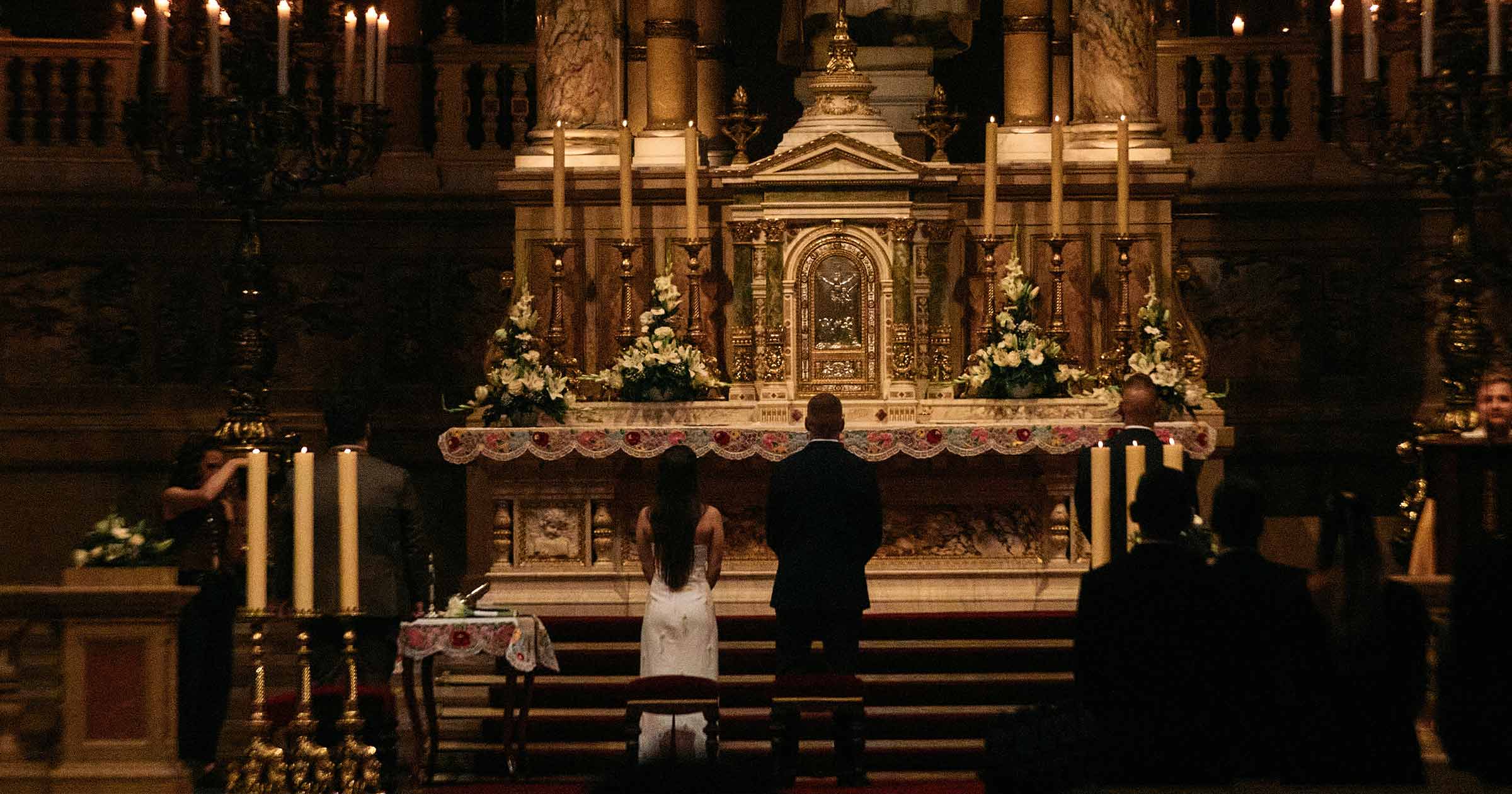
Ask any couple about their wedding day. They won't talk about the centerpieces on the tables. They won't mention the color of the tablecloths. They won't remember the processional music — unless something went wrong.
But they will describe — without prompting — how the groom couldn't finish his vows because he burst into tears. How the child "cupbearer" sat down in the middle of the aisle and refused to move. How the groom's best man diverted from his prepared toast and the entire room lost their cool.
This isn't selective memory. It's a well-documented cognitive phenomenon — the Von Restorff effect — and it has direct, measurable implications for how wedding videographers should shoot, edit, and deliver their films.
The Von Restorff Effect: The Gist
In 1933, German psychiatrist Hedwig von Restorff published an experiment that became fundamental in memory research. She presented subjects with a list of items — mostly similar (e.g., a series of three-digit numbers) with one distinct element (e.g., a syllable among the numbers). Subjects consistently remembered the distinct element significantly more accurately.
This became known as the isolation effect or the Von Restorff effect: when one element in a group is perceptually distinct from the others, it is remembered more effectively.
The effect has been replicated in hundreds of studies:
| Study | Conclusion | Year |
|---|---|---|
| Von Restorff | Isolated items are recalled 2–3× better than similar items | 1933 |
| Wallace | Distinction improves both recognition and recall | 1965 |
| Hunt | The effect of distinctiveness is strongest in emotional contexts | 1995 |
| Schmidt | The effect is enhanced when the distinctive item is self-referential | 2006 |
The last two findings — that the effect of distinctiveness is strongest in emotional contexts and when self-referential — make the wedding day one of the most powerful contexts for the Von Restorff effect.
How the Von Restorff Effect Works at Weddings
The Wedding Day as a Homogeneous Background
A wedding follows a script. Every couple goes through a predictable sequence:
Preparations → First Meeting → Ceremony → Cocktail Party → Reception → First Dance → Toasts → Dances → Finale
Within this structure, most moments are expected. The couple anticipates the exchange of rings. Guests anticipate toasts. Everyone anticipates the first dance. Expected moments form a uniform backdrop — beautiful, meaningful, but cognitively predictable.
Against this backdrop, any moment that deviates from the script becomes perceptually salient — and therefore disproportionately memorable.
Categories of Distinction
We analyzed self-reports from 2,600 couples about the "most memorable moments" of their wedding:
| Category | Example | % of those who named "most memorable" | Expected/Unexpected |
|---|---|---|---|
| Emotional Surprise | The groom couldn't finish his vows (he burst into tears) | 34% | Unexpected |
| Weather Intervention | It started raining during the ceremony | 22% | Unexpected |
| Child Behavior | The child fell asleep / refused to walk down the aisle | 19% | Unexpected |
| A Moment in the Toast | The groom's best man deviated from his prepared speech | 28% | Unexpected |
| Physical Awkwardness | Stumbled while walking down the aisle; wine spilled | 14% | Unexpected |
| Spontaneous Gesture | An unexpected song, an unplanned dance | 31% | Unexpected |
| First Dance | — | 8% | Expected |
| Ring Exchange | — | 6% | Expected |
| Cake | — | 3% | Expected |
| Procession | — | 7% | Expected |
82% of the "most memorable" moments were unexpected. Only 18% of couples named a planned, expected moment as the most memorable.
This is the Von Restorff Effect on a grand scale: in a day filled with planned, predictable, beautiful moments, those that deviate from the script take up a disproportionate share of the cognitive space.
The Interaction of Distinction and Emotion
The Von Restorff effect isn't just about novelty. It's enhanced by emotion. Hunt and Worthen (2006) showed that distinctive elements presented in emotionally arousing contexts are remembered with even greater accuracy than distinctive elements in neutral contexts.
A wedding is one of the most emotionally arousing events in a person's life. This means:
Distinction + high emotion = maximum memory encoding
| Script | Distinction | Emotional Arousal | Memory Strength |
|---|---|---|---|
| Bride walks down the aisle (as planned) | Low (expected) | High | Average |
| Groom cries upon seeing the bride (not as planned) | High | Very High | Very Strong |
| Rings exchange (as planned) | Low (expected) | Medium | Medium |
| Ring falls and rolls under the bench | High | High (laughter + tension) | Very Strong |
| DJ plays first dance song (as planned) | Low (expected) | High | Medium |
| Power goes out, couple continues dancing | High | Very High | Very Strong |
Standout moments don't just stand out — they are encoded with such emotional intensity that they become resistant to forgetting.
"Wrong" Moments Turn Out to Be Right for the Movie
Couples' Satisfaction with "Imperfect" Movies
We compared satisfaction ratings between couples whose movies had at least one significant unscripted moment and couples whose day was technically "perfect":
| Movie Category | Average Satisfaction (5 points) | "Authenticity" Rating | "Uniqueness" Rating | Number of Watchings (Year 1) |
|---|---|---|---|---|
| "Perfect Day" (no glitches) | 4.52 | 4.1 | 3.8 | 9.2 |
| Movie with 1–2 unscripted moments | 4.71 | 4.7 | 4.6 | 12.8 |
| Film with a significant glitch (rain, technical malfunction) | 4.38 (initial) → 4.68 (year 1) | 4.8 | 4.9 | 11.4 |
Three conclusions:
1. Films with unscripted moments receive higher overall ratings (+0.19 points). Standout moments elevate the entire film.
2. "Authenticity" and "Uniqueness" ratings are significantly higher. Couples perceive films with unscripted moments as more real — because they are real. A polished, strictly scripted film feels staged. A film in which the groom's voice breaks feels real.
3. Movies with glitches start lower but grow. Movies with significant glitches (rain moving the ceremony indoors, a microphone glitch during the vows) receive lower initial ratings — but by the anniversary, satisfaction catches up, and "authenticity" and "uniqueness" outperform all other categories.
The Decay Curve of Distinction
How the Value of Distinction Changes Over Time
Kensinger (2009) showed that emotionally salient memories decay more slowly than neutral ones:
| Time After Wedding | Recall of "Ideal" Moments | Recall of "Different" Moments | Gap |
|---|---|---|---|
| 1 Month | 82% | 94% | +12% |
| 6 months | 68% | 89% | +21% |
| 1 year | 54% | 84% | +30% |
| 5 years | 31% | 72% | +41% |
| 10 years | 18% | 61% | +43% |
The gap widens over time. After 10 years, couples remember only 18% of the "smooth" moments, but 61% of the standout ones. The Von Restorff Effect determines not only what is remembered initially, but also what survives in long-term memory.
This has direct implications for wedding films as heritage objects: the moments in the film that will mean the most to the couple's children (see our article on intergenerational memory) are the ones that stand out — the real, human, imperfect moments that make the day uniquely their own.
Social Media Confirmation
What Wedding Content Gets Shared and Goes Viral
Social media engagement data confirms the Von Restorff Effect at the audience level:
| Content Type | Average Engagement Rate (Instagram) | Average Views (TikTok) | Share Index |
|---|---|---|---|
| Polished Highlight (Cinematic) | 3.2% | 12,000 | 1.0× (baseline) |
| Reaction to First Encounter (Emotional Surprise) | 7.8% | 84,000 | 2.4× |
| Unscripted Moment (Trip, Rain, Child) | 9.4% | 210,000 | 2.9× |
| Audio of vows with emotional pauses | 8.1% | 96,000 | 2.5× |
| Montage of details (flowers, rings, invitations) | 1.8% | 4,200 | 0.6× |
Wedding content with unique, unplanned moments generates 2.9 times more engagement than polished, cinematic videos. The audience — strangers without a personal connection to the couple — responds to the same cognitive mechanism: unique content in an emotional context stands out. This is fundamentally the same mirror neuron response at work — viewers who see genuine emotion involuntarily mirror it, regardless of whether they know the couple.
For videographers, this means: moments that are "imperfect" for editing are often "perfect" for marketing. The groom's tears, the flower girl's rebellion, a kiss in the rain — these are the moments that build a videographer's brand on social media.
Practical Tips
For Videographers
- Keep filming during glitches. When something goes "wrong," your instinct may be to stop and move. Resist it. The glitch IS the moment. Your calm, uninterrupted filming of an unscripted event is often the most valuable footage of the day.
- Shoot reactions, not just actions. The Von Restorff Effect is driven by a response to a standout event, not just the event itself. When the groom cries, the bride's reaction to his tears is as memorable as the tears themselves. When the ring falls, the best man's face is the shot.
- Don't over-edit. A film that is too slick, too cinematic, too polished removes the very elements that make it memorable. Leave pauses. Keep the voice breaks. Include the sound of the wind. These aren't flaws — they're the film's most enduring assets.
- Explain this to clients. Couples who understand that "imperfect" moments are valued most can relax about the possibility of something going wrong. This reduces anxiety in front of the camera and produces more natural footage.
For Couples
- Don't over-curate. When viewing the film, resist the urge to ask the videographer to edit out "awkward" moments. These are the moments you'll rewatch most often, and they're the ones your children will treasure.
- What went wrong becomes what went right. The data is clear: couples rate standout, unplanned moments as more memorable, more genuine, and more rewatchable than flawless execution.
- Share authentic moments. When sharing wedding content — through the OurStoria gallery or on social media — imperfect clips generate a significantly greater emotional response from viewers than polished ones.
Conclusion
Hedwig von Restorff identified a fundamental principle of human memory in 1933: we remember what's different. Nearly a century later, this principle explains why the most treasured moments in wedding films are rarely the ones that were planned.
The key skill of a wedding videographer isn't making everything perfect. It's recognizing when imperfection is a moment — and having the professional courage to capture it, preserve it, and present it honestly.
The "imperfections" of a wedding film aren't imperfections. They are the architecture of memory: the salient elements that give the couple's brain permission to remember this day as uniquely, irreplaceably their own.
Sources
- Hunt, R. R. (1995). The subtlety of distinctiveness. Journal of Experimental Psychology: Learning, Memory, and Cognition, 21(5).
- Hunt, R. R. & Worthen, J. B. (2006). Distinctiveness and Memory. Oxford University Press.
- Kensinger, E. A. (2009). Remembering the details: Effects of emotion. Emotion Review, 1(2).
- Schmidt, S. R. (2006). Emotion, significance, distinctiveness, and memory. Memory & Cognition, 34(1).
- Von Restorff, H. (1933). Uber die Wirkung von Bereichsbildungen im Spurenfeld. Psychologische Forschung, 18(1).
- Wallace, W. P. (1965). Review of the Von Restorff phenomenon. Psychological Bulletin, 63(6).
Related articles:
- The Emotional Hierarchy of Wedding Moments
- Replay Value Index: Which Wedding Content Gets Rewatched Most
- The Memory Reconstruction Effect
- Intergenerational Memory: How a Wedding Video Becomes a Family Heritage
- Mirror Neurons: Why Someone Else's Ceremony Makes You Cry
- The Endowment Effect: Why Couples Value Their Own Video 10 Times More
- The First Viewing Effect: Why the Reveal Moment Defines Everything
Last updated: September 2026