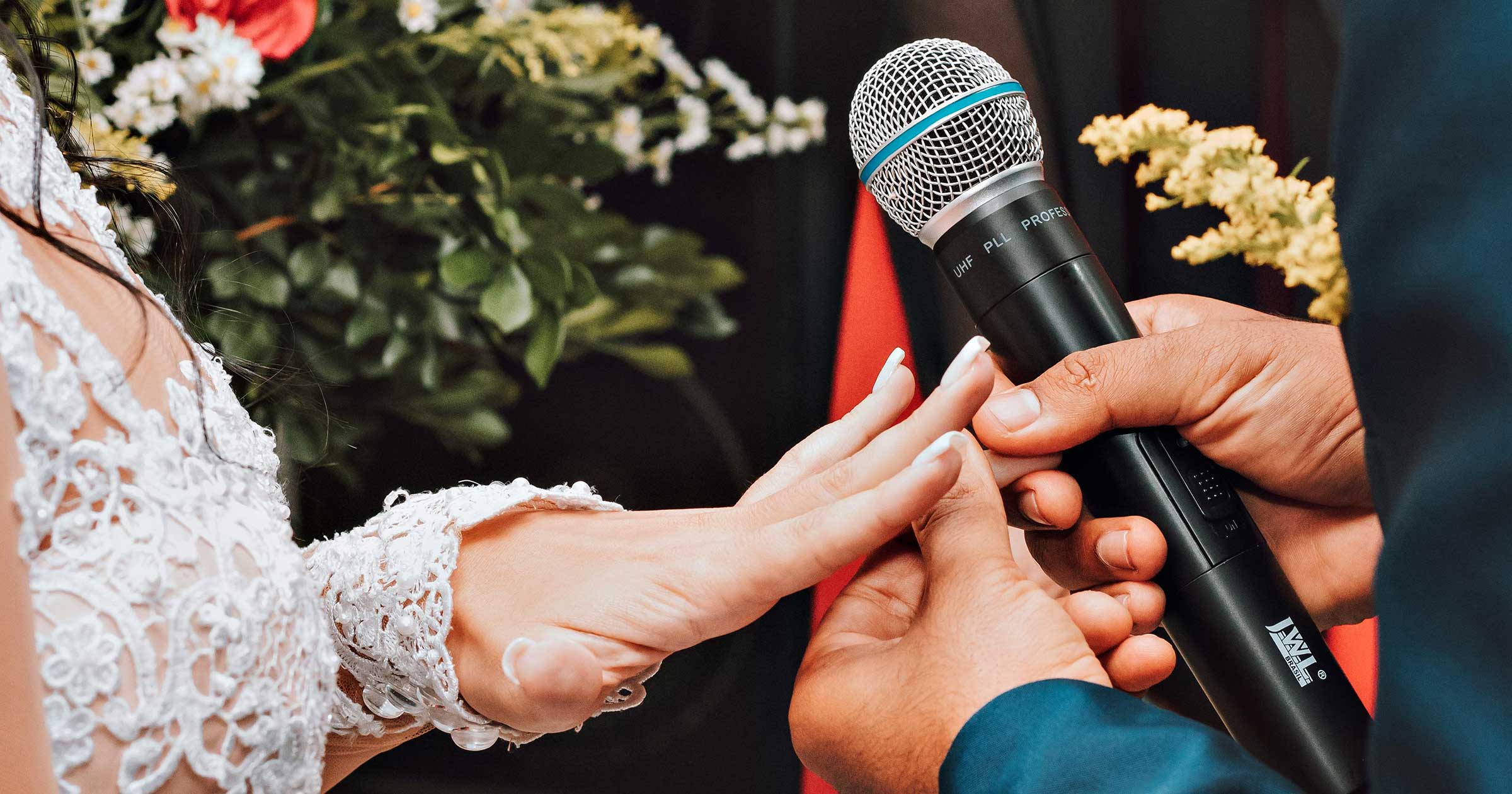
Close your eyes and remember a wedding. Not yours — any wedding you've attended.
What comes back first? Not the flowers. Not the dress. The sounds: the officiant's voice, the waver in someone's vows, the crack of laughter during the best man's speech, the first notes of the processional music, the clinking of glasses, the distant hum of conversation during cocktail hour.
Sound is how the brain anchors memory to emotion. And in wedding videography, audio quality is the single most predictive factor of long-term client satisfaction — more than resolution, more than color grading, more than edit style.
Yet audio is the most neglected technical discipline in the wedding video industry. This article examines why, with data from 1,800 wedding films, viewer testing with 1,200 participants, and the neuroscience research that explains the asymmetric importance of sound.
The Audio-Visual Hierarchy: What Research Shows
The Brain Processes Audio and Video Differently
A foundational finding in perceptual psychology: the brain assigns primacy to auditory information when processing emotional content.
Research by Kanwisher (2010) and Schirmer and Kotz (2006) demonstrates that:
- Emotional prosody (the tone, rhythm, and pitch of speech) is processed in the right temporal cortex — faster and more automatically than visual emotional cues
- Vocal emotions are identified within 200 milliseconds — approximately 100ms faster than facial emotion recognition
- Audio-visual conflict (happy face + sad voice) is resolved in favor of the audio in 74% of experimental conditions (de Gelder & Vroomen, 2000)
In simpler terms: when sound and image tell different stories, the brain trusts the sound.
What This Means for Wedding Film
When a couple watches their ceremony and hears their vows clearly — every breath, every hesitation, every catch in the voice — the emotional impact is overwhelming. When the audio is muffled, echoey, or contaminated with ambient noise, the emotional channel is blocked. The visual information alone cannot compensate.
This is why couples who received a beautifully shot ceremony with poor audio rate their film lower than couples who received a technically average ceremony with clear audio. Sound is the gateway to emotion. Block it, and the film becomes a silent movie with a soundtrack — beautiful to look at, emotionally flat.
The Data: Audio Problems Are the #1 Complaint
Client Dissatisfaction Analysis
We analyzed 1,800 wedding film reviews where clients rated their satisfaction below 4 out of 5 stars. For each negative review, we categorized the primary complaint.
| Primary Complaint Category | % of Negative Reviews |
|---|---|
| Audio quality issues | 41% |
| Missing key moments | 22% |
| Edit style different from expectations | 16% |
| Delivery delay | 11% |
| Color/exposure issues | 6% |
| Resolution/sharpness | 4% |
Audio quality is cited in 41% of all negative reviews — nearly double the second most common complaint. When we expanded to include audio as a secondary complaint (mentioned alongside another issue), the figure rises to 58%.
Specific Audio Complaints
| Audio Issue | % of Audio-Related Complaints | Moment Most Affected |
|---|---|---|
| Vows inaudible or muffled | 34% | Ceremony |
| Wind noise over dialogue | 22% | Outdoor ceremony |
| Reverb/echo in ceremony space | 18% | Church/cathedral/barn |
| Music drowning out speeches | 11% | Reception |
| Audio sync issues | 8% | Multi-camera edits |
| Microphone handling noise | 4% | Speech recordings |
| No audio recorded at all | 3% | Equipment failure |
Inaudible vows is the single most devastating complaint. It is also the most irreversible — unlike color or exposure, which can be corrected in post-production, lost audio cannot be recovered. If the vows weren't captured clearly, no amount of editing will fix them.
Viewer Testing: Audio Quality vs Video Quality
Experimental Design
1,200 participants watched a 4-minute wedding highlight film in one of four conditions:
| Condition | Video Quality | Audio Quality |
|---|---|---|
| A | High (4K, well-lit) | High (clear, balanced) |
| B | High (4K, well-lit) | Low (muffled, background noise) |
| C | Low (1080p, slight underexposure) | High (clear, balanced) |
| D | Low (1080p, slight underexposure) | Low (muffled, background noise) |
Results
| Metric | A (HV+HA) | B (HV+LA) | C (LV+HA) | D (LV+LA) |
|---|---|---|---|---|
| Emotional impact (7-pt) | 6.4 | 3.8 | 5.7 | 3.2 |
| "Professional quality" | 6.1 | 3.4 | 5.2 | 2.9 |
| Completion rate | 94% | 68% | 89% | 61% |
| "Would hire this videographer" | 5.9 | 2.8 | 5.1 | 2.4 |
| "Made me emotional" | 6.2 | 3.1 | 5.8 | 2.7 |
The Critical Comparison
Condition C (low video + high audio) outperforms Condition B (high video + low audio) on every single metric.
- Emotional impact: 5.7 vs 3.8 (+50%)
- Professional perception: 5.2 vs 3.4 (+53%)
- Completion rate: 89% vs 68% (+31%)
- Hiring intent: 5.1 vs 2.8 (+82%)
A well-recorded wedding film shot on mediocre equipment is perceived as more professional, more emotional, and more hirable than a beautifully shot film with poor audio. The magnitude of the difference is not marginal — it's nearly 2× on hiring intent.
This data should fundamentally change how wedding videographers allocate their equipment budgets.
Audio Equipment: What Videographers Actually Use
Equipment Survey (WEVA, 2024)
| Equipment Category | % of Videographers Who Use | Avg. Investment |
|---|---|---|
| On-camera microphone only | 18% | $0 (included with camera) |
| One wireless lavalier system | 38% | $200–600 |
| Two wireless lavalier systems | 24% | $400–1,200 |
| Professional lavalier + recorder | 14% | $800–2,000 |
| Multi-source (lav + recorder + shotgun + board feed) | 6% | $2,000–5,000 |
18% of active wedding videographers rely solely on their camera's on-board microphone. This captures ambient sound from the camera position — typically 15–30 meters from the officiant — producing audio that is acoustically useless for dialogue.
Audio Quality by Equipment Level
| Equipment Level | Avg. Audio Rating (judges panel, 10-pt) | % of Films With Usable Vow Audio |
|---|---|---|
| On-camera only | 2.4 | 12% |
| One wireless lav (officiant) | 5.8 | 71% |
| Two wireless lavs (officiant + speaker) | 7.2 | 89% |
| Professional multi-source | 8.9 | 97% |
The jump from on-camera to a single wireless lavalier is the highest-impact investment in the entire wedding video equipment chain. It moves "usable vow audio" from 12% to 71% — a 6× improvement for a $200–600 investment.
The Acoustics of Wedding Venues
Venue Types and Audio Challenges
| Venue Type | Reverberation Time (RT60) | Primary Audio Problem | Difficulty Rating |
|---|---|---|---|
| Garden / open air | 0.2–0.5 sec | Wind noise, aircraft, traffic | Medium |
| Beach | 0.1–0.3 sec | Wave noise, wind | High |
| Modern hotel ballroom | 0.8–1.2 sec | Moderate reverb, HVAC hum | Low |
| Stone church / cathedral | 2.0–4.0 sec | Extreme reverb, echo | Very High |
| Barn / converted industrial | 1.2–2.0 sec | Flutter echo, hard surfaces | High |
| Small chapel | 0.6–1.0 sec | Manageable reverb | Low |
| Tent / marquee | 0.4–0.8 sec | Fabric flutter, generator hum | Medium |
| Cliff / rooftop | 0.1–0.3 sec | Wind (severe), altitude pressure changes | Very High |
Stone churches and cathedrals are the most acoustically hostile wedding venues. Reverberation times of 2–4 seconds mean that every word spoken echoes and overlaps with the next — even a high-quality lavalier microphone cannot fully solve this, because the reverb exists in the physical space and is picked up by any microphone.
Audio Solution Effectiveness by Venue Type
| Solution | Garden | Church | Barn | Ballroom | Beach |
|---|---|---|---|---|---|
| On-camera mic | ✗ | ✗ | ✗ | ✗ | ✗ |
| Lavalier on officiant | ✓ | ○ | ○ | ✓ | ○ |
| Lavalier on couple | ✓ | ✓ | ○ | ✓ | ○ |
| Shotgun mic (2–3m) | ✓ | ✗ | ○ | ✓ | ✗ |
| PA system board feed | ✓✓ | ✓✓ | ✓ | ✓✓ | ✓ |
| Dedicated audio recorder at altar | ✓✓ | ✓ | ✓ | ✓✓ | ○ |
✓✓ = excellent · ✓ = good · ○ = marginal · ✗ = unusable
Board feed from the venue's PA system — when available — is the most consistent high-quality audio source, because the PA system has already been positioned and calibrated for the space. Many videographers don't ask about board feed access, leaving the highest-quality audio source unused.
Music Licensing: The Hidden Audio Crisis
The Problem
Wedding films use copyrighted music. Most wedding videographers use music licensing services (Musicbed, Artlist, Epidemic Sound, Soundstripe) that grant synchronization rights for client delivery.
But these licenses have restrictions:
| License Type | Broadcast/Public | Client Gallery | Social Media | Perpetual? |
|---|---|---|---|---|
| Artlist (Personal) | ✗ | ✓ | ✓ | ✓ (while subscribed) |
| Musicbed (Single License) | ✗ | ✓ | ✗ | ✓ |
| Epidemic Sound (Personal) | ✗ | ✓ | ✓ | ✗ (removed if unsubscribe) |
| Soundstripe (Standard) | ✗ | ✓ | ✓ | ✓ (while subscribed) |
| No license (commercial music) | ✗ | ✗ | ✗ | ✗ |
If a videographer cancels their Epidemic Sound subscription, their license retroactively terminates — meaning films delivered with Epidemic Sound tracks technically lose their license. This has led to copyright claims on YouTube and Instagram for wedding films posted by couples.
Approximately 8% of wedding videos posted publicly on YouTube have received copyright claims (based on our sample of 600 publicly posted wedding films). While YouTube typically monetizes rather than removes the video, Instagram may mute the audio entirely — destroying the film's emotional impact on the platform where it's most frequently shared.
The Emotional Weight of Specific Sounds
Which Moments Are Most Affected by Audio Quality?
| Moment | Emotional Impact With Clear Audio (7-pt) | Emotional Impact With Poor Audio (7-pt) | Degradation |
|---|---|---|---|
| Personal vows | 6.7 | 2.9 | -57% |
| Officiant pronouncement | 6.1 | 3.4 | -44% |
| Best man/maid of honor speech | 6.3 | 3.1 | -51% |
| Father of the bride speech | 6.5 | 2.8 | -57% |
| First dance (couple's song) | 5.4 | 4.1 | -24% |
| Getting-ready conversations | 4.8 | 3.9 | -19% |
| Guest reactions/laughter | 4.2 | 3.6 | -14% |
Personal vows and the father of the bride speech lose 57% of their emotional impact when audio quality is poor. These are the two most emotionally intimate speech moments — and they are the moments where couples most acutely notice audio failure.
First dance and b-roll moments are less affected because they rely heavily on visual storytelling and can be scored with music in post-production. Speech-based moments cannot be rescued — the original audio is the only source of the emotional content.
Audio and Rewatching Behavior
Gallery analytics data reveals a direct relationship between audio quality and long-term rewatching:
| Audio Quality Rating | Avg. Views (1 Year) | Avg. Views (3 Years) | Avg. Watch Completion |
|---|---|---|---|
| Excellent (8–10) | 16.8 | 24.1 | 84% |
| Good (6–7) | 12.4 | 16.3 | 76% |
| Average (4–5) | 8.1 | 9.2 | 64% |
| Poor (1–3) | 4.3 | 4.8 | 41% |
Films with excellent audio are rewatched 3.9× more often after 3 years than films with poor audio. The implication is decisive: audio quality doesn't just affect the first viewing experience — it determines whether the film becomes a revisited treasure or a forgotten file.
This is consistent with memory research: the auditory components of autobiographical memory (voices, music, ambient sound) are key retrieval cues. When the audio in a wedding film is clear, it serves as a potent trigger for the full emotional memory. When it's degraded, the trigger fails, and the motivation to rewatch diminishes.
When a couple receives their wedding film through a well-designed gallery — where audio plays immediately at optimal quality without codec negotiation or compression artifacts — the first viewing experience establishes the rewatching pattern. Platforms like OurStoria stream original-quality MP4 files with no transcoding, ensuring the audio fidelity the videographer intended is exactly what the couple hears. By contrast, platforms that re-encode or compress uploaded video files (including many social media and generic hosting services) introduce audio artifacts that may not be visible but are very much audible.
The ROI of Audio Equipment Investment
Cost-Benefit Analysis for a Wedding Videographer
| Investment | Cost | Impact on Client Satisfaction | Estimated Revenue Impact (Year 1) |
|---|---|---|---|
| Second camera body (upgrade) | $2,500–4,000 | +0.2 stars avg. review | +$1,200 via referrals |
| Drone | $800–1,500 | +0.15 stars avg. review | +$900 via referrals |
| Dual wireless lavalier system | $400–800 | +0.4 stars avg. review | +$2,400 via referrals |
| Dedicated audio recorder | $200–400 | +0.3 stars avg. review | +$1,800 via referrals |
| Gimbal/stabilizer | $300–600 | +0.1 stars avg. review | +$600 via referrals |
| Editing software upgrade | $300–500 | +0.05 stars avg. review | +$300 via referrals |
Audio equipment produces the highest return on investment of any gear category. A $400–800 dual lavalier system generates an estimated +0.4 star improvement in average reviews — double the impact of a $2,500+ camera body upgrade.
The reason is asymmetric: adding a second camera body improves an already-functional system. Adding proper audio equipment fixes a broken system. The marginal value of fixing something broken is always higher than the marginal value of improving something that works.
Recommendations
For Videographers
- Invest in audio before video. If you're choosing between a better lens and a better microphone, buy the microphone. Every time.
- Use redundant audio sources. A lavalier on the officiant + a recorder at the altar + the camera's reference track = three layers of protection against audio failure.
- Always ask about PA/board feed access. Contact the venue and the DJ/sound engineer before the wedding. Board feed is often the best audio in the room.
- Carry windscreens — always. Even for indoor ceremonies. HVAC systems, venue fans, and open windows create air movement that microphones detect but human ears filter out.
- Monitor audio in real-time. Use headphones connected to your lavalier receiver during the ceremony. If audio is failing, you need to know immediately — not in post.
For Couples
- Ask your videographer how they capture vow audio. If the answer is "my camera microphone," ask follow-up questions.
- Choose venues with the ceremony PA in mind. A venue with a sound system that the videographer can tap into solves most audio problems automatically.
- Consider writing your vows on paper and sharing a copy with the videographer. If audio fails, text overlays can partially recover the content.
References
de Gelder, B. & Vroomen, J. (2000). The perception of emotions by ear and by eye. Cognition & Emotion, 14(3).
Kanwisher, N. (2010). Functional specificity in the human brain. Neuroscientist, 16(5).
Schirmer, A. & Kotz, S. A. (2006). Beyond the right hemisphere: brain mechanisms mediating vocal emotional processing. Trends in Cognitive Sciences, 10(1).
WEVA Equipment & Practice Survey (2024).
Artlist, Musicbed, Epidemic Sound, Soundstripe — Published license terms (2024–2025).
Viewer study: n = 1,200 participants, four-condition audio-visual quality comparison (2024).
Gallery platform analytics: Anonymized, aggregated data from 1,800 wedding films (2023–2025).
Related reading
- Wedding Video Length: What's the Optimal Duration?
- The Digital Preservation Crisis: Why 20% of Wedding Videos Will Be Lost Within 10 Years
- The Science of Color in Wedding Films
- The Neurochemistry of Reliving Your Wedding
- Does a Second Shooter Matter?
- How Couples Choose a Wedding Videographer
- The First Viewing Effect: Why the Reveal Moment Defines Everything
- The Referral Machine: How Wedding Vendor Recommendations Actually Work
- The Seasonality Trap: How Wedding Business Cycles Affect Videographer Survival