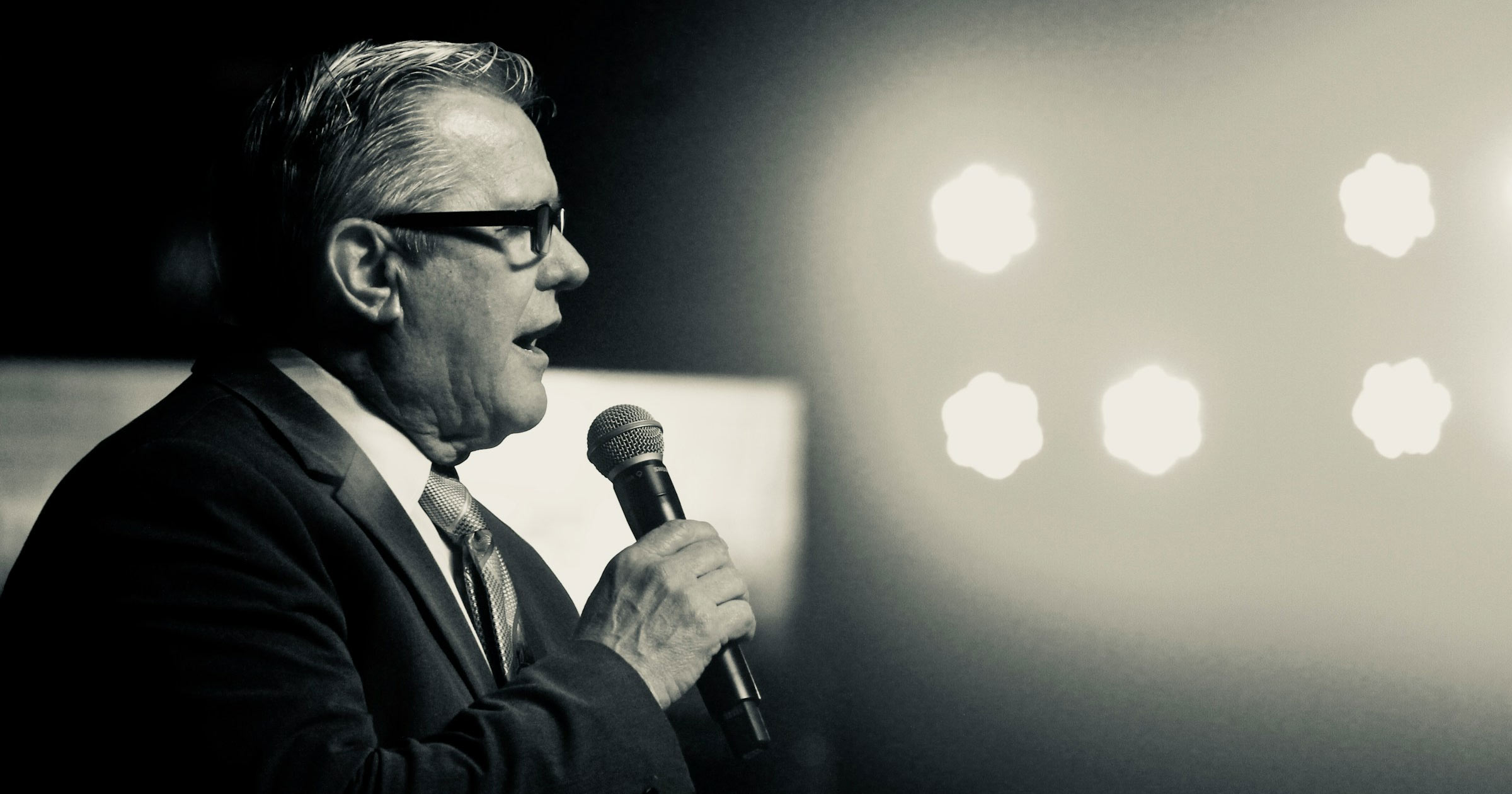
There are fathers who adore the microphone. They start with, "I'll keep it short," and finish twelve minutes later, when the servers are already clearing the dinner plates.
And there are fathers who would rather pay for the entire bar than say five sentences in front of a hundred guests.
If you're reading this article, you're probably somewhere in the middle. Your son is getting married, you've been asked to say a few words, and suddenly it turns out "a few words" is more complicated than it looked. What should you say? Should you joke or not? How much? And how can you avoid repeating what the father of the bride said five minutes earlier?
The good news: the father of the groom's speech is one of the most rewarding at the wedding. You're not expected to put on a show, like a best man. People expect one thing from you—to show that you're proud of your son and happy with his choice. If you sound sincere, the room will remember your speech better than the funniest toast of the evening.
This guide covers when the father of the groom speaks at the wedding, a simple structure, eight ready-made examples for different personalities and family situations, what to include and what to leave out, and how to deliver a confident speech even when your knees are shaking. And at the end, tips for videographers on how to record toasts at a reception.
When Does the Father of the Groom Speak?
According to traditional etiquette, the groom's parents host a rehearsal dinner the day before the wedding, with the groom's father delivering the main toast. If you need a speech specifically for the dinner, check out our sample rehearsal dinner speeches.
At the wedding itself, the father of the bride traditionally speaks as the host of the occasion. However, the rules have long since become flexible, and the groom's father is increasingly taking the microphone at the reception as well. The appropriate speech depends on the situation:
| Situation | Purpose of your speech | Emphasis |
|---|---|---|
| The groom's family is paying for or organizing part of the wedding | Greet guests on behalf of the hosts | Guests, especially those from out of town, and the other family |
| All parents speak | Add to the father of the bride's speech, not repeat it | A story about the son and remarks about his partner |
| You and the groom's mother speak together | Perform a duet | Take turns with short remarks, then a joint toast (example below) |
| You are the only one of the groom's parents speaking | Speak for the whole family | "[Mom's name] and I…"—mention her even if she doesn't come up with you |
| The couple simply asked | Give a gift | A personal story and pride in your son |
Find out three things from the couple in advance: when you speak (usually after the first dance or at the beginning of dinner), who speaks before and after you, and how many speeches there will be. If you speak immediately after the father of the bride, don't repeat the same thank-yous—briefly echo them and move on to your own. The order of speeches usually goes in the reception timeline—you can see an example in our wedding day timeline for a 5 PM ceremony.
Why We Call It a "Toast"
A quick detour—one you can even work into your speech.
The word "toast" literally means toasted bread. In England in the 16th and 17th centuries, a piece of toasted bread, often spiced, was dropped right into wine or ale—it added flavor and was thought to take the edge off sour wine. In Shakespeare's The Merry Wives of Windsor, Falstaff orders a quart of sack (a sherry-like wine) and asks for a toast to be put in it.
How did bread in a glass turn into words in someone's honor? According to the most popular theory, by the 18th century, "toast" came to refer to the person whose health was being drunk—as if the person's name "seasoned" the drink just like spiced bread. Etymologists are cautious, calling this theory plausible but unproven. But as a speech opener, it works perfectly:
"They say people once dropped a piece of toast into their wine to make it taste better. Tonight, we raise our glasses to two people who make everything better."
Father of Groom Speech: Template
A good father-of-the-groom speech is 2–3 minutes, or approximately 250–350 words. Here's how to distribute that time:
| Section | What to say | Time | Words |
|---|---|---|---|
| 1. Greeting | Who you are, thank you to the guests, special thanks to your son's partner's family | 20–30 sec | 40–60 |
| 2. Story about your son | One specific moment that shows his character | 60–75 sec | 100–140 |
| 3. Your son's partner | What you love about them, how your son has changed with them | 30–45 sec | 60–80 |
| 4. Wish | One thought—perhaps from your marriage | 20 sec | 30–40 |
| 5. Toast | Ask everyone to raise a glass, name the couple | 5–10 sec | 10–15 |
Note: the story about the son takes up almost half the speech. This is no coincidence—the story is the heart of the toast.
Princeton neuroscientists Greg Stephens, Lauren Silbert, and Uri Hasson saw why stories work so powerfully—literally. They placed a young woman in an MRI machine and asked her, without preparation, to tell a story from her life—15 minutes about her freshman year of high school. The scientists recorded her brain activity during this time. Then, they played the recording of the story for other people to listen to, also in an MRI machine. The results, published in the journal Proceedings of the National Academy of Sciences, were almost uncanny: the listeners' brains began to work in sync with the storyteller's—in the same areas, with a delay of just a few seconds. And among those who understood the story particularly well, some areas even "jumped ahead" slightly, guessing what would happen next.
The most interesting part was the control experiment. When people heard a story told in Russian, a language they didn't speak, there was no syncing at all. No understanding—no connection.
So, when you tell a good story about your son, the audience literally starts thinking along with you. A list of his virtues ("he's smart, kind, and hardworking") doesn't have the same effect.
Father of the Groom Speech Examples
Four basic examples for different personalities. Use any of them as a starting point and swap in your own details.
Example 1: Heartfelt
Good evening, everyone. I'm Robert, Andrew's dad. On behalf of our entire family, thank you for being here. And a special thank you to Tom and Lisa for raising the wonderful woman our son is marrying today.
When Andrew was twelve, his Little League team lost every game of the season. Every single one. And every Saturday, he was the first one on the field to help the coach carry equipment. I once asked him why he did that. He said, "Because the kids need someone who shows up." That's how he's lived ever since—showing up when he's needed.
Megan, you came into his life and brightened it. You're smart, generous, and you laugh at his jokes—and that takes true devotion. Welcome to the family—officially.
My advice after thirty-two years of marriage to Andrew's mom: never stop dating each other.
Please raise a glass to Andrew and Megan.
Why it works: The story about the losing team is unexpected—usually, stories about victories are told. It shows character, not achievements. The joke about "laughing at his jokes" keeps things from getting too solemn before the ending.
Example 2: Lighthearted
Hi everyone. I'm Steve, the groom's father. My wife asked me to be brief, and after thirty years of marriage, I've learned to listen. Mostly.
Ryan was a very determined kid. At six, he decided to become a professional skateboarder. At ten, an astronaut. At fifteen, a rock star. And today, he finally picked something for life—and her name is Jessica.
Jessica, you did what three guitar teachers and a skateboarding coach couldn't: you made Ryan follow through. We are incredibly happy that you are now part of our family.
To Ryan and Jessica—may your marriage be full of adventures, and may the skateboards stay in the garage.
What's good here: the jokes are about the son, and the compliments go to the bride. The classic "list → surprise ending" structure (skateboarder, astronaut, rock star… Jessica) almost always works.
Example 3: Short (about one minute)
Good evening. I'm Mark, Chris's father. Chris, I've never been prouder of you than I am today. Ashley, thank you for the joy you bring to our son and our entire family. Our home is your home. Friends, please raise your glasses to Chris and Ashley!
What's great: 50 words, and everything is in place. If you speak after long speeches, the audience will be grateful.
Example 4: For the Dad Who Doesn't Do Speeches
Good evening, everyone. I'm Gary, Josh's dad. Those who know me know I'm not much of a speechmaker. My personal record is "Pass the salt." So I wrote it all down on an index card.
Josh, when you were sixteen, we spent a month together restoring an old pickup truck. You hardly said anything, I hardly said anything, and it was one of the best months of my life. That's when I realized: you don't need a lot of words to show you care.
Caitlin, you're the first person who's gotten Josh to talk more than me. Thank you for that.
I'm not a great talker, so I'll just say it: I'm proud of you both.
To Josh and Caitlin.
Why the audience will be on your side: The father honestly admits he's no good at giving speeches—and the audience is immediately on his side. Short sentences, nothing grand. A quiet story about a pickup truck is more touching than any grandiose words.
Father of the Groom Wedding Speech Examples for Different Families
Not every family looks like a greeting card, and not every speech should sound the same. Here are four examples for specific situations.
Example 5: The Host's Welcome (When the Groom's Family Is Hosting)
Good evening, ladies and gentlemen. I'm Richard, Ben's father, and on behalf of my wife, Anne, and our entire family, welcome.
Some of you flew in from California, some drove six hours from Ohio, and our 91-year-old Aunt Dorothy said missing this wedding wasn't an option. Dorothy, we're so glad to see you. Thank you all.
I'd especially like to thank the Moreno family—Miguel and Elena. A year ago, we were two families who'd never met. Today, we're sitting at the same table and already arguing over whose relatives are the better dancers. That's what family is, I guess.
Ben and Sofia, when you first told us about your plans, you said you wanted a celebration where everyone would feel at home. Looking around, I think you've nailed it.
Eat, drink, dance—and now, please raise your glasses. To Ben and Sofia!
What to note: When the groom's family is the host, the father's speech is primarily a greeting to the guests, especially those who have traveled from afar, and to the other family. The son's story is brief here, and the focus is on everyone gathered. Tip: check in advance how to pronounce the other family's names correctly—a mistake on the microphone will be remembered for a long time.
Example 6: The Stepfather of the Groom
Good evening. I'm Doug. I came into Eric's life when he was nine, and honestly, for the first couple of years, he looked at me like I was the guy who came to fix the air conditioner and somehow never left.
I don't blame him. It's not easy to get used to a new person at the breakfast table.
I don't know when everything changed. Maybe the night his car broke down two hundred miles from home and he called me, of all people. Maybe later. But one day I realized I wasn't "Mom's husband" to him anymore. I was his person.
Eric, thank you for letting me be there. It's one of the greatest honors of my life.
Nicole, you made him happy in a way I hoped someone would one day. Welcome to our family—a little complicated, but very loving.
To Eric and Nicole.
What's important here: the stepfather speaks honestly and humorously about how the relationship took time to build—and this makes the speech more powerful. He doesn't claim to be the biological father. If the biological father is also present or speaking, discuss the speech with the couple and him in advance to avoid offending anyone.
Example 7: A Joint Speech with the Mother of the Groom
Mom: Good evening, everyone. I'm Sharon…
Dad: …and I'm Jim. We're Matt's parents. We decided to talk together because, after thirty-one years, we still can't finish a sentence without each other.
Mom: Matt was a quiet kid. He could spend hours building with Legos and not talk to anyone.
Dad: And then he met Olivia—and we learned he could talk on the phone for three hours.
Mom: Olivia, we love you for what you've made our family: louder, more fun, and much more punctual.
Dad: Our advice is short. We've tested it ourselves.
Mom: Listen to each other…
Dad: …and sometimes let the other person finish their sentence.
Together: To Matt and Olivia!
How it works: A joint speech is like a mini-dialogue—guests love this format. The joke about "finishing sentences" is repeated at the end. But rehearsing this speech is essential—at least twice together and out loud, with one microphone passed from hand to hand.
Example 8: The Proud, Quiet Dad
Good evening. I'm William, Anthony's father.
My father never told me he was proud of me. Not because he wasn't proud—it was just not common in his generation. I promised myself I'd say it to my son. And, to my shame, I still didn't say it often enough.
So today, in front of witnesses, I'll say it out loud.
Anthony, I'm proud of you. Proud of how you worked nights to finish your studies. Proud of how you take care of your mother. Proud of the man you've become.
And I'm also proud of your choice. Amanda, from day one, you've treated our family like your own. Our son chose a wonderful person.
Please raise your glasses—to Anthony and Amanda.
The secret of this speech: a very personal speech, but without drama. The most powerful moment is the simple phrase "I'm proud of you," spoken publicly. If you're that kind of dad, this speech can become the greatest gift to your son.
Father of the Groom Speeches: What to Include (and What to Skip)
Include
- Thanks to the partner's family — especially if they helped plan the wedding. Mention them by name.
- One story about your son. Stories that show character work best: how he handled difficult, funny, or awkward situations.
- Words about your son's partner—no less than about your son. This is a wedding for two.
- Short advice—one line from your life or marriage.
- Toast with the couple's names.
Skip
- Exes. Never, in any way.
- "I'll keep it brief." Just be brief.
- Work stories and career achievements of your son. This is not a resume.
- Inside jokes—if you have to explain them, half the room won't get it.
- Politics, money, religious disputes. Even if "it's all family."
- Repeating the father of the bride. If he's already thanked everyone for coming, it's enough to say, "I second Tom's words."
A strong ending is more important than a perfect beginning
A word about the ending—it's more important than it seems. This was clearly demonstrated by one of the most famous experiments by Daniel Kahneman, a psychologist who later won the Nobel Prize in Economics. He and his colleagues asked people to dip their hand in cold water—14 °C (57 °F), noticeably painful—for 60 seconds. Another time, the hand was dipped in the water for the same 60 seconds, but then remained there for another 30, while the water gradually warmed to 15 °C (59 °F). It was still unpleasant, but now easier. When participants were asked which of the two options they would repeat, most chose the longer one. It objectively involved more pain—but it ended better. The results were published in the journal Psychological Science and became a classic.
This is called the "peak-end" rule: we evaluate an experience primarily by its most powerful moment and its ending. The same principle applies to a speech—don't let the ending trail off. The last two lines—the wish and the toast—should be delivered confidently and clearly. Learn them by heart in advance.
Groom's Father Wedding Speech: Delivery Tips
Tell Yourself "I'm Excited," Not "Calm Down"
Almost everyone advises "relaxing and calming down" before a speech. Psychologist Alison Wood Brooks of Harvard Business School decided to test whether this advice works and described her results in the Journal of Experimental Psychology: General. Participants in her experiment were given two minutes to prepare a speech about why they were good colleagues and were warned that their speech would be videotaped and then evaluated by a committee. Before their speech, some said out loud, "I am calm," while others said, "I am excited."
Those who said "I am excited" spoke longer, and their speeches were rated as more persuasive, confident, and competent. The secret is that anxiety and excitement are almost the same thing for the body—your heart pounds, your palms sweat. It's almost impossible to calm down in a minute. But relabeling the same state "excitement before something good" is possible.
So before you take the microphone, tell yourself, "I'm excited." Especially since it's true—your son is getting married.
And Remember: You're Not Alone
There's a famous joke by Jerry Seinfeld: people fear public speaking more than they fear death, meaning that at a funeral, most would rather lie in the coffin than deliver the eulogy. It's funny, but the data isn't that dramatic. In Chapman University's 2023 Survey of American Fears, 28.7% said they were afraid of public speaking—fewer than were afraid of sharks. So, while anxiety is normal, panic is not the norm for most people. Simple preparation alleviates much of the fear.
Practical Tips
- Rehearse standing and with a stopwatch. Do at least one rehearsal standing up, with index cards in hand and a timer on your phone—just like you'll be doing at the wedding. A speech that took two minutes at the kitchen table can easily stretch to four once you're standing and pausing.
- Index cards—numbered. Large font, several lines per card, number in the corner. If you drop them while passing the mic (and it happens), you'll be able to pick them up in three seconds. Skip the phone: the screen goes dark and hides your face on video.
- Hold the mic correctly. The DJ will most likely give you a Shure SM58 or something very similar—it's arguably the most famous microphone in the world, used for decades on stages, in bars, and at receptions. It's cardioid. It sounds complicated, but the idea is simple: if you draw the directions from which a microphone picks up sound, you'll get a heart-shaped figure (hence the name—from the Greek "kardia," meaning heart). It picks up sound perfectly from the front, worse from the sides, and almost nothing from the back. This is convenient for DJs—the mic doesn't pick up the speakers or audience noise. But you have to take it into account, too. Hence, three rules:
- aim it directly at your mouth, not at your chin or chest—from the side, your voice drops off noticeably;
- hold it a fist's distance from your lips—this is the manufacturer's recommendation: your voice sounds fuller, and audience noise is barely audible;
- don't cup the grille with your palm, like a rapper on stage. By covering the rear holes, you make the mic less directional—it starts picking up the speakers, and the audience hears that piercing feedback whistle.
- Don't walk in front of the speakers. If you stand between the speaker and the mic, feedback squeal is almost guaranteed. Ask the DJ before the reception where the best place to stand is.
- One drink before the speech, not three. A little courage is good. Slurring on a video that lasts forever—bad.
- Wait for silence. Stand up, smile, wait five seconds. The room will quiet down on its own—better than after "one-two, can you hear me?"
- Look at the couple, but speak to the room. When addressing your son, turn toward him with the microphone.
- Memorize the ending. Say your wish and toast looking at people, not at a card (remember the peak-end rule).
- If you lose your place, smile. "So, where was I… Oh, right." Guests will forgive anything but twelve minutes.
For Videographers: Recording Father of the Groom Speeches
Toasts at the reception are one of the most important parts of a wedding film, and one of the most challenging for sound. The groom's father starts quietly and hesitantly, then ends with a loud "Cheers!" that overloads the sound. Between these extremes are the guests, the clinking of glasses, and a DJ who forgot to turn down the background music.
- Record audio from the DJ's board. Agree on a line-level output in advance—it's the cleanest signal. Recording from a camera in the hall is only a backup option.
- Have a second source. Use a lavalier on the speaker or a recorder near the toasting area. If your recorder has a backup track that's 6–12 dB quieter than the main track (in many Zoom and Tascam models, this is called a dual-level or safety track), enable it. When quiet speech suddenly turns into a loud "Cheers!", the main track may clip, while the backup track will remain clear.
- Talk to the groom's father before the reception. 15 seconds: "Point the mic at your mouth, don't cover the grille with your hand, and turn the mic with you when you face your son." This saves more sound than any filter in the edit.
- Deal with feedback in advance. Feedback happens when the mic picks up sound from the speakers and amplifies it again, in a loop. Work with the DJ to select a location for the toasts to the side of the speakers, not in front of them, and mark the spot for whoever is giving a toast. A squeal in the middle of the most touching phrase are almost impossible to eliminate in the edit.
- Ask the DJ not to touch the fader during the speech. If they suddenly raise the volume when the father speaks quietly, your board recording will "jump." It's best to set the level in advance, during a sound check with the same mic.
- Ask the DJ or coordinator about the toast order. Speeches often start unexpectedly, and sometimes someone comes out unannounced. Turn on the recorders before the first speech and keep them on until the last.
- Leave room in the frame. Fathers often start at the table and then move to the center or approach their son for a hug. A wide shot on one camera and a medium shot on the other will ensure you don't miss the hug during the final "Cheers!"
For why audio matters so much, see our wedding video audio quality impact research. And if you want to deliver your film, speeches, and photos in a beautiful gallery with a single link, try OurStoria: Start a 7-day Free Pro Trial.
The Toast He'll Replay for Years
The wedding will fly by. Your son probably won't remember what was on the menu, what song came third, or who caught the bouquet.
But he'll listen to your speech again—on an anniversary, on a difficult day, one day with his own children. And he'll hear in it not the perfect wording, but the thing that matters: his father stood before everyone they loved and said he was proud of him.
You don't need to be an orator. You just need to tell the truth, briefly and from the heart. And then raise a glass.
By the way, the groom's mother has her own guide with examples: Mother of the Groom Speech.
Related articles:
- Mother of the Groom Speech: 8 Examples, Template & Tips (2026)
- Sample Rehearsal Dinner Speeches: Templates & Examples for Every Speaker (2026)
- The Sound of a Wedding: How Audio Quality Determines Whether Couples Treasure or Forget Their Film
- Wedding Day Timeline 5pm Ceremony: Schedules for Every Season
- Wedding Planning Checklist: A Month-by-Month Timeline (Free PDF)