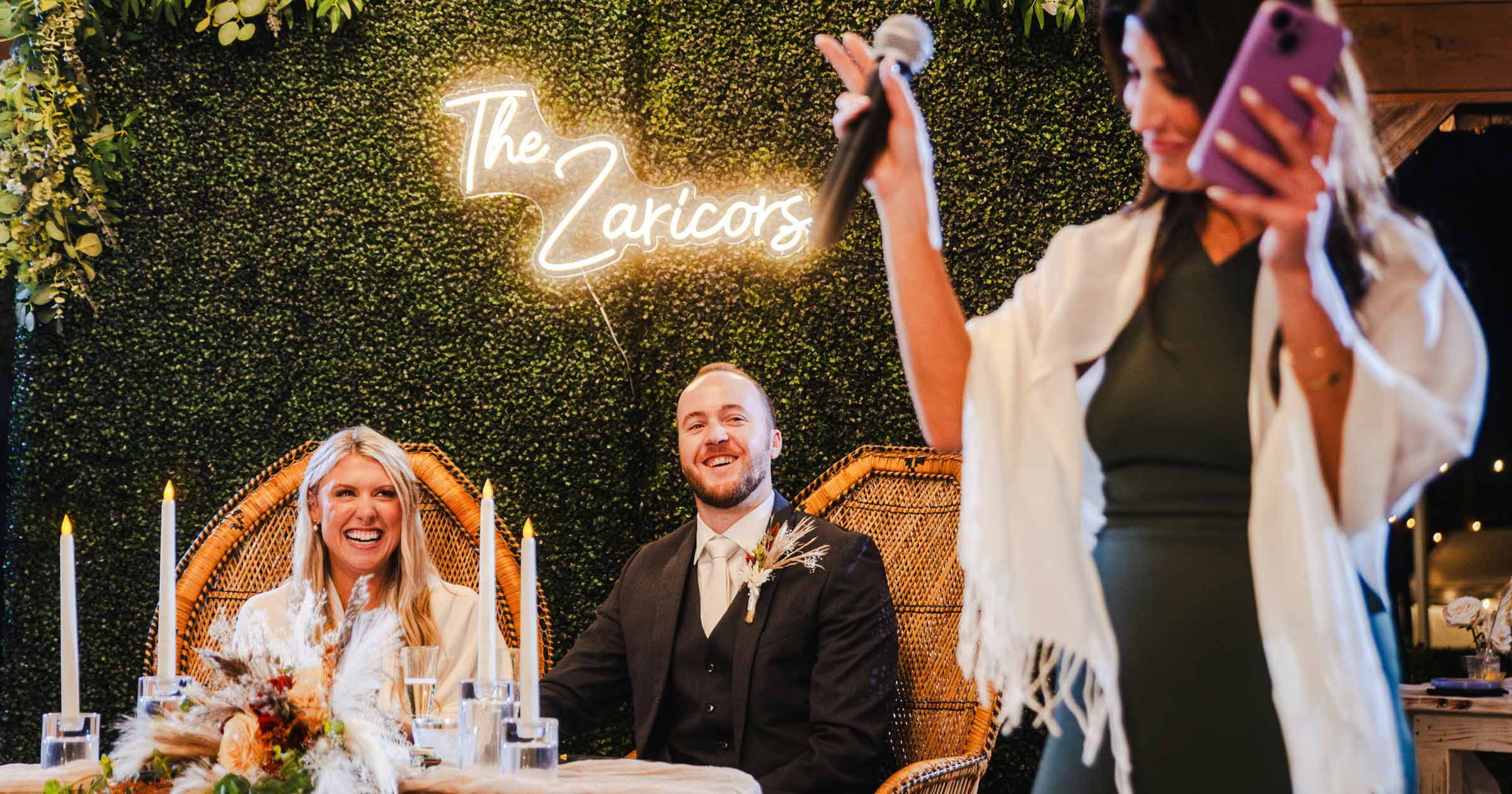
There's an old joke: the groom's mother's job at a wedding is to "wear beige and keep quiet." The bride's mother plans, the bride's father walks the bride down the aisle and gives the toast, and the groom's mother… smiles in the third row.
Luckily, this joke has become outdated. Today, the groom's mother increasingly takes the microphone at the wedding itself—and it's her speech that guests discuss at the bar. Because she has something no one else in the room has: she's known the groom since the first minute of his life.
And that's precisely why this speech is so difficult to write. Thirty years of memories must be condensed into three minutes. You must talk about your son—and not forget about his new partner. You must be sincere—and not turn the toast into a farewell to a little boy. And you have to get through it without bursting into tears by the second sentence, in front of a hundred guests and a videographer's camera.
This guide has everything you need: when the groom's mother speaks at a wedding, how long a good speech lasts, a simple structure, eight ready-made examples for different situations (including a blended family and a speech in memory of a father), ideas for what to say, and how to deliver it all calmly. And at the end, a few tips for videographers filming toasts.
When Does the Mother of the Groom Give a Speech?
According to classic American etiquette, the groom's parents host a rehearsal dinner the night before the wedding and speak there. At the wedding itself, the bride's father (as the host), best man, and maid of honor traditionally speak.
But this tradition has long since become flexible. Weddings are increasingly being paid for by both families or the couple themselves, and the role of "host" has become blurred. Today, the mother of the groom typically speaks at the wedding in a few situations:
- the groom's family is involved in organizing or paying for the wedding—then a speech on their behalf sounds natural;
- the groom's parents speak together—one begins, the other ends with a toast;
- the groom's father does not speak—due to personality, circumstances, or because he is no longer with us;
- the couple simply asked—the most common and most pleasant reason.
Speeches usually happen after the first dance or at the beginning of dinner, when guests are seated and listening. The order is easy to figure out in advance: typically, the hosts (parents) go first, then the maid of honor and best man, and finally, the couple thanks the guests. Agree with the couple on two things: when exactly you'll speak and how many speeches there will be. If there are five speeches, yours should be shorter than if there are two. The order of toasts is usually listed in the reception timeline—you can see an example in our wedding day timeline for a 4 PM ceremony.
And if you're looking for a speech for a rehearsal dinner rather than a wedding, we have a separate collection of sample rehearsal dinner speeches, including a speech from the mother of the groom.
How Long Should It Be?
Two to three minutes. Four minutes maximum, if there aren't many other speeches.
The easiest way to turn that into words: Americans speak approximately 120–150 words per minute in conversation (according to the National Center for Voice and Speech), and when nervous in front of an audience and trying to speak clearly, they usually slow down. So:
| Speech Length | Words | How Long |
|---|---|---|
| Short | 100–150 | about 1 minute |
| Standard | 250–350 | 2–3 minutes |
| Long | 400–500 | 3–4 minutes |
If a written text is longer than 500 words, it's no longer a toast, it's a memoir. Guests are eating, there's a line at the bar, the DJ is checking his watch. The best wedding speeches are almost always shorter than the author would like.
Mother of the Groom Wedding Speech: Simple Template
Almost any good mother-of-the-groom speech can be broken down into five parts:
- Welcome (2–3 sentences). Who you are (not all guests know you by sight), thank you to the guests, a special thank-you to the bride's family (or your son's partner's family) and everyone who organized the celebration.
- One story about your son (4–6 sentences). Not a biography, but one specific moment that explains the kind of person he is.
- His partner (3–4 sentences). When did you realize this was "the one"? What do you love about them? How has your son changed since they've been together?
- Wish (2–3 sentences). One thought you want to convey. One, not five.
- Toast (1 sentence). Ask the guests to raise their glasses and name the couple.
Why one story? A well-known experiment by psychologists Deborah Small, George Loewenstein, and Paul Slovic, published in the journal Organizational Behavior and Human Decision Processes, shows why. Participants were asked to donate part of their earnings to help starving children in Africa. Some were shown statistics about millions of people in need, while others were shown the story of a seven-year-old girl from Mali named Rokia. People gave noticeably more after reading the girl's story. And when statistics were added to her story, donations dropped.
It works the same way in a speech: one vivid story is more touching than a list of all the good qualities. The phrase "he was always a kind boy" means nothing. The story of how, at seven, he gave up his birthday party for a sick neighbor means everything.
Mother of the Groom Speech Examples
Below are eight examples for different personalities and family situations. Use them as a basis, and replace the details with your own—real details always work better than imaginary ones.
Example 1: Heartfelt
Good evening, everyone. For those of you we haven't met yet, I'm Linda, Michael's mother.
Thank you all for being here. And to the Johnson family, thank you for welcoming us as if we'd known each other for years.
When Michael was seven, he spent an entire Saturday building a birdhouse for our neighbor, Mrs. Patterson. She'd mentioned that she missed having birds in her yard since her husband died. The birdhouse was crooked, the roof leaked, and she kept it on her porch for fifteen years. That's my son: he notices what people need—and he shows up.
So when, after his third date with Emily, he called me and said, "Mom, she notices everything," I knew.
Emily, you're kind, you're funny, and my son becomes braver when he's with you. Thank you for loving him.
My wish for you both is simple: continue to notice each other. The little things are what matter most.
Please raise your glasses to Michael and Emily.
Why it works: One story with a detail (a crooked birdhouse, fifteen years on the porch), which then resonates with the bride ("she notices everything"). The wish stems from the same thought—the speech sounds coherent.
Example 2: Lighthearted
Hi everyone, I'm Karen, the groom's mother. Or, as Jason calls me, "the person who still has his baby photos."
Don't worry, I left most of them at home.
Jason was a challenging child. At five, he took apart our toaster. At eight, the VCR. At sixteen, the family car. It never came back together properly. Until he met Sarah.
Sarah, you're the first person who ever made my son read instructions. He's calmer, happier, and, frankly, much better dressed when he's with you. We adore you.
Marriage is like a toaster: it works best when you don't take it apart to see how it works. Just enjoy it.
To Jason and Sarah!
What's great about this: the jokes are good-natured and relatable, not a single inside joke. The funniest part is about the son, and the bride gets nothing but warmth. A recurring image (the toaster) connects the beginning and end.
Example 3: Short (about one minute)
Good evening. I'm Patricia, Daniel's mother.
Daniel, it's been such a joy to watch you grow into the man you are today. Rachel, from the first time we met, you felt like family. Thank you for making my son so happy.
May your home always be filled with laughter and your hearts filled with patience.
Please join us in a toast to Daniel and Rachel!
What's great about this: 70 words, and all five parts are in place. Perfect if there are lots of speeches or don't like public speaking.
Example 4: When You Didn't Expect Her (the "I Was Wrong" Speech)
Good evening, everyone. I'm Susan, Tyler's mom.
I have a confession to make. When Tyler told me he was dating a girl who skydives, runs ultramarathons, and once drove across the country alone, I got a little nervous. My son is the kind of guy who makes a spreadsheet before buying a phone charger.
I thought: how will this work?
Then I saw them together. Tyler, who had never traveled farther than the next state over, stood on a mountaintop in Colorado this summer and sent me a photo with the caption, "Mom, I'm alive and I love it." And Brittany, who never plans anything, now knows how much each of their trips costs, down to the dollar.
They haven't changed each other. They complement each other.
Brittany, I'm glad I was wrong. Welcome to the family.
To Tyler and Brittany!
What to pay attention to: A light "confession" creates intrigue, and the ending turns it into a compliment. Important: this should only be said if the doubts were minor and humorous. Real conflicts don't belong in a wedding speech.
Example 5: When His Partner Is Also a Groom
Good evening, everyone. I'm Debra, Nathan's mom.
When Nathan was ten, he declared he'd never get married because "weddings are boring and you can't play video games." Nathan, I checked with the DJ: there are no arcade games tonight. Apparently, you found a more serious reason.
That reason turned out to be Marcus.
Marcus, I remember the first dinner we had at our house. You washed all the dishes while we were still sitting at the table, and argued baseball with my husband—and won. After you left, my husband said, "Well, this one's staying." He's rarely wrong.
You two show that love isn't about big words, but about who does the dishes and who calls first after a hard day.
Please raise a glass—to Nathan and Marcus, my sons.
The secret of this speech: a typical, warm family speech—without unnecessary comments about it being a same-sex wedding. The final words, "my sons," are the most powerful moment: this is how a mother welcomes her son's partner into the family.
Example 6: For a Blended Family (Stepmother of the Groom)
Hi everyone. I'm Michelle, and for the past eighteen years, I've had the honor of being Kevin's stepmother.
When we met, Kevin was twelve, and he made it clear he didn't need a new mother. And you know what? He was right. He already had a mother—Carol, who's here tonight, and I want to thank her for raising this wonderful man.
I was cast in a different role—the person who drove him to swim practice at six in the morning, taught him how to drive in the supermarket parking lot, and one night, at two in the morning, listened to him talk about a girl he'd just met.
That girl was Hannah.
Hannah, he talked about you for forty minutes nonstop that night. Nothing has changed since then. Thank you for making him so happy.
I wish you what our family taught me: love isn't divided, it multiplies.
To Kevin and Hannah!
Why this works in a blended family: The stepmother openly acknowledges and thanks his mother—this eases tension in the room. She doesn't claim someone else's role, but rather shares her own. If there are difficulties in the family, discuss with the couple whether such a speech is appropriate—and read it to them in advance.
Example 7: Honoring His Late Father
Good evening. I'm Margaret, Ryan's mom.
I promised myself I wouldn't cry. So if I do, consider it a flower allergy.
Ryan's father, David, dreamed of this day. When Ryan was little, David took him fishing every Sunday, and they almost never caught anything. One day, I asked why they even bothered going. David said, "We don't fish. We talk."
Ryan, you've grown into someone people want to talk to. Dad would be so proud. He'd be standing here instead of me, probably telling the same story, only longer.
Lauren, David didn't have the chance to meet you. But I know he would have loved you—for listening to Ryan the way he did.
Please raise your glasses. To Ryan and Lauren—and to David, who's with us today.
What's important here: the memory of the father is present, but it doesn't dominate the speech—the couple and the celebration remain the main focus. A light joke at the beginning gives the audience permission to smile. The story connects father, son, and bride in a single line.
Example 8: The Funny-First, Teary-Last Speech
Hi everyone, I'm Janet, the groom's mother.
For those who don't know: Brandon is our third child. That's why we have the fewest baby photos; his baby book stops at six months, and I honestly don't remember his first word. Brandon, for the record, it was "Mama."
But I do remember something else. I remember him getting his first job at sixteen—flipping burgers—and buying me flowers with his first paycheck because "Dad forgot your anniversary." Sorry, honey, it's on the record now.
I remember him calling me from his car outside Jessica's house at twenty-five and saying, "Mom, I'm going to tell her I love her, and I'm scared."
Jessica, I've seen my son afraid of all sorts of things: exams, job interviews, roller coasters. But I've never seen him as brave as he is with you.
To Brandon and Jessica—and to everyone who's ever sat in a car, afraid to say the most important thing.
How it works: a classic "arc": the room laughs at the start and goes quiet by the end. The funny details are honest and self-deprecating (a third child, a forgotten anniversary), and the final toast is addressed to all guests—everyone remembers their own "car outside the house."
Mother of the Groom Speech Ideas
If a blank page is daunting, start with questions. Answer them in writing, a couple of sentences at a time, and you'll have enough material for three speeches.
- Childhood. What moment best explains the kind of person he's become? Not the cutest—the most telling.
- Meeting his partner. What did you notice first? What did they do that made you think, "Oh, this is serious"?
- Change. How has your son changed around them? Calmer, bolder, more punctual—any concrete change works great.
- Family tradition. Sunday pancakes, a Christmas game, an annual hike—what would you like to pass on to the new family?
- Advice from your marriage. One sentence, no lecture: "Never go to bed without agreeing on who's taking the dog to the vet tomorrow."
- Thanks to the partner's family. For the person they raised.
- A quote or a line from a song – only if it truly means something to your family. "Love is patient…" gets read at every other wedding.
What Not to Say
- Ex-partners. Neither jokingly nor seriously. Never.
- Embarrassing stories. If the story could embarrass the couple in front of their grandmother, remove it.
- "I'm losing my son." Even jokingly, this sounds like a reproach to the partner. Better: "I'm gaining a daughter" (or a son).
- Inside jokes. If context is needed for understanding, half the room doesn't know it.
- Long thank-yous to vendors. The couple will thank the florist and the baker.
- Advice about grandchildren. This is a topic for private conversation. Preferably, never.
Mother of the Groom Wedding Toast: How to Deliver It
Writing a speech is half the battle. The other half is delivering it so that others can hear you.
Rehearse out loud—actually out loud. What you say out loud sticks better than what you read silently—psychologists checked this long ago. Colin MacLeod and his colleagues from Canada's University of Waterloo even gave it a name—the "production effect"—and described it in the Journal of Experimental Psychology: in their experiments, people remembered words they read aloud noticeably better. The explanation is clear: you remember a spoken phrase twice—both the meaning and how it sounded in your voice. Therefore, three or four rehearsals out loud will yield more than ten rereadings in the kitchen. And you'll also learn which phrases make your throat tighten—it's useful to know beforehand.
Memorize your first line. Nerves are strongest in the first few seconds, when all heads turn to look at you. If your first line or two are memorized, you get through that moment on autopilot, and then your voice evens out automatically.
Note cards, not a phone. Large font, several lines per card. Phones go dark at the most inopportune moments, and the screen obscures your face in video. And a practical tip that people often forget too late: if you wear glasses when reading, put them in your purse with the cards.
Microphone under your chin. It sounds trivial, but this is the most common mistake at weddings. Voice weakens with distance much faster than it seems: the sound spreads out from the lips in all directions, like ripples in water, and less and less of it reaches the microphone. Sound engineers call this the inverse square law, and in practice, it means this: move the mic from 2 to 4 inches away from your lips, and you're already noticeably quieter. Drop your hand to your chest, and you're several times quieter. The DJ can certainly turn up the volume, but along with your voice, they'll also turn up the clinking forks and conversations at the back table. So, hold the microphone 2–3 inches from your lips, and when you turn to face the couple, turn with it. Otherwise, neither the back table nor the videographer will hear your most touching words.
What if I cry?
You'll cry—and that's okay. In fact, it might be the best thing that can happen to your speech.
Dutch psychologist Ad Vingerhoets of Tilburg University has been studying human tears for almost his entire career. Together with Janis Zickfeld and a large international team, he conducted an experiment involving 7,007 people from 41 countries. People were shown photographs of faces—all the same, only some had tears drawn on them. The results, published in the Journal of Experimental Social Psychology, were almost universally consistent: people perceive a crying person as warmer, feel closer to them, and want to support them more.
So, if the groom's mother cries during her speech, the audience doesn't judge her. The audience is on her side.
The plan is simple. If your voice starts to waver, stop. Take a breath. Take a sip of water (put a glass nearby beforehand). Smile and continue where you left off. The guests will wait. They don't need a perfect speech—they need yours.
Short Mother of the Groom Speeches: 5 Quick Templates
Sometimes you need a really short speech: there are lots of speeches, you're giving a joint speech with your husband, or you just don't like speaking. Here are five 30–60 second speech templates—insert names and one detail of your own.
- Warm. "I'm [name], mother of [son]. [Son], watching you grow up has been the greatest joy of my life. [Partner], thank you for making him so happy. To [names]!"
- Grateful. "Thank you to the [last name] family for raising the man my son loves. From today on, we are one big family. To [names]!"
- With a wish. "My husband and I have been married [N] years, and here's what we've learned: laugh more often than you argue, and always save the last slice of pizza for each other. To [names]!"
- With a touch of humor. "[Son], I've been reminding you to put on a jacket for thirty years. [Partner], it's your job now. Good luck. To [names]!"
- With one memory. "When [son] was [N], he [one detail]. He's still like that—and, [partner], you love him for that. To [names]!"
For Videographers: Filming the Mother of the Groom Toast
Why is it so important to record a mother's speech well? There's an almost physiological explanation.
Leslie Seltzer, Toni Ziegler, and Seth Pollak of the University of Wisconsin invited 61 girls aged 7–12 to the lab. First, the girls were given a small challenge that even adults dread: giving a speech and solving problems in front of a panel of strangers. Then, some were comforted by their mothers—hugs and conversations, others simply received phone calls, and still others watched a relaxing film. The scientists measured hormones: cortisol, which rises with stress, and oxytocin, the hormone of closeness and trust.
The results, published in Proceedings of the Royal Society B, surprised even the authors. The girls who only heard their mothers on the phone had hormones that behaved almost identically to those who had been hugged: stress decreased, and oxytocin increased. In the next study, the team tested another option—messaging with their mothers. It didn't work: these girls' hormone levels were no different from those who hadn't communicated with their mothers at all.
It turns out that a mother's voice—even without a hug—is more powerful than her words on a screen. The study was conducted with children, but anyone who has heard a recording of their mother's voice years later will understand what it's all about. That's why, ten years later, a recording of a mother's speech becomes more valuable to a couple than any drone footage. And that's why it can't be lost: if the audio isn't captured, there's no second take.
- Audio: board feed plus a backup. A line out from the DJ's board to a separate recorder and a second source near the speaker. Camera sound from the audience is only a backup.
- Don't cut away when she cries. The first instinct is to give her a moment and swing to the guests. Don't. A pause, a breath, a smile through tears—that's the shot people rewatch the film for. Keep the wide shot and wait for her to continue.
- Second camera on the groom. A son's reaction to his mother's story is often more powerful than the speech itself: laughter at the first joke, pursed lips at the last line.
- Deliver the speech as a separate file. Couples forward Mom's toast to relatives who couldn't make it—a grandmother, an aunt in another state. Individual clips of speeches in a gallery are a detail that people remember and tell friends about when choosing a videographer.
Learn more about why sound matters in our wedding video audio quality impact research. And if you're delivering your film, speeches, and photos to clients in a single branded gallery, try OurStoria — Start a 7-day Free Pro Trial.
The Words They'll Keep
Twenty years from now, no one will remember the reception menu or the color of the tablecloths. But somewhere on a disk, in a folder with the wedding film, there will be a file with your speech. And one day, your son will open it—maybe on an anniversary, maybe showing it to his own children—and he will again hear your voice speaking of him with such love. That same voice that, as scientists have discovered, soothes a child almost like a hug—even when that child is thirty.
So don't strive for a perfect speech. Strive for an honest one. One true story, a few warm words about the person he chose, and a glass raised to them both.
That's enough. That's always been enough.
Related articles:
- Father of the Groom Speech: 8 Examples, Template & Tips (2026)
- Sample Rehearsal Dinner Speeches: Templates & Examples for Every Speaker (2026)
- The Sound of a Wedding: How Audio Quality Determines Whether Couples Treasure or Forget Their Film
- Wedding Day Timeline 4pm Ceremony: Sample Schedules With & Without a First Look
- Wedding Planning Checklist: A Month-by-Month Timeline (Free PDF)