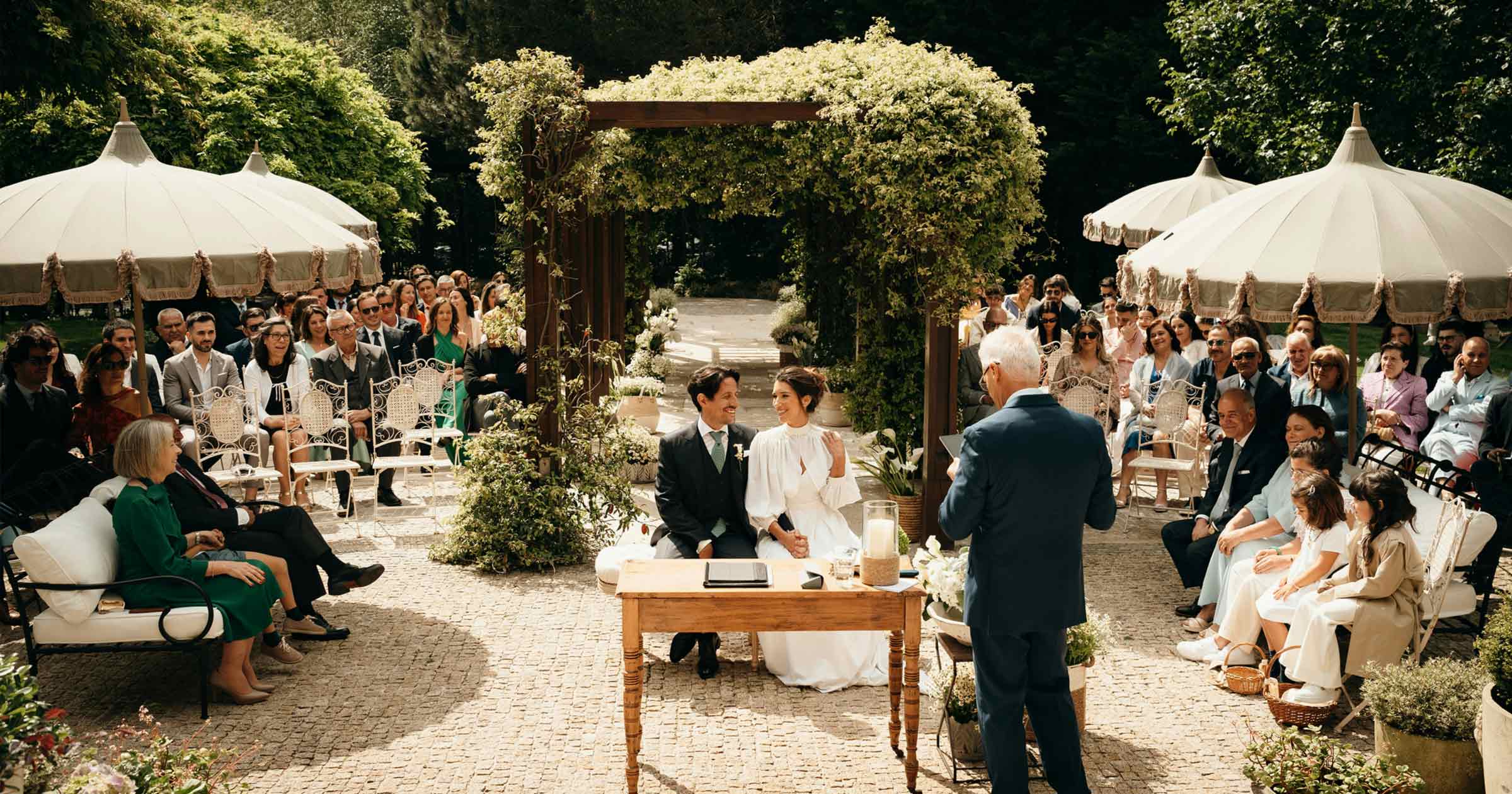
If you ask wedding photographers which ceremony time they like best, many will answer: four o'clock. Not too early—the morning doesn't turn into a rush. Not too late—in summer and early fall, there's still some real daylight left after the ceremony. Getting ready happens in beautiful window light, portraits can be taken closer to sunset, and the reception flows smoothly into the evening.
So, four o'clock is a classic. But there's a catch: because the schedule appears "standard," it's often not fully thought out. Couples grab a template off the internet, fill in their names, and on the wedding day, they discover that family photos took forty minutes instead of twenty, a bridesmaid's hair took an hour instead of forty-five, and sunset portraits had to be canceled because in October the sun sets before the main course is served.
A good schedule differs from a bad one not in the start time, but in the details: how long each block actually lasts, where the extra time is hidden, and what happens if something goes wrong. This guide includes two ready-made, minute-by-minute schedules (with and without a first look), an explanation of where these numbers come from, how to build in extra time, how to work out when getting ready should start, and how to adjust portraits to sunset in any month. And for photographers and videographers, at the end, there's a section on how a schedule becomes the structure of a film.
Wedding Day Timeline for 4pm Ceremony With a First Look
The first look is the moment when the couple sees each other in their wedding attire for the first time before the ceremony, usually alone, a couple of hours beforehand. Afterward, the photographer takes portraits of the couple, the wedding party, and their family, and by the time the ceremony starts, all the photos are done. After the ceremony, the couple goes straight to the guests for cocktail hour.
| Time | Event | Duration | Photo & Video Notes |
|---|---|---|---|
| 11:00 AM | Hair & makeup underway | — | Stylist's schedule — see Hair & Makeup Planner |
| 12:00 PM | Photo/video team arrives | — | Set up, test audio, scout window light |
| 12:15 PM | Details: dress, rings, shoes, invitation | 30 min | Flat lays, macro shots |
| 12:45 PM | Getting-ready candids (both partners) | 45 min | Second shooter with partner 2 |
| 1:30 PM | Getting dressed | 15 min | Mother / MOH helping |
| 1:45 PM | First look | 15 min | Two angles, keep audio rolling |
| 2:00 PM | Couple portraits | 40 min | |
| 2:40 PM | Wedding party photos | 30 min | |
| 3:10 PM | Family photos | 20 min | Work from a printed family photo list |
| 3:30 PM | Couple out of sight, guests arrive | 30 min | Ceremony B-roll, mic the officiant |
| 4:00 PM | Ceremony | 30 min | Processional, vows, rings, kiss |
| 4:30 PM | Cocktail hour | 60 min | Couple joins guests — candids |
| 5:30 PM | Reception room before guests | 10 min | Tables, cake, decor |
| 5:40 PM | Grand entrance + first dance | 15 min | Two angles minimum |
| 5:55 PM | Dinner | 60 min | Table candids; swap batteries and cards |
| 6:55 PM | Toasts | 20 min | Speaker + couple's reactions |
| 7:15 PM | Sunset portraits | 20 min | Check sunset time — move if needed |
| 7:35 PM | Parent dances | 10 min | |
| 7:45 PM | Cake cutting | 10 min | |
| 7:55 PM | Open dancing | 75 min | |
| 9:10 PM | Send-off / end of coverage | 15 min | Sparklers, confetti, car |
The main advantage of this option is that you don't miss your own cocktail hour, and the family photos are already over when the guests arrive. The main disadvantage is that getting ready begins half an hour earlier, and the most emotional moment—seeing each other—doesn't happen at the altar.
According to photographers, couples who choose a first look often say the same thing: they felt more relaxed at the altar. The nerves of "how will they react" are behind them, and at the ceremony they can simply be together. Those who choose to meet at the altar value something else—that very moment when the doors open and the groom sees the bride for the first time. Neither option is better than the other. It's a question of which moment you want to preserve.
Wedding Timeline for 4pm Ceremony No First Look
Without a first look, the couple sees each other for the first time at the altar. Before the ceremony, each partner gets ready separately with their side of the wedding party; family photos, a group photo with the full wedding party, and couple portraits are taken immediately after the ceremony, during cocktail hour.
| Time | Event | Duration | Photo & Video Notes |
|---|---|---|---|
| 11:30 AM | Hair & makeup underway | — | Stylist's schedule — see Hair & Makeup Planner |
| 12:30 PM | Photo/video team arrives | — | Set up, test audio, scout window light |
| 12:45 PM | Details: dress, rings, shoes, invitation | 30 min | Flat lays, macro shots |
| 1:15 PM | Getting-ready candids (both partners) | 45 min | Second shooter with partner 2 |
| 2:00 PM | Getting dressed | 15 min | Mother / MOH helping |
| 2:15 PM | Reveal to bridesmaids / parents | 15 min | Reactions — keep rolling |
| 2:30 PM | Wedding party photos, each side separately | 30 min | Couple must not see each other |
| 3:00 PM | Individual portraits of each partner | 20 min | |
| 3:20 PM | Couple out of sight, guests arrive | 40 min | Ceremony B-roll, mic the officiant |
| 4:00 PM | Ceremony | 30 min | Processional, vows, rings, kiss |
| 4:30 PM | Family photos | 20 min | Right after the recessional — announce it at the ceremony |
| 4:50 PM | Full wedding party photos | 15 min | |
| 5:05 PM | Couple portraits | 40 min | During cocktail hour |
| 5:45 PM | Grand entrance + first dance | 15 min | Two angles minimum |
| 6:00 PM | Dinner | 60 min | Table candids; swap batteries and cards |
| 7:00 PM | Toasts | 20 min | Speaker + couple's reactions |
| 7:20 PM | Sunset portraits | 20 min | Check sunset time — move if needed |
| 7:40 PM | Parent dances | 10 min | |
| 7:50 PM | Cake cutting | 10 min | |
| 8:00 PM | Open dancing | 75 min | |
| 9:15 PM | Send-off / end of coverage | 15 min | Sparklers, confetti, car |
What to pay attention to:
- 2:15 PM — the bridesmaids and parents see the dress for the first time. Instead of a first look, it's the reactions of loved ones. The videographer keeps the camera rolling: moments like these don't happen twice.
- 3:20 PM — the couple hides, guests arrive. Forty minutes, not thirty as in the first option: the coordinator needs time to separate the couple into different rooms and make sure the two of them don't run into each other in the hallway.
- 4:30 PM — family photos. Immediately after the couple walks back down the aisle. This is the most fragile moment of the day — more details below.
- 5:05 PM — couple portraits. Forty minutes during cocktail hour. In the summer, the light is already soft and warm at this time.
To keep family photos after the ceremony short, ask the officiant to announce at the end of the ceremony who should stay for photos, and give your family helper a printed list of the groups. A ready-made list is available in our Wedding Family Photo List.
Why Every Wedding Runs Late (and How to Build In a Buffer)
If you've ever been to a wedding, you know: it runs late. Almost always. And not because of one major disaster, but because of a dozen small ones: the dress turned out to have forty buttons, the best man forgot the rings in the hotel room, Aunt Linda disappeared on her way to family photos.
Psychologists have a name for this: "planning fallacy." A classic study on this topic was published in the Journal of Personality and Social Psychology by psychologists Roger Buehler, Dale Griffin, and Michael Ross. They asked 37 senior psychology students to estimate how long their honors thesis would take. On average, the students answered 34 days. Then they were asked to estimate the time it would take them "if everything went as badly as it possibly could"—they came up with about 49 days. In reality, the work took an average of 55.5 days. Not just longer than expected, but longer than the worst-case scenario. Only about 30% finished by the date they had predicted.
The most interesting part of this study is its explanation. When we plan, we imagine how everything will go according to plan, and we rarely remember how similar projects actually went in the past. This is why wedding plans created "by gut feeling" are almost always overly optimistic.
Hence the simple rule: build the buffer in up front—don't hope to find it during the day. Here's where it's most needed:
| Where delays usually happen | Why | How much buffer |
|---|---|---|
| Hair and makeup | Each person takes 10–15 minutes longer than promised | Finish 30 minutes before the dress |
| Dressing the bride | Buttons, corset, veil, shoes, last photos with mom | 15 minutes minimum, 20 is better |
| Travel between locations | Traffic jams, parking, finding the entrance | Add 15 minutes to the GPS estimate |
| Family photos | People wander off; someone has to be found | 2–3 minutes per group + 5 minutes extra |
| Ceremony start | Guests are late, musicians are setting up | The couple hides 30–40 minutes before the start |
| Reception | Food takes longer to serve, toasts are longer | Don't schedule anything time-critical right after dinner |
Another technique used by experienced coordinators is the "floating" block. This is 15–20 minutes in the schedule that are not promised to anyone. If everything goes according to plan, the couple simply relaxes during this time. If something is late, the block absorbs the delay, and the rest of the day proceeds as planned.
How Long Each Part of the Day Really Takes
The numbers in the schedules above aren't random. Here's where they come from and what happens if you shorten them:
| Block | Time in schedule | Why this much |
|---|---|---|
| Details (dress, rings, shoes, invitations) | 30 min | The photographer styles and shoots 15–20 detail shots; the videographer does the same for the film |
| Both partners getting ready | 45 min | With a second shooter, both happen at once; otherwise you need twice as long |
| Getting dressed | 15 min | Plus the reaction of Mom or the maid of honor, which can't be rushed |
| First look | 15 min | The moment itself takes a couple of minutes; the rest is time for the two of you |
| Couple portraits | 40 min | 3–4 locations for 8–10 minutes each, plus transitions between them |
| Wedding party | 30 min | Group shots, each side separately, "fun" shots |
| Family photos | 20 min | 8–10 groups of 2–3 minutes each |
| Ceremony | 30 min | A typical ceremony is 20–30 minutes; a religious ceremony may be longer |
| Dinner | 60 min | Depends on the format: buffet is faster, plated service is slower |
| Toasts | 20 min | 3–4 speeches of 3–5 minutes each |
| Parent dances and cake | 10 + 10 min | Each moment is captured from two angles |
The most common mistake is to shorten couple portraits "because we don't like having our photos taken." In reality, these 40 minutes produce half the photos that end up on your walls. It's better to shorten something else.
Day of Wedding Timeline 4pm Ceremony: Getting Ready
Plan your morning from one point—the moment the bride puts on her dress: 1:30 PM with a first look and 2:00 PM without one. Everything else is counted backward.
How to calculate the start time for getting ready
Most couples learn their start time from their stylists, but it's helpful to understand the logic. Let's say:
- Hair and makeup need to be done for the bride, four bridesmaids, and two mothers—that's seven people;
- Each bridesmaid and mother will need approximately 45 minutes for hair and 45 minutes for makeup, with an hour for the bride;
- Two stylists are working: one does hair, the other does makeup, simultaneously.
So: 6 people × 45 minutes = 4.5 hours per stylist, plus an hour for the bride—5.5 hours. Add a 30-minute buffer before the dress. With the dress going on at 1:30 PM, getting ready should begin around 7:30 AM. If starting so early is intimidating, invite a third stylist or ask some of your bridesmaids to arrive with their hair already done.
That's why the schedule lists "Hair & makeup underway" at 11:00 AM—that's not the start time, but the moment when the work is already in full swing.
More Morning Rules
- The bride's makeup is done closer to the end so that her makeup looks fresh in the photos and doesn't look "tired" by the first dance.
- The photographer and videographer arrive approximately an hour and a half before the dress. First, the details—dress, rings, shoes, invitations—then the finishing touches and both partners getting ready.
- Eat before getting ready. Dinner is still 6–7 hours away. A couple who only drank coffee in the morning is running on adrenaline by the first dance.
- One person is responsible for the schedule. Not the bride. A coordinator, a bridesmaid, or a reliable friend—someone who keeps an eye on the clock so the couple doesn't have to look at it at all.
How Sunset Changes a 4pm Wedding Timeline
Both schedules are designed for summer: sunset portraits are scheduled for 7:15–7:20 PM. But the sun doesn't adjust to your timing, and depending on the month, golden hour lands at completely different points in the day.
So why does everyone love the light before sunset? The answer comes from the British physicist Lord Rayleigh, the same one who explained why the sky is blue. Air handles different colors of sunlight differently: it scatters blue light in all directions, while allowing warmer hues to pass through almost unimpeded. During the day, this scattered blue light fills the entire sky—that's why it's blue.
Before sunset, the sun shines not from above, but from the side, and its rays have to travel through a much thicker layer of air to reach us. Over that long trip, the blue gets scattered away, and a warm, yellow-orange light reaches us. It's softer, its shadows are longer, skin looks warmer, and nobody squints. Photographers call this time the golden hour—roughly the last hour before sunset.
A fun detail: Rayleigh received the Nobel Prize not for the blue sky, but for the discovery of argon, a gas that makes up almost one percent of the air and which no one had noticed before.
Here's how sunset times change in different cities (calculated for each date):
| City | June 20 | September 19 | October 17 | December 19 |
|---|---|---|---|---|
| New York | 8:30 PM | 7:00 PM | 6:14 PM | 4:31 PM |
| Boston | 8:24 PM | 6:49 PM | 6:01 PM | 4:14 PM |
| Chicago | 8:29 PM | 6:55 PM | 6:07 PM | 4:22 PM |
| Atlanta | 8:51 PM | 7:40 PM | 7:02 PM | 5:32 PM |
| Miami | 8:14 PM | 7:21 PM | 6:52 PM | 5:34 PM |
| Dallas | 8:38 PM | 7:29 PM | 6:53 PM | 5:24 PM |
| Denver | 8:31 PM | 7:04 PM | 6:19 PM | 4:38 PM |
| Phoenix | 7:41 PM | 6:31 PM | 5:53 PM | 5:23 PM |
| Los Angeles | 8:07 PM | 6:55 PM | 6:17 PM | 4:47 PM |
| Seattle | 9:10 PM | 7:15 PM | 6:19 PM | 4:19 PM |
What does this mean for a 4 PM ceremony?
- Summer (June–August). Sunset after 8 PM. Portraits at 7:15–7:20 PM, between toasts and dancing—right during golden hour. The schedule works as is.
- September. Sunset around 7 PM. Golden hour starts at 6:00 PM, during dinner. Step out for 15–20 minutes between dinner and toasts, around 6:30 PM.
- October. Sunset around 6–7 PM, depending on the city. In New York or Seattle, golden hour begins during cocktail hour. If you don't have a first look, couple portraits at 5:05 PM will be nearly perfect. If you did have a first look, step out for 10 minutes immediately after the ceremony.
- November–December. On the first Sunday in November, the United States switches clocks to standard time, and sunset shifts an hour earlier overnight. In December, the sun sets in New York, Chicago, and Seattle at 4:15–4:30 PM—almost immediately after the ceremony. For a winter wedding with a 4 PM ceremony, a first look is the only chance to take portraits in daylight.
Check the sunset time for your date and venue and include it in your schedule—our template has a dedicated line for this.
Sunset Around the World
If your wedding is not in the US, check this table:
| City | June 20 | September 19 | October 17 | December 19 |
|---|---|---|---|---|
| London | 9:21 PM | 7:08 PM | 6:05 PM | 3:53 PM |
| Paris | 9:57 PM | 7:57 PM | 6:59 PM | 4:55 PM |
| Berlin | 9:33 PM | 7:14 PM | 6:09 PM | 3:53 PM |
| Rome | 8:48 PM | 7:14 PM | 6:27 PM | 4:41 PM |
| Madrid | 9:48 PM | 8:19 PM | 7:33 PM | 5:50 PM |
| Bucharest | 9:03 PM | 7:21 PM | 6:30 PM | 4:38 PM |
| Kyiv | 9:13 PM | 7:05 PM | 6:04 PM | 3:55 PM |
| Toronto | 9:02 PM | 7:22 PM | 6:32 PM | 4:43 PM |
| Sydney | 4:53 PM | 5:48 PM | 7:09 PM | 8:04 PM |
| Melbourne | 5:08 PM | 6:13 PM | 7:38 PM | 8:41 PM |
| Brasília | 5:48 PM | 6:07 PM | 6:10 PM | 6:40 PM |
Three things that stand out:
- Northern Europe swings to extremes. In London, Berlin, and Kyiv in December, the sun sets around 3:55 PM—before the ceremony even begins. But in June, it's light until almost 9:30 PM, and golden hour falls during the dancing.
- The Southern Hemisphere is the opposite. In Sydney and Melbourne, December is the height of summer: sunset is around 8:00 or 9:00 PM, and a 4:00 PM ceremony gives you almost the entire evening of daylight. In June, the sun sets less than an hour after the ceremony.
- Brasília barely changes. The city is located near the equator, so sunset stays around 6:00 PM year-round. For a wedding photographer, this is a rare luxury: you don't have to adjust your schedule to the season.
For Photographers and Videographers: The Timeline Is Your Film's Structure
For a photographer, a schedule is a shooting plan. For a videographer, it's also a script for the future film. A highlight reel almost always follows the same order as the day itself: details, getting ready, first look, ceremony, evening. And if the schedule doesn't include a certain moment, it won't be in the film either. Learn how schedule design influences both the day itself and the final film in our study The Timeline Effect.
A few things to suggest to the couple during the planning stage:
- Mark battery and card change points in the schedule. In both schedules, this is dinner—the only long block when nothing important happens. If the schedule doesn't include such a break, add one.
- Plan for the light transition. A ceremony at four in the afternoon begins in daylight and ends in the warm glow of lamps and fairy lights. Somewhere during cocktail hour, white balance, exposure, and possibly lenses change. How lighting affects how viewers perceive a film is covered in our study on wedding lighting.
- Mic the officiant before guests arrive. The schedule allocates time for this: "Couple out of sight, guests arrive." Don't leave it to the last minute.
- Discuss a "floating" block. Couples rarely think about the time buffer. If you suggest it yourself, you'll not only save the sunset portraits, but also show that you're thinking about the entire day.
The same structure of the day comes in handy at delivery. A full wedding film lasts 40–60 minutes, and almost no one watches it from beginning to end: Mom wants to rewatch Dad's toast, the bridesmaids want the first dance, Grandma wants the moment the bride walks down the aisle. By breaking the film into chapters based on schedule blocks—getting ready, first look, ceremony, toasts, dancing—everyone can jump straight to their moment. In OurStoria client galleries, you can add such chapters directly from DaVinci Resolve or Premiere Pro markers (here's how: wedding film chapters), and put the photos right next to the film—all at a single link. Start a 7-day Free Pro Trial—no credit card required.
Free Wedding Day Timeline Template
Both schedules are from our free wedding timeline template. It includes nine other options: a classic all-day wedding, an intimate wedding, a destination wedding, and schedules for 2, 3, and 5 PM ceremonies—with or without a first look. Plus, there's a hair and makeup planner (perfect for the calculations in the section above), a blank template, and a checklist for the coordinator. The template is available as a printable PDF and in Word format, so you can fill in your own times.
Planning a different ceremony time? Check out the schedules for a 3 PM ceremony and a 5 PM ceremony. And to make sure you don't miss a single moment of the day, take our wedding shot list: 145 shots for the photographer and videographer for all stages.
The Best Timeline Is the One You Don't Notice
A good schedule is like good editing: it's invisible. Guests don't know that family photos were timed to the minute, that the photographer changed cards during dinner, and that 15 minutes after the toasts were set aside in case of delays. They simply remember that everything went smoothly.
But you remember something else: how you stepped outside during golden hour while the guests were finishing dessert, and had ten minutes alone in the warm light. Ten minutes like that are worth spending an evening on the schedule.
Related articles:
- Wedding Planning Checklist: A Month-by-Month Timeline (Free PDF)
- Wedding Day Timeline 3pm Ceremony: With and Without a First Look
- Wedding Day Timeline 5pm Ceremony: Schedules for Every Season
- Wedding Family Photo List: Every Grouping, in Order
- The Timeline Effect: How Wedding Day Schedule Design Determines Both the Experience and the Film
- Light and Perception: How Lighting Conditions at the Wedding Affect Viewer Perception of Film Quality
- How Long Do Wedding Photos Take? Timing for Every Part of the Day