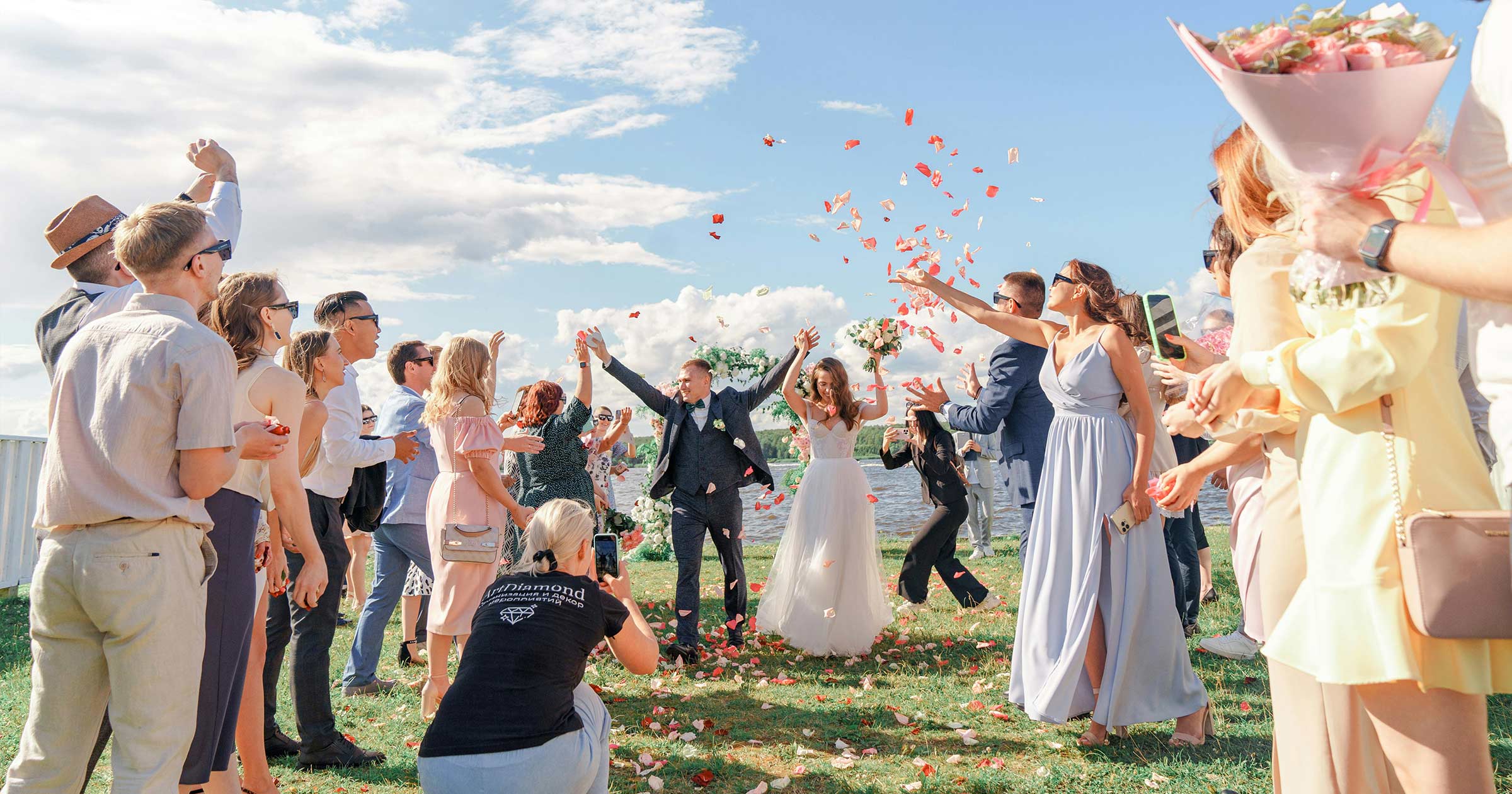
Cinematic wedding videography
Cinematic wedding videography borrows the language of cinema — shallow focus, deliberate movement, rich color, music-driven editing — to turn a wedding day into a film. Here's what defines the style, the tools behind it, and why the delivery should be as cinematic as the footage.
For videographers: Deliver cinematic films through branded 4K galleries from $24.99/month after a free 7-day Pro Trial
"Cinematic" is a style choice, not a quality tier. It's a set of creative decisions borrowed from narrative filmmaking — applied to a real day with real emotions. Here are the five pillars.
Fast prime lenses at f/1.2–1.8 isolate subjects from their background, creating the signature bokeh that separates cinematic footage from standard video. The eye goes where the focus goes — selective focus is selective storytelling.
Smooth, intentional camera movement on gimbals, sliders, and drones adds dimensionality and visual rhythm. It pulls the viewer into the scene rather than observing from a static tripod — a technique that activates the brain's vestibular processing and creates a measurable sense of presence.
Color grading transforms flat, log-profile footage into rich, emotionally evocative imagery. Warm tones, lifted shadows, film emulation LUTs — the grade is what gives a cinematic wedding film its visual signature and emotional temperature.
Cinematic editing is paced to music, not to chronology. Cuts land on beats. Moments are juxtaposed for emotional arc, not just timeline accuracy. The editor selects and sequences moments to build a narrative — like a trailer for the most important day of your life.
A cinematic film doesn't show everything — it shows the right things. The lingering glance, the father's hands adjusting a tie, the first laugh after the vows. Cinematic videography is the art of choosing which 5 minutes of a 14-hour day tell the complete emotional story.
Beyond capturing vows and speeches, cinematic films layer ambient sound, room tone, and a carefully selected soundtrack to create an immersive audio landscape. Sound design is half the emotional impact — a lesson borrowed directly from cinema.
Three distinct approaches to wedding videography. None is objectively better — each serves a different vision of how you want your day to be remembered.
| Aspect | Cinematic | Documentary | Traditional |
|---|---|---|---|
| Camera style | Shallow DOF, gimbal movement, drones, creative angles | Handheld or steady, observational, unobtrusive | Tripod-based, fixed angles, straightforward coverage |
| Editing approach | Music-driven, selective moments, narrative arc | Chronological, minimal cuts, events as they happened | Linear, ceremony-to-reception, minimal stylization |
| Music | Licensed tracks, soundtrack-driven pacing | Natural audio dominant, music supplementary | Background music, often generic |
| Typical length | 3–8 min highlight + optional ceremony edit | 20–45 min narrative with full speeches | 60–120 min full-day coverage |
| Mood | Romantic, dramatic, emotionally heightened | Authentic, intimate, naturalistic | Straightforward, complete, archival |
| Best for | Couples who want a film that feels like a movie | Couples who value authenticity and completeness | Couples who want full-day documentation |
Many modern wedding videographers blend these styles — a cinematic highlight reel paired with a documentary ceremony edit. The style labels are starting points, not rigid categories. Ask your videographer to show you a full wedding film (not just a teaser) to understand their natural approach before booking.
The equipment doesn't make the filmmaker — but certain tools unlock the visual language that defines cinematic wedding videography.
Full-frame sensors with large photosites for clean low-light and shallow DOF. The Sony FX3, Canon R5C, and Blackmagic Pocket 6K Pro are current workhorses — offering internal 10-bit log recording, ProRes or RAW, and compact form factors that work in tight wedding venues.
24mm f/1.4, 35mm f/1.4, 50mm f/1.2, 85mm f/1.4 — the core cinematic kit. Wide apertures create the shallow depth of field that defines the look. Primes force the videographer to move, which adds energy and intentionality to every frame.
3-axis gimbals (DJI RS series, Tilta Nucleus) produce the smooth tracking shots and reveals that give cinematic films their sense of motion. Drones add sweeping aerial perspectives of the venue and surroundings — particularly effective for outdoor and destination weddings.
Research at the Max Planck Institute for Biological Cybernetics has demonstrated that smooth, continuous camera movement — particularly dolly and gimbal-based tracking — engages the viewer's vestibular system, the sensory apparatus responsible for spatial orientation and balance. When the visual field moves coherently, as it does in a well-executed gimbal shot, the brain interprets the motion as self-movement through space, producing what researchers term the "presence illusion" — a measurable sense of being physically inside the scene rather than passively observing it (Riecke, B.E., Schulte-Pelkum, J., & Bülthoff, H.H., Perception, 2006). This neural mechanism explains why cinematic wedding films feel fundamentally more immersive than static tripod coverage: the viewer's brain processes the smooth motion as if they are moving through the wedding, not watching it on a screen.
If shallow DOF and gimbal movement are the body of cinematic videography, color grading is the soul. It's the single most transformative step in post-production.
Professional cinematic videographers shoot in log profiles (S-Log3, C-Log3, BRAW) — flat, desaturated footage designed to preserve maximum dynamic range. The grade transforms this raw canvas into the final emotional tone of the film. Warm skin tones, lifted shadows with a slight orange push, desaturated greens, filmic highlight rolloff — these decisions shape how the viewer feels about every scene.
Film emulation LUTs (look-up tables) provide starting points that mimic classic motion picture stocks — Kodak Portra warmth, Fuji Pro 400H pastels, or Kodak 5219 cinema richness. The best colorists use these as foundations, then refine per-scene to ensure consistency across the unpredictable lighting conditions of a wedding day: church interiors, golden hour portraits, reception dance-floor lighting.
The goal isn't to make footage look "filtered" — it's to create visual coherence and emotional direction. A well-graded cinematic wedding film has a unified palette that ties together 14 hours of mixed lighting into one continuous visual story. Read more about how color grading shapes emotional perception in wedding films.
Environmental psychology research published in the Journal of Consumer Psychology has established a robust link between color temperature and emotional response. Warm tones — the ambers, soft oranges, and golden hues that characterize cinematic wedding grading — consistently increase feelings of intimacy, comfort, and emotional closeness in viewers (Babin, B.J., Hardesty, D.M., & Suter, T.A., Journal of Business Research, 2003; Crowley, A.E., "The two-dimensional impact of color on shopping," Journal of Consumer Psychology, 1993). This aligns with broader findings in environmental psychology demonstrating that warm ambient light temperatures elevate perceived social warmth and interpersonal trust. For cinematic wedding videographers, this research validates what colorists have practiced intuitively: pushing skin tones toward warmth and grading shadows with amber undertones doesn't just look "prettier" — it measurably amplifies the viewer's emotional connection to the people on screen.
A cinematic wedding film without the right soundtrack is a silent movie. Music drives the edit, sets the emotional pace, and transforms footage into feeling.
In cinematic wedding videography, the music comes first. Most cinematic editors choose the track before they begin sequencing footage. The song's structure — intro, build, climax, resolution — becomes the narrative scaffold for the entire film. Cuts land on beats. Emotional peaks align with musical crescendos. The quiet verse carries the tender moments; the chorus carries the celebration.
This is the fundamental difference between cinematic and chronological editing. A documentary edit follows the timeline of the day. A cinematic edit follows the emotional arc of the music, pulling moments from any point in the day and placing them where they serve the story best. The getting-ready sequence might pair with a gentle piano intro. The vows might fall under a stripped vocal bridge. The reception entrance might explode over a percussive drop.
Licensed vs royalty-free matters. Premium licensing libraries (Musicbed, Artlist, Soundstripe) offer tracks composed specifically for narrative filmmaking — dynamic range, emotional progression, clean sections for voice-over. Generic royalty-free tracks often lack the structural complexity that cinematic editing requires. The right song selection is as much a creative decision as the camera angle or the color grade.
Beyond music, cinematic sound design layers ambient audio — room tone during the ceremony, natural laughter during toasts, wind at an outdoor venue — to create a sense of place that pure music alone cannot. The best cinematic wedding films make you hear the day as vividly as you see it. For more on how audio quality impacts the viewing experience, see our research on wedding video audio.
You spent 60+ hours crafting a film with cinema cameras, fast glass, and a professional color grade. Then you send a Dropbox link. The disconnect is jarring.
The cinematic wedding videography industry has a delivery problem. Videographers invest $15,000+ in camera bodies, lenses, gimbals, and drones. They spend weeks color grading, sound designing, and editing to music. The result is a genuinely cinematic piece of work — shot in 10-bit log, graded to filmic warmth, mixed with licensed music, and rendered at 4K.
Then they send a Google Drive link.
The couple — who has been waiting 10–16 weeks — opens a folder icon. They see a filename. They download a 25 GB file and wait 30 minutes. They double-click and hope their laptop's default media player handles 4K H.265. There is no branding, no streaming, no emotional build-up, no premiere moment. The delivery experience is completely disconnected from the production quality.
This is where most cinematic videographers leave value on the table. The delivery is the couple's first and most emotionally charged interaction with the finished film. It's also the moment with the highest referral potential — the instant they want to share it with everyone they know. A file-transfer link kills that momentum. A branded, instant-play gallery amplifies it.
A delivery platform built for videographers who treat their work as cinema — because the last frame of the experience should match the first.
Custom-branded private galleries with your logo, colors, and custom URL. The couple opens the link and sees their film presented by your studio — not someone else's platform. Every view is a brand impression.
Your 4K master streams instantly through a global CDN with byte-range delivery. No download required. No buffering. The couple presses play and the film begins — on any device, at full quality. The way cinema should be experienced.
Twelve gallery layouts — from the dark-mode immersive Cinematic layout to the editorial Estate — each designed for a different presentation style. Match the gallery to the mood of the film.
OurStoria is purpose-built for wedding videographers who treat their work as cinema. Start with a free 7-day Pro Trial (no card), then Pro at $24.99/month with 450 GB of video storage, 40 projects, and full branding. Scale to Studio ($59.99/month) for 1.5 TB and 120 projects as your production house grows.
See full pricing details, explore our complete wedding video guide, or start your free 7-day Pro Trial and deliver your next cinematic film through a gallery that matches the quality of your craft.
A cinematic wedding video is defined by shallow depth of field, gimbal or stabilizer-based camera movement, professional color grading, music-driven narrative editing, and selective storytelling. It draws from film language to create an emotionally immersive experience rather than simply documenting events.
Cinematic wedding videography typically ranges from $3,000 to $10,000+, depending on experience, location, and deliverables. The premium reflects cinema-grade gear, extended color grading and sound design time, and the creative expertise to produce film-quality results. See our wedding videography services guide for detailed tier breakdowns.
Cinematic videography prioritizes visual aesthetics and mood — shallow DOF, color grading, licensed music. Documentary captures events as they unfold with minimal intervention, including full speeches and natural audio. Many modern videographers blend both: a cinematic highlight paired with a documentary ceremony edit.
Typical setups include full-frame cinema cameras (Sony FX3, Canon R5C), fast prime lenses (24mm–85mm at f/1.2–1.8), 3-axis gimbals, drones for aerials, wireless lapel microphones, and portable audio recorders. The investment in glass and stabilization is what enables the cinematic visual language.
The best cinematic films are delivered through branded private galleries with instant 4K streaming and original-quality downloads — matching production quality with a premium viewing experience. Platforms like OurStoria offer 12 gallery layouts, password protection, and CDN-powered playback for a delivery that feels like a premiere.
Most cinematic videographers share highlight reels on their portfolio sites. For a curated selection of films that showcase the intersection of cinema and weddings, see our guide to the best films about weddings — from Hollywood to independent cinema — as inspiration for what cinematic wedding videography aspires to.
Branded 4K galleries, original-quality downloads, 12 presentation layouts, and safe archival — from $24.99/month after a free 7-day Pro Trial. The delivery platform built for videographers who think in frames, not files.