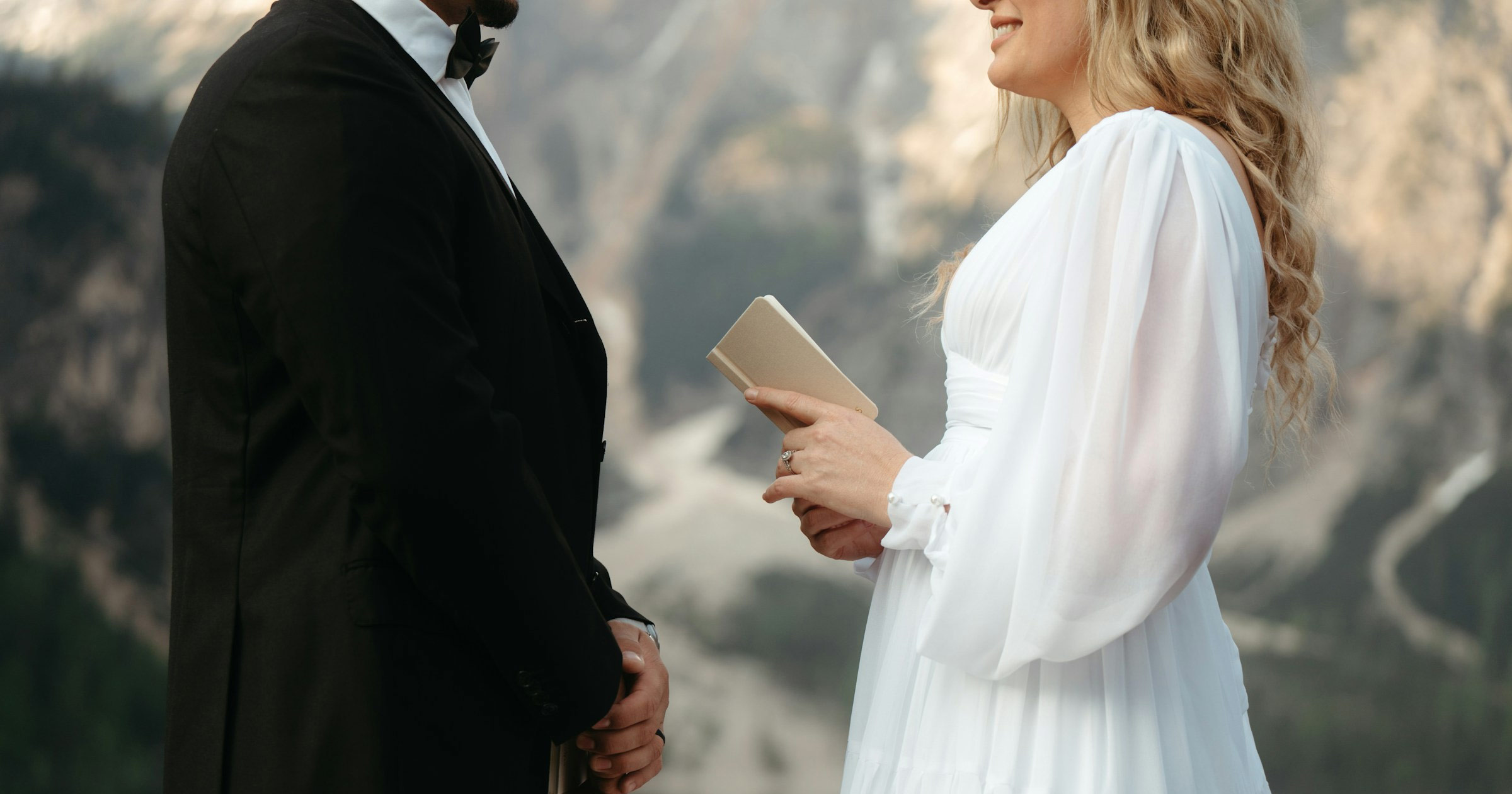
"To have and to hold, from this day forward, for better, for worse, for richer, for poorer, in sickness and in health…" Almost everyone who has ever watched a Hollywood wedding knows these words. Your parents, grandparents, and most likely their parents spoke them too.
Surprisingly, these words are almost five hundred years old. They were spoken almost exactly the same way in mid-16th-century England. And many phrases that seem simply beautiful to us have their own history: why it's "till death us do part" and not "until death parts us," what "plight thee my troth" means, and why the word "obey" gradually disappeared from brides' vows.
Many couples today write their own vows. But traditional ones are still there—and they have a power that even the most beautiful personal text lacks: you're speaking the same words as generations before you. This guide covers the classic vows and their history, the modern standard version, short repeat-after-me vows, vows from various traditions, how to put your own spin on traditional vows, and how to deliver them so they're heard—both by guests and in a wedding film.
Wedding Vows Traditional: The Classic Text
The most famous traditional vows in English come from the Book of Common Prayer, the prayer book of the Church of England. Here's the groom's vow from the 1662 edition:
I, ___, take thee, ___, to my wedded wife, to have and to hold from this day forward, for better for worse, for richer for poorer, in sickness and in health, to love and to cherish, till death us do part, according to God's holy ordinance; and thereto I plight thee my troth.
In this text, the bride said almost the same thing, with two differences: instead of "to love and to cherish," she said "to love, cherish, and to obey," and at the end not "plight" but "give thee my troth."
Where Did These Words Come From?
These vows first appeared in English in 1549—in the first Book of Common Prayer, the main author of which was Archbishop of Canterbury Thomas Cranmer. Prior to this, weddings in England were conducted according to Latin rites—the so-called Sarum and York rites—but even in these rites, the couple recited the vows in their native language. Cranmer took these medieval words and transformed them into a text that has survived almost unchanged to this day.
A few interesting details:
- "Till death us depart." That's exactly what the 1549 text said. The word "depart" then meant "to separate." Over time, its meaning changed—"depart" came to mean "to leave"—and in the 1662 edition, the phrase was changed to "till death us do part." This is how the formula we know today emerged.
- "Plight thee my troth." "Troth" is an old form of the word "truth," meaning "loyalty, one's word of honor." "Plight" means "to pledge." Literally, "I pledge my fidelity to you."
- "Bonere and buxum in bedde and at borde." This is what the bride promised in the medieval Sarum rite: to be "bonere and buxum" in bed and at table. The word "buxom" back then had nothing to do with figure: it comes from the root "to bend" and meant "obedient, docile." Cranmer did not include this promise in his text.
Why "Obey" Disappeared from the Vows
The bride's promise "to obey" remained in Anglican texts for centuries. But in the 20th century, more and more couples omitted it. The most famous such wedding was that of Princess Diana and Prince Charles in 1981: Diana did not promise to obey her husband; instead, she promised to "love, comfort, honour and keep" him. The New York Times ran the headline "LADY DIANA WON'T VOW TO OBEY CHARLES." Thirty years later, at her wedding to Prince William, Kate Middleton spoke the same words his mother had. Interestingly, not all royal brides followed Diana's example: Sarah Ferguson in 1986 and Sophie Rhys-Jones in 1999 did use the word "obey."
Today, most church and civil ceremonies in the United States do not include "obey" in the vows, and the vows of the bride and groom are identical.
Two more famous phrases from the same text
The same marriage service gave us two more phrases everyone knows:
- "Speak now or forever hold your peace." In the original, the minister asked whether anyone knew a reason the couple couldn't lawfully marry and added: "let him now speak, or else hereafter for ever hold his peace." In movies, someone always bursts into the church at this point. In real life, almost never.
- "With this ring I thee wed." The words the groom said as he placed the ring on the bride's finger.
Standard Marriage Vows: The Modern Version
This is how the traditional vows sound today at most church ceremonies and many civil ceremonies in the United States—"thee" has been replaced with "you," and the vows of the bride and groom have become identical:
I, ___, take you, ___, to be my wife/husband, to have and to hold from this day forward, for better, for worse, for richer, for poorer, in sickness and in health, to love and to cherish, till death do us part.
Note: in the modern version, it's more common to say "till death do us part" rather than "us do part"—it sounds more natural to today's ears. Both versions are correct; choose the one that speaks best to you.
Basic Wedding Vows: Short Versions
Many couples prefer the short version, which is recited by repeating short phrases after the officiant:
I take you to be my wife/husband. I promise to be true to you in good times and in bad, in sickness and in health. I will love you and honor you all the days of my life.
An even shorter version for a civil ceremony or a very intimate wedding:
I, ___, take you, ___, to be my partner in life. I promise to love you, to support you, and to stand by you, for as long as we both shall live.
Common Wedding Vows: What Each Promise Means
Traditional vows aren't just pretty words, but a list of specific promises. Here's what each one means:
| Phrase | What the couple promises |
|---|---|
| to have and to hold | To belong to each other, to be close, and to support each other |
| from this day forward | From this day forward, without looking back |
| for better, for worse | In good times and in hard times |
| for richer, for poorer | Regardless of money |
| in sickness and in health | To care for each other when things are physically difficult |
| to love and to cherish | To love and treasure each other |
| till death do us part | Forever |
Couples who write their own vows often start with this table: they take one traditional promise and expand on it in their own words. "For richer, for poorer" becomes "and when we eat ramen in a student apartment, and when we finally buy a house."
Traditional Marriage Vows in Different Faiths
Not all traditions use the same vows as in the Anglican prayer book. Here's how this part is structured in different ceremonies:
Catholic ceremony. The couple gives their consent in the form prescribed by the Church. In essence, it's a promise to be faithful "for better or for worse, in sickness or in health," to love and honor each other throughout life. The priest gives the exact wording, and in the Catholic Church, the formula of consent is not altered—the couple can share personal words at another point in the day.
Protestant ceremonies—Methodists, Baptists, Lutherans, Presbyterians, and others—most often use a text close to the standard version above. Many churches allow the couple to add their own words—check with the pastor.
Jewish Ceremony. A traditional Jewish wedding does not have vows in the traditional sense. The central moment is when the groom places a ring on the bride's finger and recites the ancient Hebrew formula "Harei at mekudeshet li…"—"With this ring you are consecrated to me according to the law of Moses and Israel." The spouses' commitments are recorded in the marriage contract, the ketubah, which is signed by witnesses. In many modern ceremonies, both partners recite this formula, and the couple also adds personal vows.
Hindu ceremony. Instead of spoken vows, there's the saptapadi, "seven steps" around the sacred fire. Each step is a separate promise: for food and abundance, for strength, for prosperity, for happiness, for children, for a long life together, and for true friendship.
A Quaker ceremony has no officiant: the couple stands in the middle of the congregation and recites the vows themselves.
In the presence of God and these our friends, I take thee, ___, to be my wife/husband, promising with Divine assistance to be unto thee a loving and faithful husband/wife so long as we both shall live.
Civil ceremony. Typically a short version of the standard vows, omitting the religious words. The officiant may suggest their own version or accept yours; the law usually doesn't require any specific wording—what matters is that both partners clearly express their consent.
Classic Wedding Vows: How to Make Them Personal
Traditional and personal vows aren't an either-or choice. Here are a few ways to combine them:
- Add one sentence of your own after the traditional vows. For example: "…till death do us part. And I promise to always save you the last bite of dessert." One lively phrase after the solemn vows—and the room smiles.
- Recite the traditional vows out loud together, and each person in their own words immediately after. This way, you have both the weight of tradition and your own voice.
- Read the personal vows to each other privately—during the first look or in letters that morning—and say the traditional vows at the altar. Many couples find this easier: what's personal remains personal.
- Include the words your parents spoke in the ceremony. If you have a recording or the text of their wedding vows, repeating them is a beautiful way to honor family.
- Check with your officiant what can be changed. In some churches, the text of the vows is fixed, but in a civil ceremony almost anything is allowed.
Vows for Marriage Ceremony: Practical Tips
Repeating after the officiant is easier than memorizing. The officiant says a short phrase, and you repeat it. Most couples do this, and it's perfectly normal: no one expects you to memorize it. Ask the officiant to break the vows into short chunks of three to five words.
If you're reading it yourself, use a card, not a phone. Large font, thick paper. Phones go dark at the worst possible moment, and the screen obscures your face in photos and videos.
Speak slowly and a little louder than you think is necessary. Nervousness causes people to speed up and speak more quietly. Guests in the back rows should hear every word.
Think about the sound in advance. Vows are the most important sound in a wedding film, and also the quietest: two people speak to each other, not into a microphone. Without a lav mic, they're almost inaudible. Ask the videographer to put a lav mic on the groom or the officiant ahead of time—it takes 30 seconds before the ceremony and saves the most important words of the day. For information on recording wedding sound, see our wedding shot list, in the "Audio to Capture" section.
Rehearse at the rehearsal. At the ceremony rehearsal the day before the wedding, say your vows at least once out loud, standing in your places. This takes half the stress out of the process.
For Videographers: The Words Couples Come Back To
Vows are the moment in a wedding film that couples return to most often. On an anniversary, on a difficult day, twenty years later, showing the film to children. And yet, they're the easiest to miss: quiet voices, the wind outside, the rustle of dresses, guests coughing in the front row.
- Two lav mics. One on the groom and one on the officiant—so you hear both the vows and what the officiant says to the couple. If the officiant uses an amplified mic, record the board feed as well.
- A backup recorder at the arch or altar—in case a lav fails.
- Windscreens on the lavs for outdoor ceremonies.
- Don't cut the vows down to three lines in the highlight. The highlight might take a couple of lines, but the couple will want to watch the entire ceremony and vows again.
So the couple can get back to their vows in a second, rather than rewinding a forty-minute film, break the full film into chapters: "Getting Ready," "Ceremony," "Vows," "Toasts," and "Dancing." In OurStoria client galleries, chapters can be imported directly from DaVinci Resolve or Premiere Pro markers (here's how: wedding film chapters), and the couple can access the exact moment they said "I do" with one click. Start a 7-day Free Pro Trial—no credit card required.
Words That Have Outlived Everyone Who Said Them
Almost five hundred years ago, someone first uttered the words "for better for worse, for richer for poorer" in an English church. Since then, these words have been spoken by millions of people. Many of them are long gone. But the words remain—and on your wedding day, you will add another pair of voices to this chain.
That's the power of traditional vows. You're promising each other not something new and unusual, but the same thing everyone who loved before you has promised. And that promise still holds true.
Related articles:
- Sample Rehearsal Dinner Speeches: Templates & Examples for Every Speaker (2026)
- Mother of the Groom Speech: 8 Examples, Template & Tips (2026)
- Father of the Groom Speech: 8 Examples, Template & Tips (2026)
- Wedding Film Chapters: How to Add Them from DaVinci Resolve and Premiere Pro
- The Sound of a Wedding: How Audio Quality Determines Whether Couples Treasure or Forget Their Film
- Wedding Ring Photos: 25 Ideas and How to Shoot Them