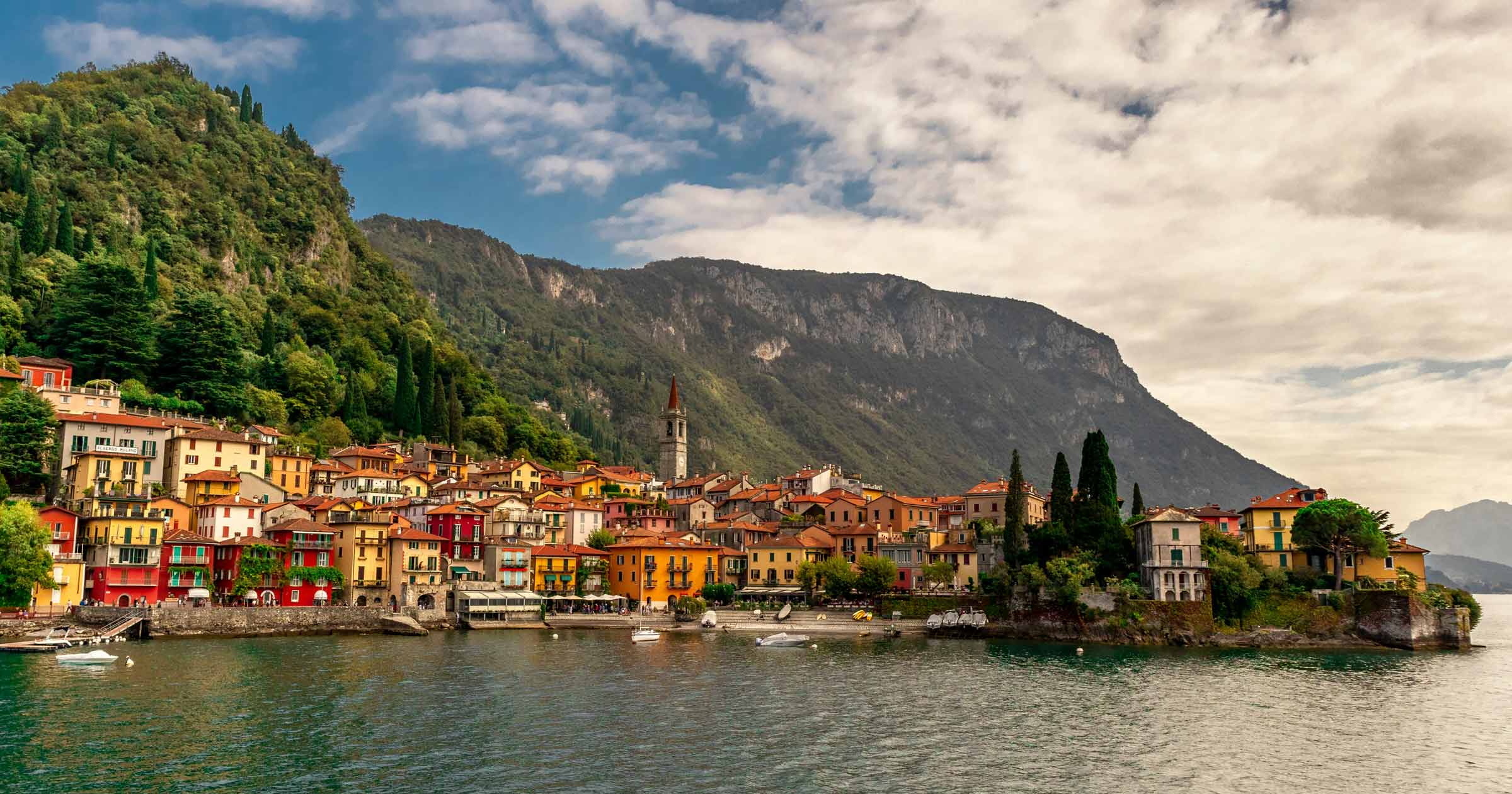
Italy has no single wedding filming permit: the villa, the church and the town each decide what you can film. Every wedding drone must be registered on D-Flight and flown with an EASA certificate; UK, US and Australian licenses aren't valid, and flying over a crowd of guests is not allowed.
Lake Como has an airfield. Right on the water.
The seaplanes of the local flying club, which has been operating here since the 1930s, take off and land in the first basin of the lake, right next to the town of Como. In the fall of 2024, a 56-year-old tourist rented a boat and calmly crossed this runway—just as a plane was about to land. The boat was stopped by the water police. The man explained that he had no idea about the runway or the restrictions. The fine was up to 6,000 euros.
This isn't a horror story. It's a good illustration of how Italy works for a visiting videographer: beauty lies on the surface, and the rules are under the water.
Como and Tuscany are the two main Italian wedding destinations for couples from the US, UK, and Australia. And they are two different worlds. On Como, everything is decided by the water, the boats, the villas with gardens, and the mountains that steal the sun prematurely. Tuscany is cars and ZTLs, heat, stone towns, churches with their own rules, and long sunsets in the hills.
This guide is for a videographer flying to Italy for a wedding: what the Italian aviation authority ENAC and EU regulations say about drones (with a separate section for pilots from the US, UK, and Australia), what are the rules for villas and gardens on Como, how much luggage is allowed on a speedboat, how to behave in Siena Cathedral, why you shouldn't drive into Florence with your cases, what Italian law says about the image of guests—and how to deliver a film to a family living in three countries. We run OurStoria—a platform for delivering films to clients, and this last section is about that. Other countries and cities can be found in our guide directory.
Disclaimer. We are not lawyers or flight instructors. All information about laws, drones, and site regulations is taken from government agencies' websites and the sites themselves as of November 2026. Rules are subject to change—check them before your trip.
Lake Como vs Tuscany
Couples choose between them based on their mood. It's more useful for a videographer to compare them based on what interferes with filming.
| Lake Como | Tuscany | |
|---|---|---|
| How do you and your guests get there? | Boats, ferries, water taxis, narrow roads along the shore | Car, transfer, walking through the old town |
| Main location | Villa with a garden by the water | Villa or agritourism in the hills, church in the city |
| Who decides whether filming is allowed? | Villa owner (often a foundation or province), municipality — on the streets and embankments | Villa owner, parish or cathedral, municipality — in the squares |
| Drone | Airspace over the lake, seaplanes near Como, villa regulations | Historic centers, cathedral regulations, d-flight maps |
| Light | Mountains block the sun before sunset, water reflects the sky | Open hills, long sunsets, harsh afternoon sun |
| The main danger of the day | Boat schedules and afternoon wind | Heat in July-August and ZTLs |
Hence the main rule of this guide: break your day down by location and figure out who's in charge of each one. A villa garden, a promenade, a church, the sky above, and the water below—these are five different permits, and sometimes five different "nos."
Italy Drone Laws
Italy is an EU country, so drones here operate under the general European regulations of EASA (the European Aviation Safety Agency). These are enforced by the national authority, ENAC (Ente Nazionale per l'Aviazione Civile). Registration, zone maps, and operator codes are available through its d-flight portal.
What ENAC requires before any flight. The list on the authority's website is short and includes no exceptions for weddings: - the pilot must have the appropriate qualifications; - The operator must register on the d-flight portal; - Obtain a European operator code in the form of a QR code and attach it to each drone; - purchase third-party liability insurance; - check the rules of the open category; - check the d-flight maps to see if the location is legal to fly.
Pay attention to insurance. In many EU countries, it's only mandatory for heavier drones. There's no weight limit on the ENAC page: the operator must insure their drones, period. Your home insurance policy may not cover flights in Italy—it's worth checking this before departure, not on your villa terrace.
Registration—what it depends on. Only toys and drones under 250 grams without a camera are exempt. Every wedding drone has a camera, so registration is required even for the smallest ones.
Where to register if you're not from the EU. Here's the main difference for a videographer from the US, UK, or Australia:
| Where are you from | What to do |
|---|---|
| From an EU or EASA country (Ireland, Germany, France, etc.) | Your home registration is also valid in Italy—one registration for all EASA countries |
| From the US, Australia, Canada | ENAC: Non-EU operators register in the first EASA country they intend to fly in. If that's Italy, then on d-flight |
| From the UK | After Brexit, the UK is no longer a member of EASA. British CAA registration is not valid in Italy – the rules are the same as for the US |
Pilot Certificate. For drones over 250 grams in the open category, a pilot certificate from an agency of an EASA country is required. A US Part 107, UK Flyer ID, or Australian CASA license are not acceptable. The basic Italian A1/A3 certificate is an ENAC online exam: 40 questions in 60 minutes, a score of 60 out of 80, a fee of €31, four attempts, and a certificate valid for five years. The catch is in one line: adult candidates enter using an SPID – an Italian digital identity, which tourists do not have. The page does not explain how non-residents can take the exam without an SPID. Ask ENAC directly: [email protected].
Where and how high. The Open category according to EASA rules is flights below 120 meters above ground and has three subcategories:
| Subcategory | What's permitted | What does this mean at a wedding |
|---|---|---|
| A1 | Flying over people, but not over crowds | Over a couple on an empty pier – yes, over 120 guests on a terrace – no |
| A2 | Close to people: 30 meters horizontally from bystanders, 5 meters in low-speed mode | A separate A2 certificate and a drone of the appropriate class are required |
| A3 | Far from people: 150 meters from bystanders and from residential and urban areas | Lakes and hills away from villages, but not over a villa with guests |
ENAC specifically reiterates: no flights over crowds. A wedding ceremony on a villa terrace is very similar to what the regulations call an "assembly of people." Therefore, drone footage in Italy is almost always before or after the ceremony: a couple on an empty dock, a boat on the water, a villa from above while guests are still at the hotel.
Zones. D-Flight maps show where flying is prohibited or only permitted with restrictions: airports, military installations, and temporary restrictions. Access to the maps is free after registering on the portal. No-Fly zones, as d-flight clearly states, are completely closed to drones, and authorities can impose them temporarily. Therefore, it's best to open the map the evening before the wedding, not just while planning.
If you're accustomed to American regulations, we have an article about drones at weddings in the US. It's useful as an example of how the FAA operates, but it doesn't apply to Italy.
Can You Fly a Drone at Lake Como?
The lake seems like the perfect place for a drone: water, mountains, and villas. But Como has three special features.
Seaplanes. Remember the runway in the first basin? Aeroclub planes land low over the water just outside the city. Check this area yourself before flying near Como, Cernobbio, and neighboring towns on the d-flight map. If your wedding is on the southern part of the lake, this should be at the top of your list.
Villas decide for themselves. A villa's garden is private or museum property, and ENAC permission does not imply the owner's permission. Villa Monastero in Varenna, for example, belongs to the province of Lecco, and the villa's rules for photo shoots state that drone flights must be coordinated with the province: a self-declaration of d-flight registration, insurance, and, for drones over 250 grams, a pilot's certificate is required. The current rules are on the villa's website. Villa del Balbianello doesn't mention drones on its official website, so please inquire in writing.
Guests on boats. If a couple wants an aerial shot of the wedding boat leaving the pier with guests on board and on the pier, that's another crowd. Film the boat departing with the couple and crew, and the guests from the ground.
The most common option for visitors is a local pilot with Italian registration, insurance, and knowledge of which villas are legal to fly over. Your task is the shot list and time; theirs is a legal flight.
Can You Fly a Drone in Florence?
The short answer: over the city center – almost certainly not. The historic center is densely built up, crowds move through it all day, and Peretola Airport is located on the northwestern outskirts of the city. All of this is the reason for the zones on the d-flight map and the "no crowds" rule in its purest form. For a wedding in Florence, the drone is usually relocated outside the city: to a villa in the hills of Fiesole or Chianti, where the nearest village is far away.
And in church, drones are completely out of the question. The rules of Siena Cathedral, discussed below, state this in one sentence: drones are never allowed during the liturgy.
Lake Como Wedding Photo Permits
There's no single city office on Como that issues "wedding photography permits." However, each famous villa has its own rules, and the most famous ones are posted directly on their websites.
Villa del Balbianello. This villa on the cape near Lenno belongs to the FAI, the Italian National Heritage Trust. It hosts civil and symbolic ceremonies and receptions for up to 130 guests. The main ceremony venue is the Durini Loggia: 80-100 guests, with no more than 60 seated. A separate note for you: photography, "for example, weddings," is subject to a fee and must be booked by email; the address is listed on the villa rental page. If you're photographing a wedding at the villa, everything is arranged through the couple and the venue. If the couple wishes to come for a portrait walk on a different day, a separate reservation is required.
Villa Monastero. A former monastery with a botanical garden in Varenna. The rules for private photo sessions are specific: - Book at least 14 days in advance, payment must be made within 7 days, otherwise the booking is cancelled; - The fee includes entry for two people and a maximum of four team members—photographers, videographers, a wedding planner, and a makeup artist are specifically mentioned in the list of examples; - Other guests purchase regular garden tickets; - No decorations, flower arrangements, or music; - The shoot is "exclusively for private and non-commercial use."
It's worth rereading that last point. The villa has a separate rate for commercial shoots: book 20 days in advance and include a team of up to 13 people. If you plan to include garden shots in your studio's promotional video, ask in writing whether a couple's private booking is suitable.
Calculate your team size in advance. Four people is less than you might think. The photographer, their assistant, you, and the second cameraman—and there's no room left for the planner. Decide before the trip who goes to the garden for portraits and who waits by the pier.
Streets and embankments. In the lakeside villages, the municipality decides. Varenna, for example, introduced new regulations for tourists in the summer of 2026: according to Sky TG24, tour groups are limited to 25 people, guides are banned from using megaphones, and strolling around the village in a swimsuit or shirtless carries a fine of up to 200 euros. The regulations don't mention weddings, but if the couple plans to have all the guests stroll through the narrow streets after the ceremony, it's a good idea to check with the municipality. Placing anything larger than a tripod on the embankment—lights, stands, or decorations—is considered an occupation of public space (occupazione di suolo pubblico), and permission for this is issued by the municipality. Ask the planner who handles this.
Getting Around Lake Como by Boat
On Como, half of the wedding destinations are reached by boat. And the water has its own baggage rules.
Speedboats are not for luggage. Public transportation on the lake is provided by the state-owned company Navigazione Laghi. Its baggage rules include a clause worth memorizing: hydrofoils (aliscafi) and catamarans do not accept luggage with a longer side than 60 centimeters. One piece up to 60 cm, 40 liters, and 20 kg is carried free of charge. Each additional piece is subject to a fee.
Slow ferries are more tolerant. On regular boats and ferries, you can carry up to 60 kg of carry-on baggage per person, with each piece no longer than 80 cm and no larger than 40 liters. Anything larger is carried on board at the captain's discretion, provided it doesn't interfere. An extra seat costs €4.20, and special baggage costs €8.40.
Calculated on a napkin (our estimate). Wes from Charleston is shooting Abby and Owen's wedding at a villa near Tremezzo. He has a backpack with cameras, a case with a 65cm gimbal, a bag with lights, and an 85cm tripod in a case. The gimbal and tripod are too long to fit on the hydrofoils. On a slow ferry, the case will fit, but a tripod longer than 80cm requires the captain's permission. So, a fast boat from Bellagio is not an option for Wes, and a slow ferry is a risk. The only other option is a water taxi or a private boat, where luggage allowance can be arranged in advance.
Water taxis and private boats. This is the usual way to get to Villa del Balbianello: FAI reports that a paid water taxi departs from Lido di Lenno (not the FAI's service, book in advance), and any private boat can also dock. Walking from Lenno is about a kilometer uphill, partly on gravel, about 25 minutes, and, as the FAI itself warns, the road is not suitable for strollers or people with limited mobility. With two cases, that's 25 minutes, which you won't get back. Navigazione Laghi itself charters boats for private transfers and ceremonies—the price is calculated based on the route, time, and vessel.
What to shoot from a boat. A wedding transfer on the water is one of the best shots of Como, but the sound on the boat is almost always lost: the engine, the water, the wind. Locals know that the wind on the lake follows a schedule: in the morning, the tivano, a northerly wind, blows from the mountains, and around midday it gives way to the breva, a southerly wind from the plains. After lunch, vows on an open terrace are recorded on a lav mic in the wind. Wind protection and a backup recorder are essential for each speaker—more on that in our guide to recording audio at a wedding.
Timeline (our estimate for June, villa on the west shore): - 3:30 PM — Guests on the pier, boats approaching the villa; - 4:30 PM — Ceremony, the sun is still high; - 5:15 PM — Aperitif on the terrace, group shots; - 7:30 PM — the couple in the garden and on the pier: the sun has already set behind the mountains, the light is soft and even; - 8:15–9:00 PM — the sky over the water turns pink, the mountains on the eastern shore are still illuminated; - 9:15 PM — sunset behind the ridge, candlelit dinner.
The reason for portraits taken so early is in the section on light.
Filming a Wedding in a Tuscan Church
If a couple is getting married in Tuscany, you're almost certainly photographing a Catholic mass. And churches have written rules for photographers.
Siena Cathedral. The Archdiocese of Siena and the Opera della Metropolitana, the organization that manages the cathedral, published rules of conduct for photographers and videographers at ceremonies in the cathedral in August 2023. They begin with a surprise: any filming in the cathedral requires an Opera professional pass. It's issued to those who sign the rules for three years, and only after you present an insurance policy covering damage to people and property. A list of signatories is kept in the Opera secretariat.
Next, there are rules that change your arrangement: - inspect the cathedral and the ceremony layout in advance, arrive early and introduce yourself to the priest to arrange for special moments to be photographed; - do not cross the central nave in front of people; walk around behind them; - never call guests over to pose for the camera; - Flash and additional lighting - only with prior permission from the Opera; - The presbytery - the area near the altar - is reserved for the priest; you may enter it only for a short shot that cannot be taken from anywhere else; - Bags and trunks - in the sacristy or a side area, not in the pews; - During the liturgy, the homily, and the Eucharistic prayer, everyone stands still - including you; - No tripods, lamps, or drones without special permission.
Arezzo and Cortona. The Diocese of Arezzo-Cortona-Sansepolcro has gone further. According to La Nazione, since 2008, it has had accreditation for photographers and videographers: training, certification, and a rule that only accredited specialists are allowed into the liturgy, and priests are advised not to allow anyone without certification. The list is published on the diocesan website. If the couple is getting married in Cortona—one of the most popular Tuscan towns among Americans—find out this information months in advance, not weeks.
What does this mean for filming? A long-focus lens from the aisle isn't a luxury here, but the only legitimate angle for many moments. Wireless lavalier microphones on the groom and the priest (with his consent) and a recorder at the pulpit make up for the positions that are off-limits. We discussed how to assemble such a set in our article on wedding lenses.
The Mass is long—so is the film. A wedding with a full Mass often lasts about an hour (our estimate based on the typical order of service). Hazel from Sydney and Marco from Florence were married in Siena, and both families want a full recording of the ceremony—but in different ways. Hazel's mother is looking for the vows. Nonno Franco is looking for the moment when the choir began singing what they sang at his own wedding. Without navigation, each of them would spend an hour scrubbing through the timeline on their phone. Divide the ceremony into chapters: entrance, readings, vows, rings, communion, exit. In OurStoria client galleries, chapters can be imported directly from Premiere Pro or DaVinci Resolve markers, or you can set them manually—we described how this works in the article about wedding film chapters.
Florence ZTL
Florence doesn't like cars. Almost the entire historic center is a ZTL, or limited traffic zone. Cameras are installed at the entrances that read license plates, and unauthorized entry results in a fine. If you rent a car, they can catch up with you through the rental company months after the wedding.
Why this matters for videographers. A tourist will leave the car in the parking lot and walk. You don't: you have luggage, lights, a tripod, and a deadline. The logical desire to "drive up to the bride's hotel, unload, and leave" is exactly what gets visitors caught.
How to enter legally. Entry permits are issued by Servizi alla Strada on behalf of the City of Florence (Comune di Firenze). Visitors have a day pass: - two types: "passage only" or "passage and parking" in spaces reserved for residents; - valid from midnight to midnight on the selected day (if purchased on the same day, from the moment of payment); - no more than 10 days per month and 60 days per year per vehicle; - only for vehicles up to 3.5 tons; - purchased online, printed, and placed behind the windshield where it is visible; - cannot be cancelled or refunded.
ZTL operating hours vary by sector and season, and in summer there is also a night ZTL. Current rules and prices are available on the Serviziallastrada website. Signs at the entrance indicate whether the zone is currently active, and their word is more important than any online sign.
Other Tuscan cities. Siena, San Gimignano, Cortona, and Montepulciano have their own ZTLs and regulations. The general advice is: check with the planner how suppliers approach the hotel or church, and ask for your license plate number to be added in advance if the venue does so.
Photographing Guests in Italy: Image Rights and GDPR
Italy has a long and strict tradition of image rights. A US videographer should understand this before posting a teaser.
What the law says. The Civil Code (Article 10) allows a person to seek legal redress for damages if their image has been displayed or published in violation of legally permitted circumstances or in a manner detrimental to their dignity and reputation. The Copyright Act of 1941 (Article 96) states it more simply: a person's portrait may not be exhibited, reproduced, or sold without their consent. Exceptions (Article 97) include fame, public office, justice, science, and events or ceremonies of public interest or held publicly. But even then, it is prohibited if the broadcast harms a person's honor, reputation, or "decoro"—dignity.
A Fan's Story. The subtlety of Italian courts' understanding of the word "public" is well illustrated by an old case, still cited by lawyers. Television filmed a fan at the stadium: he suffered so eloquently for his team that his face became a symbol of the "tormented tifoso," and the image was used as the opening credits of the program. A match is a public event, and filming the stands is permitted. But the Court of Cassation ruled that the exception for a public event does not justify a use that is no longer related to the event itself and serves another purpose.
Translate this to a wedding. The bride's aunt, who cries during the vows, is part of the story of the day in a family film. That same woman in your studio's Instagram promo video is a different target. And a wedding in a private villa isn't exactly a "public event."
European Data Protection Act. The GDPR, the European Personal Data Protection Regulation, applies over and above Italian law, and videos with recognizable individuals constitute personal data. The Italian data protection authority, Garante Privacy, takes a particularly strict view of children. In April 2026, it reviewed a father's complaint that the children's mother had posted photos of their children on Facebook without his consent. Garante ruled the publication illegal, even though the photos were harmless and seen by few people: for children under 14, both parents must provide consent. This is a family dispute, not a photographer's matter, but it sets the standard: a girl with flowers and a boy with rings in your portfolio is a question for which it's best to have a written response from both parents.
What to do in practice: - Agreement with the couple. A separate point: can the photos be used in portfolios and advertising, and whose images exactly—the couple, guests, or children? - Warning to guests. A line in the invitation or on the wedding website: "There will be photography and video at the wedding." - For advertising purposes only - the couple or those who have consented. Guests remain in the film for the family. - Portfolio: check the venue's rules too. Remember the "private use only" clause in the Villa Monastero rules.
The film does not have to be public. Many people are used to sharing a wedding with a YouTube link or Vimeo link—and a year later, a video with all the guests' faces is circulating in other people's chats. It's safer when the film with guests is kept in a private gallery for the family. In OurStoria's client galleries, viewers can open the film via a link without registering; the gallery can be password-protected, and you edit the teaser for social media separately—with only those who have consented.
Getting Married in Italy: Legal Requirements
For a videographer, this isn't a legal question, but a screenplay one: will the film feature a real marriage registration and who handles it?
Foreigners can marry in Italy, but they need a certificate of no impediment. In Italian, it's called a Nulla Osta; the British government explicitly states that it's the same as a certificate of no impediment and explains how to obtain one through the embassy in Rome. Americans should check the procedure on the website of the US Embassy in Italy; Australians should contact their consulate. The paperwork is prepared in advance, and it's handled by the couple and the planner, not you.
What does this mean for filming: - A civil ceremony is legal. It is conducted by a municipal official, has a mandatory script, and often includes a translator. Ask in advance where you can stand and whether a lav mic can be used on the officiant. - A symbolic ceremony is based on the couple's script. Many couples register at home, while in Italy, they hold the ceremony for guests. Villa del Balbianello, for example, hosts both civil and symbolic ceremonies. Vows in a symbolic ceremony are almost always written by the couple themselves, meaning the sound must be impeccable. - Specify the dates in the contract. If the couple is registering in Boston a week before Como, it's a separate shoot, separate expenses, and possibly a great way to start a film.
Best Time of Year for a Wedding in Italy
Tuscany in summer is scorching hot. Every summer, the Italian Ministry of Health publishes heat wave bulletins for 27 cities, with alert levels up to level 3. In 2026, Florence was repeatedly placed at level 3: according to Italian agencies, it was the first to enter the "red" zone in July, and temperatures were expected to reach around 37°C (98°F) on August 10-12. The current bulletin is available on the Ministry website.
For a videographer, heat isn't just about guests melting in the sun: - the camera overheats – especially when filming in 4K without a fan and in a black case in direct sunlight; keep a spare camera in the shade and in a cooler bag, but not in the cold (otherwise condensation will form); - batteries and cards – in the shade and not in the car; - a 4:00 PM ceremony in the open sun means harsh light, squinting faces, and sweat on the groom's forehead; if the couple can move it up an hour, do so; - yourself - water, hat, breaks. Eight hours in the heat without water is the main risk of the day.
Como - mountains and water. The lake lies between mountains, and this changes the light more than the season. We calculated the sunset times for Como and Florence using the standard sun position formula:
| Como | Florence | |
|---|---|---|
| Sunset June 21 | ~9:18 PM | ~9:01 PM |
| Sunset September 15 | ~7:36 PM | ~7:27 PM |
| Sunset October 15 | ~6:39 PM | ~6:33 PM |
| Sun from 6° above the horizon to 4° below it ("golden hour") | 57–69 minutes | 55–66 minutes |
| Sunset to end of civil twilight | 30–38 minutes | 28–36 minutes |
This is an astronomical sunset—over a flat horizon. In Tuscany, with its open hills, you'll actually see it. Not on Como. The villages on the west coast—Tremezzo, Lenno, Cernobbio—are nestled beneath the mountains, and the sun sets behind the ridge significantly earlier than the standard sunset time (our estimate; a sun scheduling app based on the topography will show the exact time for a specific villa). However, the east coast and the water remain lit for a long time. Therefore, soft-light portraits on the west coast begin earlier, and the "golden" shot is often the villa facing the sun, not the couple facing the sun.
September and October. The softest light in both regions and less heat. But the days are shorter: by mid-October, sunset is already around 6:35 PM, and on October 31, 2027, Italy switches its clocks to standard time—and the sunset jumps an hour earlier. In autumn, there's a haze over Como in the mornings that clears by midday: beautiful for a bride getting ready by the window, but not ideal for a drone.
Delivering the Film to Family in Three Countries
A wedding in Italy is almost never entirely Italian. Let's get back to Abby and Owen: her family is in Boston, his is in Manchester, and their friends are all over Europe. Hazel and Marco live in Sydney and Florence, and half of their family doesn't speak English.
| Where to watch | Summer time difference with Italy (CEST, UTC+2) |
|---|---|
| Florence, Como | 0 |
| Manchester, London | -1 hour |
| Boston, New York | -6 hours |
| Sydney | +8 hours (before Australian Daylight Saving Time begins in October) |
Send the link at 10 AM Italian time, and it's 4 AM in Boston and 6 PM in Sydney. Our simple plan: send the gallery around 2 PM–3 PM Italian time. That's late evening in Sydney, morning in Boston, and lunchtime in Manchester (our estimate of the "golden mean," not a rule).
What works here: - One link that opens without registration. Nonno Franco won't create an account for his granddaughter's wedding. - The film, the ceremony chapters, the speeches, and the photos—all right next to each other. Otherwise, the links will spread across three family chats, and half of them will be impossible to find in a year. - The interface language is for the viewer. Marco's family will understand the "Guarda" and "Scarica" buttons faster than "Watch" and "Download." - Anyone can watch, but only the family can download. Two hundred guests will watch the film, and the parents will keep the original.
This advice works with any tool: a cloud folder, a website page, or a separate password for the archive. We, naturally, prefer our own. In the OurStoria client gallery, the film, clips, and photos are located under a single link with your logo; viewers don't need to register. You choose the gallery language for each project—eight languages, including Italian, German, Spanish, and French. We described how this works in our article on client gallery language. For Hazel and Marco, you can create two galleries—an English one for Sydney and an Italian one for Florence. You can also set a separate password for downloads, which only the family knows. You can learn more about the process in our guide to delivering videos to clients, and general data on overseas weddings can be found in our research on destination filming. If you're also visiting Germany or London this season, check out our Germany and London guides.
Start a 7-day free Pro trial →
Italy forgives almost everything except haste. A boat that wasn't allowed to have a suitcase. A tripod that couldn't be set up in the cathedral. A camera that overheated on a hill in Chianti. All of this can be solved if you find out in advance.
Only one thing can't be solved: this day will never happen again.
Twenty years from now, Abby won't open the link for the view of the lake. She'll open it for Owen's voice, which broke on the second phrase of the vow, while the breva hummed over the water. And Nonno Franco—for the moment when the choir began to sing in the Siena cathedral and he, unashamedly, took his wife's hand, just like sixty years ago.
The mountains, the villa, and the sunset are just the scenery. You photograph people.
Related articles:
- All Wedding Filming Guides for Videographers
- Destination Wedding Videography: Logistics, Storytelling Challenges, and Satisfaction Data From 1,400 Events
- How to Deliver Wedding Video to a Client: A Step-by-Step Workflow
- Client gallery language per project: delivering weddings in the couple's language
- Wedding Film Chapters: How to Add Them from DaVinci Resolve and Premiere Pro
- How to Record Audio at a Wedding: Vows, Toasts, Readings and the Kit
- Wedding Drone Videography: FAA Part 107 Rules, Venues and Gear (2026)
- Best Lens for Wedding Videography: What to Use for Every Part of the Day