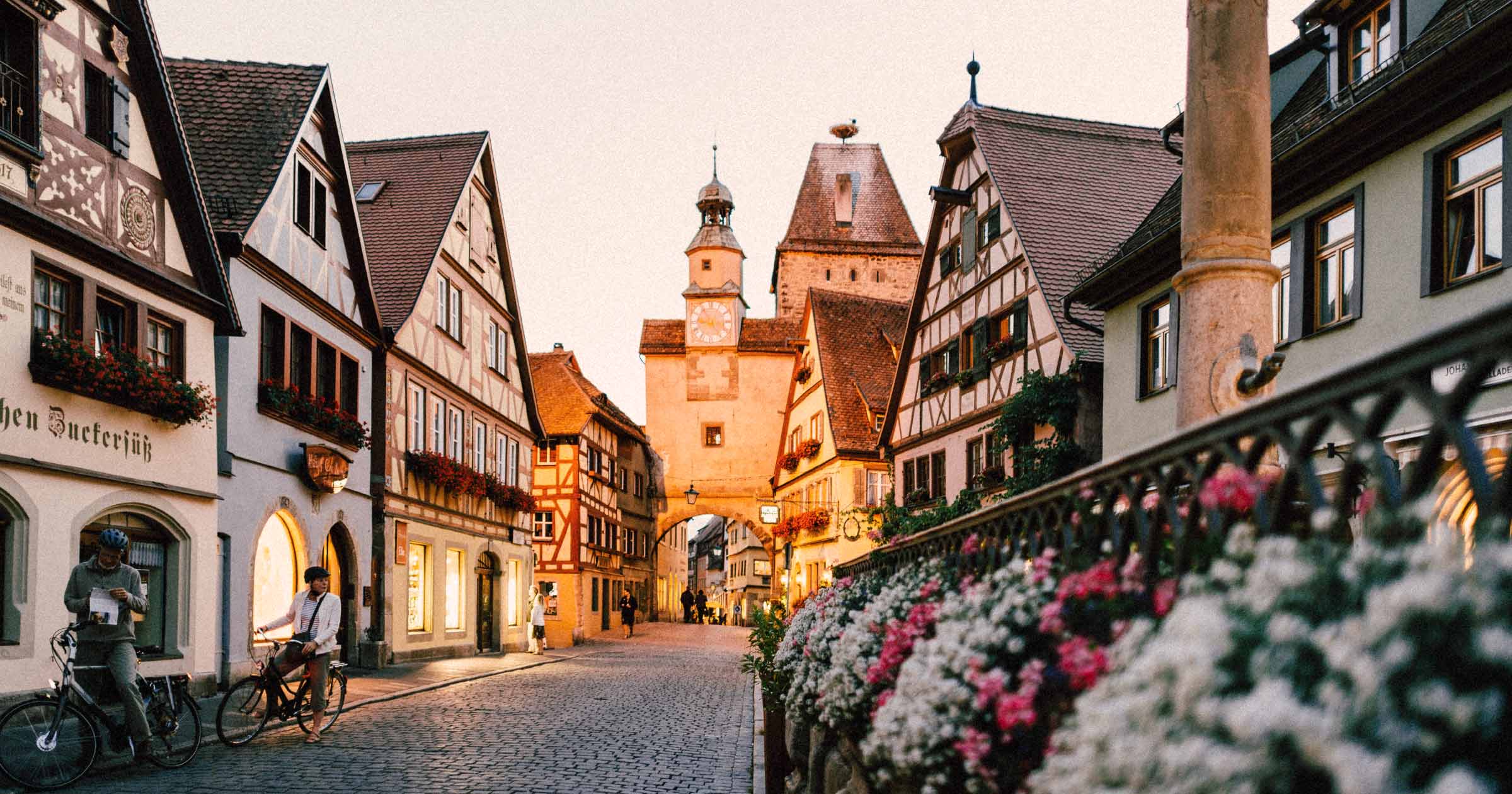
Germany has no single wedding filming permit: each registry office, palace and park sets its own rules, and some registry offices ban video outright. Neuschwanstein allows a couple's private film only in its gardens. A drone needs LBA registration (€20) and an EU A1/A3 certificate (€25).
Marienbrücke Bridge, September, 2:07 PM. Below is the Pöllath Gorge, opposite Neuschwanstein, the very same angle the couple from Chicago showed you on their first call. You're standing with a gimbal among forty tourists with phones, and the only question that matters now is: can what you're filming now be shown to anyone other than the couple themselves?
The answer in Germany is almost always "depends on whose land it is." A castle belongs to Bavaria. The garden around the palace in Heidelberg belongs to another state and another department. Eltz Castle belongs to private owners and the surrounding forest reserve. The sky above them belongs to the European Union, Germany, and the Dipul map all at once. And the right to an image of a guest at the table belongs to the guest themselves, and this right has been around for over a hundred years.
This guide is for videographers who shoot weddings in Germany: locals tired of combing through rules from dozens of websites, and visitors from the UK, US, and Australia, with couples who've chosen a "fairytale castle." It's a collection of information scattered across official websites: what's allowed in the registry office (spoiler: each has its own rules), regulations for castles in Bavaria and Baden-Württemberg, drones according to EU regulations and German no-go zones, laws on filming guests and recording speeches, lighting by month, and how to deliver a film to a family living in two countries.
Amounts are in euros, distances in meters. Regulations are subject to change; links to official authorities are included throughout the text. Please check them before each shoot and before the 2027 season.
Do You Need a Permit to Film a Wedding in Germany?
The short answer. At the registry office, it's subject to the specific registry office's rules, and video is often prohibited. In state-owned castles and their parks, wedding photography for the couple is usually allowed without a permit, and for your portfolio, only with a paid permit. Drone photography near a castle is almost always prohibited. At a private location, it's subject to an agreement with the venue and EU drone regulations.
The long answer begins with the fact that in Germany, there is no "city permit for wedding photography," like in some Australian or American cities. Each location has its own owner, and each has its own rules.
| Where | Whose | Wedding Photography | What's Important |
|---|---|---|---|
| Registry Office (Standesamt) | Municipality | Each registry office has its own rules | Video and sound are prohibited in some registry offices |
| Neuschwanstein, Nymphenburg, Linderhof, Herrenchiemsee | Bayerische Schlösserverwaltung | In gardens and parks - yes, for private use by couples | No inside; drones, lights, flashes - no; portfolios - for a fee |
| Heidelberg, Bruchsal, Schwetzingen | Staatliche Schlösser and Gärten Baden-Württemberg | According to the rules of the individual palace | Publication - separate, paid permit; drones prohibited |
| Sanssouci and the palaces of Potsdam/Berlin | Stiftung Preußische Schlösser and Gärten | Commercial photography - with permission | Application processing - up to 6 weeks |
| Eltz Castle | Private | For private use only | Drones prohibited within a radius of 1.5 km |
| Berlin Parks | Districts (Bezirke), Grün Berlin | Film production — district permit | Friedrichshain-Kreuzberg does not permit filming in green areas |
| Castle hotel, estate, restaurant | Private | By contract with the venue | Drone — according to EU regulations, LBA, and §21h LuftVO |
Before promising a couple a location from someone else's Instagram, find out whose land it is and what is written there about commercial filming.
Can You Film in a German Registry Office?
Let's start with something that visiting couples are the last to know. In Germany, legal marriage is only possible at the registry office: the Civil Code (BGB, §1310) explicitly states that a marriage is concluded by the declaration of the bride and groom "before the registrar." The church wedding and outdoor ceremony in the castle garden are a beautiful, yet symbolic, part of the process. Many German couples therefore split their wedding into two days: a short registration at the Standesamt on Friday, and a ceremony for guests on Saturday.
For couples from abroad, getting married in Germany is a whole other story: a foreigner needs an Ehefähigkeitszeugnis, a certificate from their home country stating there are no impediments to marriage, which is valid for six months (§1309 BGB). Therefore, destination couples from the US and UK often get married at home, while in Germany they hold a free ceremony—a freie Trauung. For you, the difference is huge: at a free ceremony, the rules are set by the venue and the officiant, while at a registry office, it's the registrar and their office.
And at the registry office, the rules are indeed different. Three guidelines we've read:
| Registry Office | What's allowed |
|---|---|
| Berlin-Pankow | Photos — by one person and only of their own guests. "Videos and livestreams are prohibited in the town hall" — videos and broadcasts are prohibited throughout the town hall building |
| Freising (Bavaria) | Photographers are free to roam the hall. Video and sound are prohibited. Maximum 20 people in the hall, including photographers |
| Heidelberg | Photos and videos for private purposes are permitted. Please agree with the registrar on the day of the ceremony. Publishing recordings where employees are visible or audible is prohibited. |
Three registry offices—three responses: from "take pictures" to "keep your camera down." The reason is simple: in Pankow, two or three couples are in the building at a time, and the registry office protects the other couples' privacy. This isn't a whim, but rather the same right to one's own image, discussed below.
How to work with this:
- Find the registry office's instructions (usually a PDF "Informationsblatt" or "Hinweise zur Trauung" on the city website) and read the section on Photos/Video. If there's no mention of video, email the registry office and save the reply.
- If video is prohibited, agree with the couple in advance: you film the preparation, the exit from the town hall, the first minutes on the steps, and the photographer will record the actual ceremony. You can't promise a "full ceremony at the registry office" in the contract until you've read the rules.
- If video is permitted, still introduce yourself to the registrar beforehand. In Heidelberg, this is a requirement, while elsewhere, it's a matter of courtesy that determines where you'll be allowed to stand.
- The registrar is not a guest. Even in places where filming is permitted, publishing footage of a registry office employee is a separate matter. Include the couple's appearance in your portfolio, not the registrar's face.
Can You Take Wedding Photos at Neuschwanstein Castle?
You can—but not inside, not with a drone, and not for your portfolio for free.
Neuschwanstein, Linderhof, Herrenchiemsee, and Nymphenburg in Munich are all managed by the Bayerische Schlösserverwaltung, the Bavarian Office of Palaces, Gardens, and Lakes. Its website has a separate section on wedding photography, and it states it clearly:
- Wedding photography is not permitted inside buildings open to the public. Even private photography and video is prohibited inside Neuschwanstein Castle itself—visitors are only allowed on a guided tour.
- Permitted in the gardens and parks, as long as the photos are for private use only. No advance notice is required for a wedding photoshoot; the couple is free to share the photos on social media—the office considers this a private matter.
- Prohibited: drones, driving a wedding car, softboxes, flashes "and other equipment." What the agency considers "other equipment"—gimbals, monopods, on-camera lights—isn't specified on the page. Ask the agency at [email protected] before your trip and keep the answer in your phone.
- Portfolios are separate and require a fee. If you want to display photos on your website or in advertising, the agency asks that you send them by email with your request and warns that a fee is charged for permission.
The last point is crucial for a videographer. A wedding film for a couple is for private use. Your showreel with Neuschwanstein in the background, an ad on the studio's Instagram, a shot on the website's main page—are no longer private. Integrate this into your workflow: if you plan to include shots in your portfolio, send a request after the wedding, before publication, and factor the fee into the price of the shoot.
Palaces in Baden-Württemberg
The neighbors have their own rules, and in some places they're more specific.
Heidelberg Castle. You can take "small-scale" photos in the garden without permission—with a phone or regular camera, without a photographer and without professional staging. So you, with your camera, don't fall under this rule. The castle's information sheet adds a phrase worth quoting to the couple: further use of the footage is "ausdrücklich nicht gestattet" (expressly not permitted), and this applies to wedding shoots. Commercial shoots require written consent, at least ten working days in advance, and are subject to a fee; publication costs an extra fee for a separate reproduction permit. Drones are prohibited over the castle and garden. Contact: [email protected].
Bruchsal Palace is a rare example of a wedding shoot being sold as a service inside a Baroque palace: the state rooms, the vestibule, and the Balthasar Neumann Staircase. Slots are 60 minutes, up to five slots per day from Tuesday to Sunday, €165 per hour with supervision, four people included, booking through the palace box office, cancellation up to 24 hours in advance. The information sheet covers photography for private use only; whether it covers video, check with the palace ([email protected]). Drones are prohibited throughout the palace grounds, "regardless of size, weight, or insurance coverage."
Who Owns the View: Sanssouci and Burg Eltz
In Germany, there's a court decision that explains the entire logic of this section. The Prussian Palaces and Gardens Foundation—the one that manages Sanssouci in Potsdam—sued a photo agency that was selling photos of its palaces and parks. The case went all the way to the Supreme Court (BGH, V ZR 45/10). The court ruled that the right to take and use photos of buildings and gardens belongs to the owner—as long as the photos were taken from their land. And the foundation is not obligated to allow commercial photography free of charge. A parallel case—regarding filming—was decided on the same day and along the same lines.
The flip side of this same rule is copyright law (§59 UrhG): anything permanently located near public streets and squares can be photographed and used, for buildings, this covers only the exterior. This leads to a simple practical distinction. A shot of a castle from a public road is yours. The same shot from the park, which you entered with a ticket, is subject to the park owner's rules.
Sanssouci. The foundation permits commercial photography upon request; processing time in Berlin and Brandenburg is up to six weeks. We didn't find any separate rules for wedding walks on the foundation's website—the most current rules are at spsg.de.
Eltz Castle is privately owned, and the rules there are the most strict. Photography is for private purposes only. Drones are prohibited over the castle and throughout the entire Eltz Forest nature reserve, within a 1.5 km radius. If a couple wants an "aerial shot of the Eltz Forest," it won't be available, and it's best to request this before booking. For questions, contact [email protected].
Can You Fly a Drone at a Wedding in Germany?
Yes. But the rules here are two-layered: the EU-wide rules and the German ones on top.
Layer One — EASA, unified EU rules. A wedding is a typical open category scenario: drones up to 25 kg, no higher than 120 m, line of sight. Within the open category, there are three subcategories, and the difference for weddings is crucial:
| Subcategory | Drones | People |
|---|---|---|
| A1 | C0 (up to 250 g), C1 (up to 900 g) | Permitted over people, never over crowds |
| A2 | C2 (up to 4 kg) | 30 m from bystanders, 5 m in low speed mode |
| A3 | up to 25 kg | 150 m from people and urban areas |
A "crowd of people" is what a wedding is: guests at the ceremony, on the dance floor, on the steps of the registry office. Neither a light drone nor a certificate grants the right to fly over them.
What an operator needs in Germany (according to the Luftfahrt-Bundesamt, LBA, website):
| What | Details | Fee |
|---|---|---|
| Operator Registration | For drones over 250g or with a camera—in other words, for any wedding drone. A number is printed on each drone | €20 (individual), €50 (company) |
| EU Competency Level A1/A3 | Free online course and online exam, 40 questions | €25 |
| A2 Flying Qualifications | A1/A3 + self-practice + theory exam at a center designated by the LBA | €30 |
| Certificate validity | 5 years | — |
| Liability insurance | Mandatory for every drone | Depends on the policy |
Insurance is a German peculiarity that visitors often overlook. In the EU, insuring light drones is a matter for each country, and Germany requires it: a drone is legally considered an aircraft (§1 LuftVG), and aircraft owners are required to insure their liability (§43 LuftVG). The Federal Ministry states this in a simple statement for pilots: you must have liability insurance to operate a drone. Private liability insurance often doesn't cover commercial use—for weddings, you need a policy that specifically mentions the drone and the operation.
If you're flying from abroad. From another EU country – nothing new: registration in your country of residence is valid in all EASA countries, and a pilot certificate with an EASA logo is also valid. From the US, UK, or Australia – register in the first EU country you fly in and complete EU training: qualifications from a non-EU country are not recognized there. The US Part 107 (for information on US regulations, see our article on wedding aerial filming according to FAA regulations) and the British CAA certificate are not valid in Germany. For information on British regulations, see the London guide.
Layer two – German restricted areas, §21h LuftVO. Here, Germany is stricter than many of its neighbors. List of wedding-related issues:
| Zone | Rule | What does this mean at a wedding |
|---|---|---|
| Residential plots (Wohngrundstücke) | Flying over these areas is permitted only with the express consent of the owner or resident (there are some exceptions: drones up to 250g without a camera, or flights above 100m under certain conditions) | Garden weddings: the owners' gardens require their consent, but neighbors' plots also require their consent |
| Nature reserves, national parks, FFH zones, and bird sanctuaries | Only with the consent of the nature conservation authority | Some lakes and mountain valleys in Bavaria are such zones |
| Airports | 1,000m from the border + access corridors | Weddings around Munich, Frankfurt, and BER |
| Other airfields | 1.5 km | Small airfields are found in almost every district |
| Control zones | Only with clearance from air traffic control | — |
| Highways, federal waterways, railways | 100 m, with exceptions | The Rhine is a federal waterway, and railways run along both banks |
| Beaches and bathing areas | Only outside bathing hours | Lake wedding in July during the day |
| Hospitals | 100 m | — |
All this should be verified using the official map dipul — the digital platform of the Ministry of Transport. Look at the takeoff point and the entire route, not the site address: the castle hotel may be outside the designated area, while the slope overlooking it may already be within the nature reserve.
And another German detail. The Bavarian Palace Authority clearly states that private flights—"for example, wedding photos"—are requests that are generally denied; takeoffs and landings on its property are permitted only in justified, exceptional cases. Flying over a crowd or in a restricted area carries a fine of up to €50,000. The authority reports any violations it learns of.
Where the drone is permitted: a private site, the owner has given written consent, there are no neighboring residential properties along the route or their owners agree, no nature reserve or airfield nearby, and guests are not under the drone.
Can You Fly a Drone in Berlin?
Central Berlin is one of the most restricted cities in Europe for drones. The Berlin Film Commission (BBFC) names zone ED-R 146: a circle with a radius of 3 nautical miles, or 5.5 kilometers, around a point whose coordinates coincide with the Reichstag building. This zone encompasses almost everything the couple saw in the guidebook: the Brandenburg Gate, the Tiergarten, Museum Island, and most of Mitte. Exceptions are issued not by the Berlin authority, but by the federal agency, the BAF. Another zone, ED-R 4, is 3.7 km around the Helmholtz Research Center in Wannsee. Temporary zones also appear during state visits, sometimes 24 hours in advance.
The conclusion for a wedding videographer is simple: in central Berlin, the drone remains in its case. Aerial photography is feasible outside the city—on the Brandenburg lakes, at estates—after a dipul check.
Photography Laws in Germany
In the summer of 1898, Otto von Bismarck died. Two photographers secretly entered the room where the body lay, photographed it, and a few days later offered the image to a newspaper. The scandal showed that people in Germany had no legal right to decide who displays their image and how. Nine years later, the Kunsturhebergesetz (Copyright Law for Fine Art and Photography), or KUG, was enacted. Sections 22 and 23 of this law remain in effect to this day.
For a wedding videographer, their meaning is as follows.
§22: A person's image may be distributed and publicly shown only with their consent. A film for a couple is not a public showing. A video on a studio's Instagram account is certainly not.
§23: Exceptions. People who appear only as a "Beiwerk"—a background image next to a landscape or location—and participants in gatherings and processions may be shown without consent. However, exceptions do not apply if showing them violates the "legitimate interests" of the person depicted.
In practice, this means: a guest accidentally included in a general shot of a square is considered a background. A guest crying in close-up during the vows is not considered a background, and their consent is required for your portfolio.
Does the GDPR Also Apply to Photographs and Films?
Yes, and this has been under discussion in Germany since 2018. Video in which a person is recognized constitutes personal data, meaning the DSGVO (the German name for the GDPR) applies to the filming. Lawyers are still debating how the KUG and the GDPR fit together. However, the Baden-Württemberg supervisory authority alleviates some of the tension in its policy guide "Photographers and Data Protection Authorities": in practice, the difference between the positions is small, because the KUG's assessments are always taken into account when weighing interests under the GDPR.
The same guide contains a paragraph that seems written for weddings, and here's its gist:
- The contract with the couple covers the couple. Photography is permitted if it is the essence of the contract, for example, when hiring a photographer. But this only applies to the contractual party itself—the couple ("des Hochzeitspaares"), not the guests.
- For guests, a different basis is required because they did not sign the contract. This is usually a "legitimate interest"—a balancing of interests.
- What guests expect. At an invitation-only event, guests expect to be photographed for the sake of memory. But they don't expect these shots to be published, much less used in advertising.
- Children in the frame as more than just background footage require parental consent.
Let's translate this into working rules:
- In the couple's contract, there's a clause stating that the couple informs guests about video filming (a line in the invitation or on the wedding website, a sign at the entrance) and that guests can ask not to be filmed in close-up.
- Portfolios are a separate clause. The couple's consent to the use of footage is separate from the filming contract, with the option to refuse. For recognizable guests in advertising, their consent or footage of them in the background is required.
- Children - in close-up shots only with parental consent; it's best not to include them in a portfolio at all.
- A couple from the US or Australia might not understand the point of all this: "Here, everyone films everyone." Explain briefly: in Germany, a guest can request the video be removed, and that would be their right.
Recording Speeches: §201 StGB
Sound is protected even more strictly in Germany than images, and is subject to criminal law. §201 StGB punishes the unauthorized recording of another person's "privately spoken word," as well as the use of such a recording or its transfer to third parties, with up to three years in prison or a fine.
Wedding speeches are not such a case. A toast into a microphone in front of hundreds of guests is delivered publicly; that's what you were hired for. The risk lies elsewhere, and we've already written about it in our Melbourne and Los Angeles guides: a lapel microphone worn by a groom who steps aside with his father and says something not intended for the guests. Germany is unique in that this is covered under the criminal code, not a civil lawsuit.
Three rules:
- Sound recording is in the contract, and everyone wearing a lavalier microphone knows what it's recording.
- Pause the lavalier microphone or make notes on the recorder between scenes: anything outside the "public" portions is not included in the edit.
- Anything questionable is not included anywhere—not in the film, not in the "funny takes" for the couple's friends.
How to technically assemble the audio of speeches—with backup recorders and protection against radio interference—is covered in the article on recording audio at a wedding.
And here, German logic fits in quite well. Speeches are the most personal part of a wedding film: the bride's father recalls her mother, the best man tells a story the groom's boss shouldn't hear. Posting them on a public hosting site where the link can be shared with anyone is a bad idea in any country, and in Germany, it's even more of a legal issue. In the OurStoria client gallery, each speech can be shared as a separate clip alongside the full film, via a single private link. A separate download password is set for the download. Anyone who receives the link can view it, but only those you or the couple have given the password can download the file. You can find out how this works in the article about download passwords.
Bavaria, Berlin and the Rhine
Germany is vast, and weddings vary widely. Three regions come up most often for videographers, each with its own challenges.
Bavaria. Castles, Alps, lakes—and almost everywhere, the owner has rules. Neuschwanstein and the other palaces follow the palace authority's rules (above). Lakes at the foot of the Alps are often located in nature reserves and protected areas—drones are not allowed there without permission from the nature conservation authority; check with dipul. In the mountains, keep simple physics in mind: at altitude, sunset in the valley occurs earlier than the schedule predicts because the sun sets behind the ridge. Arrive for portraits 30–40 minutes earlier than the estimated sunset time (our estimate; depends on the terrain). Ceremonies at mountain venues require a backup plan in case of a thunderstorm on a summer afternoon.
Berlin. A city for urban couples: a registry office in the Old Town Hall, a stroll through Mitte, a rooftop dinner. There are two pitfalls. The first is the registry office: in Pankow, for example, video is completely prohibited in the town hall (above). The second is parks. The Berlin Film Commission outlines a regime for mini-teams—up to five people, a maximum of one tripod—and even these require a district permit; the Friedrichshain-Kreuzberg district, however, prohibits filming in its green spaces altogether. Parks in Berlin (Tempelhofer Feld, Britzer Garten, Gärten der Welt) require a two-week application. These are film production regulations; whether they apply to a couple's wedding walk with one videographer without a tripod is something to be confirmed with the district before filming. Potsdam palaces—according to the foundation's rules, up to six weeks for an application. Drones—outside the city.
Rhine Valley and Mosel. The Middle Rhine between Koblenz and Bingen is a UNESCO World Heritage Site, with dozens of castles and vineyards on the slopes. There are two logistical pitfalls here that aren't visible on the map. First, there's no permanent bridge on this stretch of the Rhine—only ferries cross. If the bride is getting ready on one bank and the castle hotel is on the other, check the ferry schedule, especially the last evening one. Second, the Rhine is a federal waterway, with railways running along both banks, and §21h requires drones to be kept 100 meters away from them, with exceptions. A beautiful shot "over the river by the castle" almost always runs into these rules. Castle hotels on the Rhine are privately owned, and permission to film and fly is granted by the owner; Eltz am Mosel is a private castle, with drones prohibited within a 1.5 km radius.
Let's do some quick math on the wedding formalities for a visiting videographer in Bavaria (our calculation, fees from government websites):
| What | Amount |
|---|---|
| Drone operator registration with the LBA (individual) | €20 |
| EU Competence Level A1/A3 | €25 |
| Wedding walk in Neuschwanstein Park for the couple's private film | €0 |
| Permission to use castle footage in a portfolio | Fee upon request from the BSV |
| Drone liability insurance for commercial work | Under the policy |
| Total fixed fees | €45 + insurance + portfolio fee |
The money is small. What's expensive is the time: submitting an application ten working days in advance, communicating with the registry office, checking the dipul, and obtaining written consent from the venue for the drone. Add these items to your project checklist immediately after signing the contract.
Golden Hour in Germany, Month by Month
All of Germany shares a single time zone, but stretches about 650 km from west to east. Therefore, the sun sets noticeably later in Cologne than in Berlin, and in Munich, further south, summer days are shorter than in Hamburg. Daylight Saving Time in 2027 runs from March 28 to October 31.
| Date | Berlin | Munich / Neuschwanstein | Cologne | What does this mean |
|---|---|---|---|---|
| Mid-May | around 8:55 PM | around 8:45 PM | around 9:15 PM | Early summer, soft, long-lasting light |
| June 21 | around 9:33 PM | around 9:17 PM | around 9:50 PM | Light until almost 10:30 PM; sunset walk during dinner |
| Mid-July | around 9:23 PM | around 9:10 PM | around 9:40 PM | Hot, thunderstorms in the afternoon |
| Mid-August | around 8:33 PM | around 8:28 PM | around 8:54 PM | Sunset returns to a convenient time |
| Mid-September | around 7:23 PM | around 7:27 PM | around 7:47 PM | Favorite time: Even light, first autumn colors |
| Mid-October | around 6:12 PM | around 6:26 PM | around 6:41 PM | Short days; move the ceremony earlier |
| December 21 | around 3:54 PM | around 4:22 PM | around 4:28 PM | Winter wedding: dusk by 4 PM |
Time is calculated using the NOAA algorithm; please check the date and location.
In June, civil twilight in Berlin—when it's still light without streetlights—lasts until almost 10:30. This is a gift for sparklers: at 10:00 PM, the sky is still blue, not black. And this is a timing trap: if a couple wants a "sunset walk" at 9:15 PM, someone has to tell the host that the first dance is moving up.
In winter, it's the opposite. On December 21st, the sun sets around 4:00 PM in Berlin, and a ceremony at 2:00 PM means sunset in the middle of the walk. Fast lenses and your own lighting are a must here—but remember, your own lighting is not allowed in the parks of Bavarian palaces. Therefore, portraits must be taken indoors or before 3:00 PM.
Delivering the Film to Two Families
German weddings with foreigners are common. Half the guests speak English, half speak German, and some of the most important guests didn't show up at all.
Let's break it down. Lauren from Chicago and Felix from Stuttgart got married in September: the wedding ceremony on Friday in Stuttgart, a free ceremony on Saturday at a castle hotel on the Rhine, and a sunset stroll through the vineyards. Felix's grandmother, Oma Gisela, attended the ceremony but left before the speeches—she's eighty-eight. Grandpa Hal, Lauren's grandfather, didn't fly across the ocean at all.
Eight weeks later, you deliver the film. And then:
- Time zones. Chicago is seven hours behind Germany. You sent the link at lunchtime—Grandpa Hal is asleep. He'll open it in the morning, on his phone, without you and without explanation.
- Language. Oma Gisela only reads German.
- Length. The full film, including speeches, is an hour and a half. Oma Gisela wants to see her grandson's speech, which she missed, and Grandpa Hal wants to see the father of the bride's toast.
- Photos. Lauren's parents also want photos—to download and print.
In the OurStoria client gallery, there's a single link: the full film, individual clips of each speech, and photos side by side, and no one needs to create an account. Grandpa Hal opens the clip with the toast in Chicago in the morning, and Oma Gisela opens Felix's speech in Stuttgart.
Language is also manageable. The gallery interface is translated into eight languages, and you select the language for each project separately—Deutsch is one of them. If the main viewer is a German family, select German: the buttons, download window, and password form will be in German. And the greeting you write yourself is displayed exactly as written, without automatic translation. Write it in two languages: two lines in German for Oma Gisela and two in English for Chicago—what's in the gallery and where to find the speech. For more details, see the article on client gallery language.
And finally, something that's least thought about. The couple downloads from the gallery the exact file you uploaded: with your color and sound, without any recompression by the messenger. The September light over the Rhine that you've been waiting for all day arrives in Chicago just like that. Try it at your next wedding: upload the full film, speech clips, and photos, write a bilingual greeting, and send a single link to everyone—from Stuttgart to Chicago.
Start a 7-day free Pro trial →
How to structure the entire delivery—from the deadlines you set during the consultation to the email a week after delivery—is in the guide on how to deliver a wedding film to a client. What the gallery looks like inside is on the client gallery for videographers page. If the couple's next wedding is with friends on Lake Como, here's the Italy guide, and if it's in Iceland, here's the Iceland guide. All guides are collected on the Wedding Filming Guides page.
The Rules Are the Frame
At first glance, Germany seems like a country where everything is forbidden. Video in the registry office is prohibited. Drones near the castle are prohibited. Lights in the park are prohibited. A shot of a guest in an advertisement requires consent.
But if you look closely, each "no" reveals a specific interest. The couple who signs their wedding right after yours. The elderly woman who doesn't want to see herself crying on someone else's Instagram account. The forest around Eltz Castle. A three-hundred-year-old palace.
When the rules are read in advance, they cease to be an obstacle and become a frame. You know where to stand on the registry office steps. You know that a stroll through Neuschwanstein Park requires no softbox, meaning you need to capture the soft evening light. You know that a drone can fly over the vineyards on the Rhine only with the owner's written consent, but never over the heads of guests.
And somewhere in Stuttgart, Oma Gisela opens a link and clicks on her grandson's speech, which she missed. She doesn't care how many letters you sent to the department. She sees Felix raising his glass.
Related articles:
- All Wedding Filming Guides for Videographers
- Filming Weddings in London: Permits, Royal Parks, Drone Rules and Light
- Filming Weddings in Italy: Lake Como & Tuscany — Drone Rules, Villas, Churches and ZTL
- Wedding Drone Videography: FAA Part 107 Rules, Venues and Gear (2026)
- How to Record Audio at a Wedding: Vows, Toasts, Readings and the Kit
- Client gallery language per project: delivering weddings in the couple's language
- Download Passwords for Wedding Galleries: Guests Watch, the Couple Downloads
- How to Deliver Wedding Video to a Client: A Step-by-Step Workflow