Almost every couple who's decided to elope has had their own kitchen-table evening. A guest list on a laptop. 140 entries. Cousins you've seen twice. Mom's coworkers. An argument over whether to invite an ex-roommate.
And at some point, one of you says out loud what you've both been thinking about for a week: "Maybe we should just elope?"
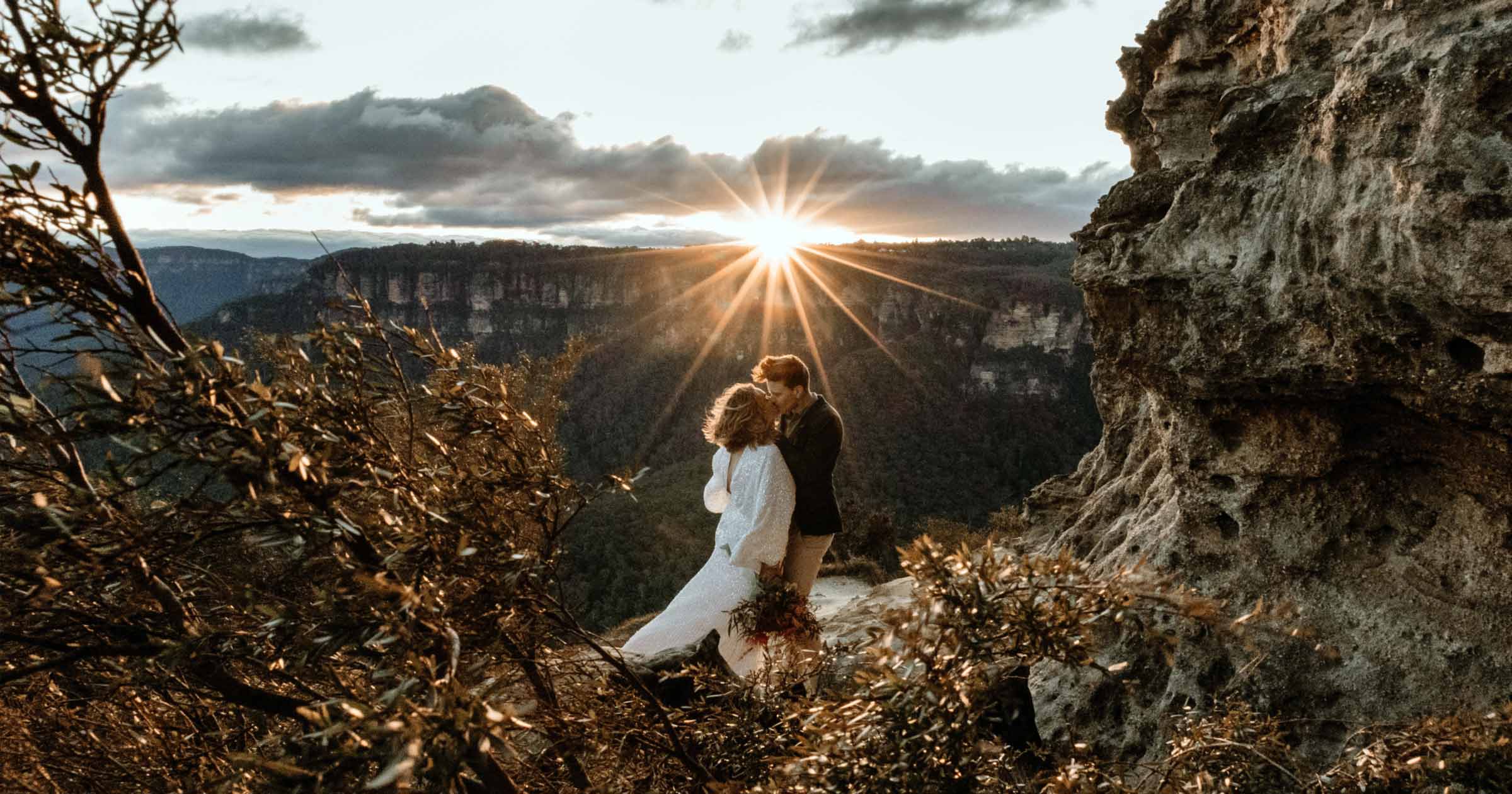
For Claire and Dominic, it happened in March. Five months later, they stood on a granite ledge above the valley at 7:40 a.m. with a photographer, a videographer, and two best friends. Claire had bought her dress three weeks earlier. Dominic finished writing his vows in the car.
It sounds simple, and for the most part, it really is simple. But "just eloping" consists of a dozen small decisions that no one warns you about: where you can stand with your bouquet without permission, and where you can't; whether a witness is needed and how many; who has the right to sign; when to tell Mom—before or after; and how your grandmother, who dreamed her whole life of seeing you at the altar, will still get to see that day.
This guide covers eight steps from the first conversation to the moment your family watches your film. It covers state and park regulations with links to official websites, real permit prices, and an honest conversation about family. If you're still deciding what constitutes an elopement, start with the article what does it mean to elope. And if you're a videographer planning to film an elopement, practical location guides are available in the wedding filming guides section.
How to Elope Instead of a Wedding
First, about the decision itself, because this is where most couples get stuck for a long time. Not on the logistics. On the question, "Are we really allowed to?"
What are you actually canceling? The Knot surveys thousands of couples every year. The 2026 Real Weddings Study included 10,474 couples who got married in 2025. The average wedding cost $34,000, had 117 guests, and cost an average of $292 per guest. Look closely at that last number: almost three hundred dollars per person—that's dinner, a seat at the table, chair rental, bar share, and flowers. When you reduce the list from 117 to 4, you're not cutting "wedding," but basically that one line item.
Weddings didn't become this way overnight. Economists Andrew Francis-Tan and Hugo Mialon of Emory University, studying wedding expenses, recalled a curious detail from the work of sociologists Cele Otnes and Elizabeth Pleck. In 1959, Bride's magazine advised couples to devote two months to planning and provided a checklist of 22 tasks. By the 1990s, the same magazine recommended twelve months and 44 tasks. Weddings haven't become twice as important. They've become twice as long. So if you think a "real wedding" must last a year, that's a fairly recent tradition.
What the data says about marriage. In the same study, published in the journal Economic Inquiry, Francis-Tan and Mialon surveyed more than three thousand Americans who had ever been married. High wedding expenses were associated with shorter marriages, while modest wedding expenses were associated with longer marriages. But they also found two things that couples deciding to elope should know. Marriages with well-attended weddings lasted longer, on average. So did marriages followed by a honeymoon—whether expensive or not. The authors explicitly state that this is a correlation, not a cause: a cheap wedding doesn't save a marriage, and a large one doesn't guarantee it. But the conclusion is practical. It's wise to spend the savings on travel. And don't completely erase loved ones from your day—they should find another place in it: at the dinner afterward, in a letter, in the film. This is covered in steps 7 and 8.
How do you know if eloping is right for you? You don't need to weigh a hundred pros and cons. Three honest questions are enough:
| Question | If the answer is "yes" | If the answer is "no" |
|---|---|---|
| Can you imagine a day without crowds—and is that a relief, not sadness? | Eloping may be for you | Think about a small wedding of 20–30 people |
| Are there at least 1–2 people without whom the day wouldn't happen? | Bring them—it's still an elopement | You can go just the two of you |
| Will someone in the family be truly hurt, not just surprised? | Tell them before (step 7) | You can tell them after |
Calculation on a napkin. Here's the cost of the "bureaucratic skeleton" of an elopement, if you only count official prices (this is our example, not the national average). A license in Colorado is $30. A Yosemite ceremony permit costs $150 (NPS lists this as both the permit cost and the non-refundable application fee; check with the park office to see if it's one or two). A week's car entry costs $35. Total costs start at $215. Everything else—photographer, videographer, travel, lodging, clothing, and dinner—are up to you, and it's here that you decide where your money goes: on people who will make the day special or on chairs for guests you've met twice.
Step 1: Decide Who's Coming
The word "elopement" conjures up images of two people and no one else. In reality, an elopement is any day where the guest list is so short that you don't write it down, you just know it.
| Option | What it looks like | Who it's suitable for | What to consider |
|---|---|---|---|
| Just the two of you | You, the photographer, and (if required by law) the officiant | Couples for whom the day is a conversation between two people | Some places require a witness—the photographer can be one (check state regulations) |
| You + 1–2 people | Best friends, brother, sister | Those who need someone "in their corner" nearby | These people are often the witnesses |
| You + parents | 4–6 people | If it's important for the parents to be there | Consider who will be upset if they weren't invited |
| You + 8–15 people | Your closest friends | Those who value family, but not the scale | National parks have group limits per site |
How to resolve this without a fight. Establish a one-line rule: "Only those we can't imagine this day without are allowed to come with us." Not "who would be offended," not "who wouldn't be comfortable not inviting." If a name passes this filter for both of you, the person goes. If only for one of you, you can discuss it. The rule sounds strict, but it's easy to stick to when the "what about your auntie too?" starts.
Why numbers are more important than they seem. Not only the atmosphere depends on them, but also the paperwork. Almost all park permits count people. At Cabrillo National Monument in San Diego, for example, the wedding venue can have no more than 100 people. In Yosemite, the group and vehicle limits are specific to each site. And the rules for photography in national parks, as we'll see in step 3, also start with "up to eight people."
Step 2: Pick a Place
The location is the star of the episode. At a large wedding, the backdrop is the restaurant and tent. Here, the backdrop is the ridge, the ocean, the desert, and it's in every frame.
Choose based on four factors, in that order.
1. Can you legally get married there the way you want? The state issues the license, not the location. If you're planning to marry yourselves, without an officiant, this narrows your choice to states that allow it (step 4). First, legality, then the view.
2. Is a hike necessary, and how long? A granite ledge at 7:40 a.m. also means climbing in the dark with a dress in your backpack. If you're bringing your parents, the parking lot is worth more than the summit, a two-hour walk away. Honestly assess how far you and your guests will walk—in the shoes you'll actually wear that day.
3. Season and weather. Every place has months when it's beautiful, and months when it's dangerous or closed. In Yosemite, for example, according to the park itself, Tioga and Glacier Point roads are typically closed from November until late May or June, and wildfire smoke is most common in August and September. A beautiful Instagram photo says nothing about whether it was taken on the only clear morning of the month.
4. Crowds. The most underrated factor. The famous lookout at midday on a Saturday means forty tourists with phones behind you. Almost every park recommends the same thing as Yosemite on its wedding page: early or late weekdays.
How to avoid mistakes. Find your spot in the photos, and then look at it at three other times: midday, on a weekend, and in bad weather. If you like it anyway, it's your spot. We've compiled a selection of destinations with their pros and cons in the article best places to elope, and we've also examined one of the most popular places in detail—elopement in Yosemite.
Step 3: Permits for National Parks, Beaches and Public Land
This is where couples often learn new things—and, unfortunately, sometimes right there, from a ranger.
National Parks. A ceremony in a national park almost always requires a permit—called a special use permit. This isn't a formality, but rather the park's way of ensuring that three weddings and a busload of schoolchildren don't converge on the same spot. Here's how it works, using Yosemite as an example, from the park's official website:
| Rule | Yosemite (nps.gov/yose) |
|---|---|
| Do you need a permit? | Yes, for any ceremony anywhere in the park |
| Cost | $150, non-refundable (check with the office to see if this includes the $150 application fee) |
| When to apply | More than 21 days in advance, but not earlier than one year in advance |
| Duration | Up to 2 hours |
| What's prohibited | Arches, balloons, signs, chairs; rice, butterflies, and anything else that's "released"; amplifiers and music louder than 60 dB at 50 feet; drones |
| What's allowed | Bouquets, boutonnieres, light fabric runner on the sand |
| Entry | Not included: guests and the couple pay the same entry fee ($35 per car for 7 days) |
| Exclusivity | No: the permit does not close the site to other tourists |
Note the last line. The permit allows for the ceremony, but not for a location without people. That's why the time of day is also part of the permit, even though it's not specifically stated.
Beaches. Beaches are more complicated because a beach can be owned by anyone: a city, state, county, or federal agency. A federal example is Cabrillo National Monument in San Diego. Weddings there are held only at one venue, Wedding Bluff, from 9:00 AM to 3:30 PM, with a maximum of 100 guests. The application fee is $100, and applications must be submitted at least 21 business days in advance. San Diego's city beaches operate under completely different rules and through a different office. So the first thing you need to find out about a beach is whose property it is. This is usually visible on the park's website or on a sign at the entrance.
What about the photographer? Do they need a permit too? Here's the good news. Since the EXPLORE Act was passed, the National Park Service has written on its website that in most cases, photography does not require a permit if the group does not exceed eight people, only handheld equipment is used, the site is not obstructed, and the photography does not interfere with nature or other visitors. Photography related to an already-permitted event—the service directly cites a wedding as an example—doesn't require a separate permit. However, individual parks have their own rules for commercial photographers, so ask your photographer to confirm them for your park. A good photographer usually knows this already.
About drones, briefly. They are not allowed in national parks. Yosemite's wedding page explains it in one sentence. If you're dreaming of a shot from above, choose a location outside the national park and discuss it with the videographer in advance.
And about leaving no trace. Park services have seven Leave No Trace principles, which grew out of joint work between the Forest Service, the National Park Service, and the Bureau of Land Management back in the 1980s. They sound like rules for tourists: plan ahead, travel on durable surfaces, pack out trash, leave what you find, respect animals, and be considerate of other visitors. For an elopement, they translate very concretely. Don't leave the trail to take a photo in a meadow. Don't take live petals to throw on the ground. Don't pick flowers for a bouquet. It won't show up in photos, but rangers will notice, and the next couple in that spot might be out of luck.
Step 4: Marriage License, Officiant and Witnesses
This is the point at which an elopement stops being a pretty stroll and becomes a marriage. And this is where the rules vary the most from state to state.
Three things determine everything:
- License. It's issued by the county clerk, and almost always both parties must appear in person. The license has an expiration date: if you don't get married on time, you buy a new one.
- Officiant. In many states, this can be a priest, judge, or friend who has qualified to perform the ceremony. In some, no one—you do it yourselves.
- Witnesses. Some don't need one, some require one, and some require two.
Here's what it looks like in four popular elopement states, according to the official county websites:
| State | License | Witnesses | No officiant? | Important detail |
|---|---|---|---|---|
| Colorado | $30 (most counties); valid for 35 days and only in Colorado | Not required | Yes: couples can marry themselves and sign the license as the officiant | Signed license must be returned to the clerk within 63 days |
| California | Valid for 90 days, ceremony can be performed anywhere in the state | Public license—one witness; confidential - no witnesses, but only if you already live together as spouses | No, but a friend can be a one-time deputy | Officiant returns license in 10 days |
| Pennsylvania | Philadelphia: $90, self-uniting: $100; valid from the third day, 60 days | Self-uniting requires two witnesses | Yes, with a self-uniting license | Couple returns license themselves within 10 days |
| Nevada (Las Vegas) | Valid for 1 year | Vows must be witnessed by someone other than the officiant | No: Nevada-licensed officiant | The fastest "come and get married" |
Where does a marriage without an officiant come from in Pennsylvania? This license is still unofficially called a "Quaker" license. Quakers have been marrying without a priest for centuries: the couple simply made promises to each other in front of the community, and Pennsylvania—the state founded by Quaker William Penn—has recognized this. It was long believed that the license was only for Quakers. In 2007, Mary Jo Knelly and David Huggins-Daines went to the Allegheny County office in Pittsburgh and were turned away: they were neither Quakers nor Baha'is. The American Civil Liberties Union (ACLU) filed a lawsuit in federal court on their behalf, and within days, Judge Joy Flowers Conti ordered the county to issue them a license. Today, in Philadelphia, you can get one simply by stating so when applying. Thus, a tradition of one community became the easiest way for two people to get married on a hilltop—albeit with two witnesses present.
Colorado—same idea, no witnesses. Here, clerks clearly state: witnesses are not required; the couple can perform the ceremony themselves and sign the license as both parties and officiant. That's why Colorado is so popular with couples who want to truly elope alone. But there's a catch: a license obtained in another state cannot be used in Colorado, and a Colorado license can only be used in Colorado.
How to avoid getting into trouble.
- Only check the website of the county where you obtain your license. Blogs (including ours) become outdated, and clerks change their hours, prices, and payment methods. Some accept cash only, others only card.
- Count back from the date. If the license becomes valid on the third day, and you arrive on Friday for the ceremony on Saturday, you won't make it.
- Decide who will return the paperwork. After the ceremony, the license must be signed and returned to the clerk. Until it's returned, the marriage isn't on record. The most common story: the signed license sits in the glove compartment of a rental car for a week.
- If you want "the ceremony there, the papers at home." Some couples get legally married in their county a week before the trip, and simply exchange vows in the mountains. This is a perfectly normal approach, especially if you're drawn to a country or state with complex regulations.
We are not lawyers, and this table is not legal advice. Check the rules with the county clerk where you'll be getting your license: their website usually has everything, from the price to the application form.
Step 5: Hire a Photographer or Videographer
At a large wedding, photos and videos are just one of many budget items. At an elopement, they're practically the only thing left, besides the rings. There are no guests to retell it later. There's only what was captured.
Why an elopement specialist is more than just a photographer. An elopement specialist essentially does four jobs: knows locations and permits, plans the day around the sun, hikes the trail with you, and often—by state law—can be your witness. A regular wedding photographer can take great photos, but if they've never been to the park you're visiting, you'll spend the first half of the day figuring out where the parking is.
What to ask on the first call:
| Question | Why ask | Good answer |
|---|---|---|
| Have you shot at this location? | Knowledge of spots, light, and rules | "Yes, here's a gallery from there" — and it's a full gallery, not just three shots |
| Who gets the filming permit? | So you don't get questions from a ranger | "I'll check the park rules and tell you if I need anything from you" |
| Can you be our witness? | If it's just the two of you | "Yes, if the state allows it — I've done that before" |
| What happens if the weather ruins the day? | This is not uncommon in the mountains | A clear plan B: a backup day, a backup location |
| How many hours and what's included? | Getting ready, travel, and the hike all count as hours too | A step-by-step schedule, not just "4 hours" |
| How will you deliver the photos and video? | This is what your family will see | One link, no registration required, photos and video together |
Video—is it necessary if there are photos? The answer "yes" is heard more often at an elopement than at a regular wedding, and the reason is simple. A photo will show what you looked like. A video will show how Dominic's voice wavered on the second line of the vows, how the wind blew the veil away, and how Claire laughed through her tears. At a large wedding, a hundred people would have heard it. Here, it's two friends and a microphone. For everyone else, including your mom, this will be the only way to hear you.
The last question in the table is not a formality. Ask the videographer how exactly they will deliver the film. A link to a cloud folder that will disappear after a month is a bad option for a day you'll revisit for years. A better option is a gallery like OurStoria: a single link that allows any relative to access the film, individual clips, and photos without registration or passwords for other services. We discussed how to choose a videographer in the article how to choose a wedding videographer.
Step 6: Plan the Day
An elopement has no reception to anchor the schedule. Therefore, the day revolves around one thing: the sun.
Why sunrise and sunset? Soft, low light flatters faces, rather than scorching the crown of their heads. And—equally important—there are fewer people. Sunrise is almost always emptier than sunset. The price is a 3:30 AM alarm.
Here's an example of Claire and Dominic's day (a guideline, not a rule—your day will depend on the location and season):
| Time | What's happening | Why |
|---|---|---|
| 3:30 AM | Wake up, coffee, makeup in the room | Getting ready leisurely—part of the film |
| 5:00 AM | Departure, photographer and videographer meet in the parking lot | Arrive before the tourists |
| 5:40 | A short 30-minute climb to the point | Dress in a bag, trekking shoes |
| 6:30 | First look on the trail | First tears in soft light |
| 7:15 | Dawn, ceremony, vows | The best light and silence |
| 7:40 | Signing the license | If you need witnesses, they're already nearby |
| 8:00–9:30 | Portraits, walk | While the light is soft |
| 10:30 | Breakfast in town | A celebration is also part of the day |
| After lunch | Nap | No kidding |
| Sunset | Optional: second short session or dinner | Different light, different shots |
What to pack in your backpack. Printed permit (Yosemite specifically requires this), license and pen, paper vows (your phone will die), water, snacks, bandages, a warm jacket over your dress, and a flashlight. If you're bringing your parents, a folding chair isn't always allowed; check the venue's rules.
Vows. Without guests, vows sound different: you're saying them to one person, not to the crowd. You can write your own, or use classic ones—we've compiled a collection and history of traditional vows in the article traditional wedding vows. One tip: ask the videographer to attach a lapel microphone to one of you. Otherwise, in the windy mountains, your vows might just be noise.
Step 7: Tell Your Family — Before or After?
This is the most difficult step, and there's no single right answer. There are three working scenarios.
| Scenario | What it looks like | Who is it suitable for | Risk |
|---|---|---|---|
| Tell in advance | A few weeks in advance, in person or by phone | If there's someone in the family who will be hurt by the news "afterward" | There will be arguments about "let's just..." |
| Tell the day before | Call the evening before | If you want to avoid arguments but don't want a surprise | Parents may ask you to come |
| Tell after | Call from the venue, video, letter | If the family is comfortable accepting children's decisions | Someone will feel excluded |
If you tell before. Talk about a decision, not a question. "We decided to get married just the two of us in the mountains" sounds different than "We're thinking maybe...." A question can be answered with "no." A decision can only be answered with "tell me more." And immediately suggest where your loved ones will be that day: dinner after you return, the film you'll watch together.
If you tell them after, write a letter. It may seem old-fashioned, but there's research worth knowing. Psychologists Amit Kumar of the University of Texas at Austin and Nicholas Epley of the University of Chicago Booth School of Business asked people to write a thank-you letter to someone important in their lives. Before sending, the authors estimated how surprised and delighted the recipient would be, and how awkward they would feel. Then they asked the recipients themselves. The authors got it wrong on all counts: they underestimated how surprised and delighted the recipient would be, and overestimated how awkward the recipient would feel. Most of all, the authors were concerned with choosing the right words. The recipients hardly cared—they were touched by the warmth itself. The study was published in the journal Psychological Science.
For an elopement, this means something simple. A letter to your mom, in which you explain in your own words why you decided this way and thank her for everything she has done for you, will work better than you think. And it doesn't have to be perfect.
Claire wrote her mother, Denise, a handwritten letter and gave it to her along with the first photo two days after their return. Denise cried, then called her sister, then asked to see everything. She wasn't on that cliff. But it was important to her that they thought of her that day.
One more thing. If someone in the family has serious health issues or is very elderly, consider bringing them along or making a special moment for them—a short video call right from the ceremony. Dominic's grandmother, Evelyn, watched the ceremony on FaceTime from his brother's phone. The sound wasn't great. But she saw it.
Step 8: Share the Day Afterward
This is where the elopement comes full circle. You left on your own to have the day to yourselves. Now you want everyone you love to see it.
Dinner or party afterward. Many couples gather their family together a week or a month later at their home or favorite restaurant. No program, no seating arrangements, no first dance. Simply: here we are, we're married, let's eat. This is exactly the case when Francis-Tan and Mialon's research is worth rereading: your day can be filled with many people—just not on the same morning or on the same cliff.
Film—for those who weren't there. At a large wedding, guests see the day for themselves. At an elopement, almost all your loved ones will only see it on film. Therefore, it's important not only to film it, but also to share it so everyone can see it: your uncle on an Android, your aunt on a work laptop, your grandmother who will never install a new app.
A simple recipe works here. Ask the videographer to deliver the film as a gallery like OurStoria. It's a single link that you send to the family chat: no one has to register or remember the password, the film opens in the browser, and Grandma Evelyn watches it on the living room TV, not on a tiny phone screen. The vows can be posted as a separate clip for those who want to rewatch them without rewinding. And the photos are located next to the film, at the same link, and can be downloaded. You can see what it all looks like from the inside in the gallery examples.
How to show the film to your family. If you're planning dinner, start with the film. Ten minutes, lights out, TV on. Your sister and your mom will see you rising at dawn and the tremor in Dominic's voice. And it's no longer "they left without us." It's "they took us with them—just later."
Elena and Cole, another couple we want to tell you about, did just that. They got married alone on the beach, and a month later, they gathered thirty people in her parents' backyard. First, there was a movie on a projector, then a barbecue. Cole's mom later said it was the best wedding she "felt like she'd ever been to."
See what a wedding film gallery looks like →
Your Day, Your Size
An elopement is no less a wedding. It's a wedding of a different scale.
No arch, no seating chart, no 140-line spreadsheet. A one-page permit. A $30 license. An alarm at 3:30. Two friends with a thermos.
And that one second, the reason it all happened: when you look at each other at the edge of the valley, the sun just rising, and there's no one else but the two of you.
And then—a link to the family chat. And Mom, watching this moment on TV and saying, "Now I understand why you left."
Related articles:
- What Does It Mean to Elope? History, Legal Steps and Who Comes
- Best Places to Elope: 14 Spots in the US and Abroad, and the Catch at Each
- How to Choose a Wedding Videographer: The Complete Guide (2026)
- Traditional Wedding Vows: Classic Examples From Every Tradition
- The Family Audience: Who Actually Watches Wedding Films Beyond the Couple — Generational Viewing Data
- The Micro-Wedding Revolution: How Smaller Events Changed Wedding Videography Forever