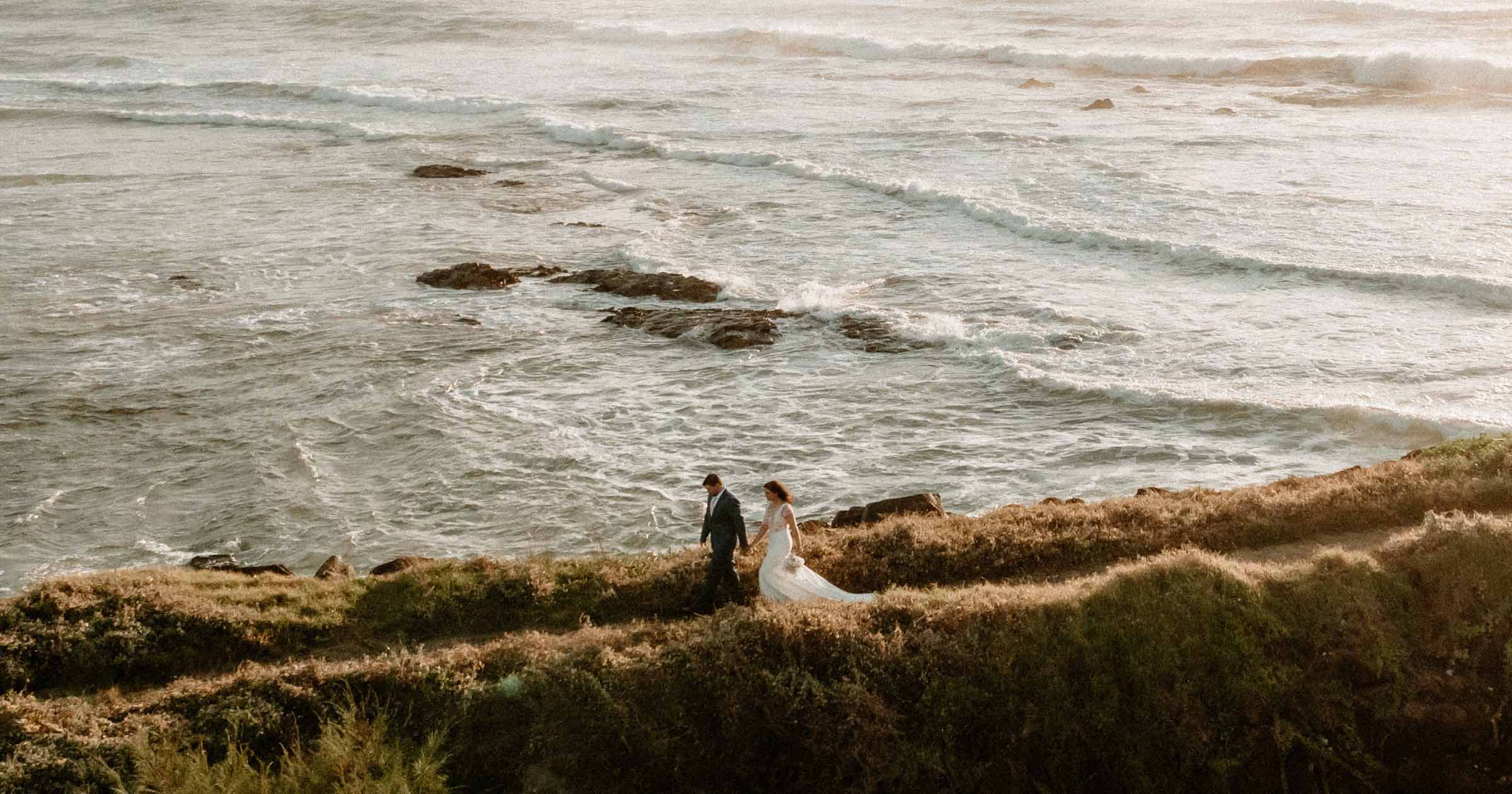
Gemma and Finn decided to elope on a Saturday night, in a Columbus kitchen, over cold pizza. No 150 guests, no seating arrangements, no arguing over which cousin to invite. Just them, a beautiful location, and a person with a camera.
By Sunday, they had forty tabs. Yosemite at sunrise. A beach on Maui. Lake Como. An Icelandic glacier. Each tab contained equally beautiful photos and not a word about what it actually takes to get married there.
And that's the first thing you need to know. Every beautiful location has its own fine print. Somewhere, a permit costs $300 and is sorted out within a month. Somewhere, no more than twenty people are allowed. Somewhere, a drone is a criminal offense, not a beautiful photo. Somewhere, the 2026 dates are already booked, and bookings for 2027 will open on a specific day and time.
This article is a map of those conditions. We've compiled 14 locations in five categories: national parks, mountains, water, cities, and international locations. For each, we list why couples go there and the catch, based on the official park, county, and agency pages as of November 12, 2026. If you're still deciding whether to elope, start with what is an elopement. If you've already chosen a location, a step-by-step plan can be found in the article how to elope.
How to Choose Among the Best Elopement Locations
Before falling in love with a photo, ask the location four questions. They'll eliminate half the tabs faster than any ranking.
1. Do you need a permit and how long does it take to get one? In US national parks, the answer is almost always yes. It's not a formality: a permit determines where you stand, how long the ceremony lasts, and what you can bring. Processing times range from two weeks to a month, and popular venues are booked up a year in advance.
2. How many people are allowed? An elopement is usually two people, an officiant, and a photographer. But if you want to invite your parents and best friend, you need a venue with a limit of twenty people, not ten. And remember, the photographer and videographer also count: Grand Teton and Rocky Mountain say so explicitly.
3. What is banned at the ceremony and in filming? The most common surprises include drones (banned by default in every national park), confetti and petals (throwing anything is prohibited in many parks), arches and decor (not allowed in Yosemite and Grand Teton), and music through a speaker (not allowed almost everywhere).
4. Who will see the day? This question is often the last thing on people's minds, and that's a mistake. When there are 150 people at a wedding, 150 people saw it. When only the two of you are at the elopement, grandma, parents, and friends will only see the day in film and photos. Therefore, a videographer at an elopement isn't a luxury, but the only way to take the family along. And it's worth agreeing in advance how the film will be distributed: ask the videographer to share it as a gallery like OurStoria—a single link that can be forwarded to family members, without registration or passwords.
Keep these four questions in mind, and let's get started.
National Parks: The Most Romantic Elopement Destinations in the US
National parks are the main reason Americans started eloping in nature in the first place. They boast the country's most iconic views, and they belong to everyone. This isn't a metaphor. In the summer of 1864, at the height of the Civil War, Abraham Lincoln signed a law granting Yosemite Valley and the Mariposa Grove of giant sequoias to the state of California with the stipulation that they be kept "for public use, resort, and recreation." The National Park Service calls this law the beginning of the entire national park movement.
There's a downside to this idea, which couples discover when applying. Since the space belongs to everyone, you can't reserve it entirely. None of the parks below offer exclusive use: tourists will pass by, and that's perfectly normal. And to accommodate everyone, parks impose group limits, time limits, and bans.
A general rule for all national parks: drones prohibited. In 2014, the National Park Service issued Policy Memorandum 14-05, which directed park superintendents to close their parks to the launching, landing, and operation of drones. It remains in effect with a few exceptions. Violation is a misdemeanor, a minor offense, with a maximum penalty of six months in prison and a $5,000 fine. Experienced videographers know this and leave the drone at home: a shot from above can be captured from a viewpoint with a regular camera.
Yosemite
Why here: The granite walls of El Capitan and Half Dome, waterfalls, mist in the valley at dawn. This is the image everyone imagines when they think of a "mountain elopement."
The catch: A ceremony permit is required anywhere in the park, for any wedding. It costs $150 and is non-refundable. Apply up to a year ahead and no later than 21 days before the date. Permits are not issued on holidays or holiday weekends. The entire event is limited to two hours. Arches, balloons, and decorations are prohibited, but bouquets and boutonnieres are permitted. Important: a permit does not guarantee a specific location. You submit an application, and the park confirms the location.
Two more expenses: for groups of 30–50 people, the park assigns a monitor for $50 per hour, and everyone, including guests, pays an entrance fee to the park. Learn more about ceremony locations, seasons, and roads in our Yosemite wedding filming guide.
Grand Teton
Why go here: A jagged wall of mountains rising straight from the plains and the Snake River below. Arguably the most "cinematic" skyline in the country.
The catch is the dates. There are two types of permits. The large one is for a specific location, for groups of more than 12: Schwabacher Landing, Glacier View Turnout, Snake River Overlook — up to 25 people, Colter Bay Swim Beach — up to 40. The season runs from May 15 to October 12. And most importantly: all large sites for 2026 are already taken, and applications for 2027, as stated on the park's website, open on December 3, 2026, at 8:00 a.m. Mountain Time. If you're dreaming of the Tetons in the summer of 2027, set your alarm.
Small permits are for groups of up to 12 people, at various points within the park, excluding Jenny Lake, String Lake, Hidden Falls, and cemeteries. One permit is issued per site per day.
Other rules: the application costs $200 and is non-refundable and cannot be carried over to the following year. Processing takes at least 30 days, and the park specifically states that it will not expedite the process. You have one hour for everything, including preparation and photography. Arches, altars, tables, confetti, bubbles, balloons, and sound systems are prohibited. Chapels within the park are a different story: they're booked directly and don't need an NPS permit.
Faye and Henry learned about all these rules in March, when the larger sites were already full. They took out a small permit for six—the two of them and both sets of parents—and, frankly, they don’t regret anything: at eleven in the morning, there was no one but them at their quiet spot by the river.
Arches
Why come here: red rock, natural arches, and the sunset sky of the Utah desert.
The catch: the most famous arch, Delicate Arch, is not on the list of ceremony locations. The park considers other locations on a case-by-case basis, with no guarantees. The list includes six locations with their own limits: Park Avenue (15 people), Double Arch and The Windows (25 each), La Sal Mountains Viewpoint and Panorama Point (50 each), and the Devils Garden Campground Amphitheater (80). An application costs $185, plus a separate monitoring fee, which will be quoted when issuing the permit. The permit is valid for one hour.
The good news, which many parks don't offer, is that after the ceremony, you can take photos anywhere in the park; there are no restrictions. So, vows are at Double Arch, and sunset portraits are wherever you like.
Joshua Tree
Why come here: the desert, twisted Joshua trees, huge boulders, and a starry sky. This is the closest to Los Angeles and the quietest spot on this list.
The catch is the heat and the traffic. A permit is required for any ceremony anywhere in the park. Applications are $120 and non-refundable. Submit at least 15 days in advance; processing takes about 15 business days. The permit covers two hours in total, including guest arrival and cleanup. Joshua Tree's capacity limits are not only in people but also in cars: Indian Cove Amphitheater accommodates up to 100 people but only one car, while Live Oak Picnic Area accommodates up to five people and three cars. Indian Cove is closed for ceremonies from June 1 to August 31. The park itself recommends scheduling ceremonies in the morning or evening—and in the desert, this advice applies not only to crowds.
Mountain Elopement Spots: Colorado's Rocky Mountain National Park
Colorado is a special case, and not just because of the mountains.
Why here: High-altitude lakes, meadows with elk, ridges over 10,000 feet. And a legal distinction unmatched almost anywhere else.
Legal distinction. In Colorado, a couple can solemnize their own marriage. Without an officiant or witnesses. Here's how the Larimer County Clerk, home to Rocky Mountain National Park, puts it: "Couples themselves may solemnize their own union or marriage," and specifically states, "Witnesses are not required in the State of Colorado." A license in this county costs $30, residency is not required, it must be used within 35 days, and returned to the clerk within 63 days of the ceremony. For an elopement for two, it's perfect: you stand at the summit, read the vows, sign the papers, and you're married. Rules and fees may vary by county, so check with the county clerk where you're applying for a license. Pennsylvania has a similar tradition—the self-uniting license, which originates from the Quakers, but requires witnesses; check your county's Register of Wills for details.
The catch is the park. A Rocky Mountain ceremony permit costs $300—the most expensive fee on our list—and it's the same for any venue and any group size. Applications are accepted one year in advance of the wedding month, starting on the first of the month, on a first-come, first-served basis. May-June and August-October are already booked for 2026.
The maximum ceremony size is 30 people, including photographers, officiants, and even babies. Each location has its own limit: 10 people at the Lily Lake dock, 15 at the 3M Curve, 15 at Sprague Lake in summer and 30 in winter, and 20 at Bear Lake, but only in winter, not on weekends.
The good news: the wedding permit replaces the timed entry reservation the park requires of other visitors during the season. The bad news: throwing petals, rice, and birdseed is prohibited, music is limited to 60 decibels, and the arch is only allowed in one location, the Moraine Park Discovery Center amphitheater. And, of course, drones are prohibited—the park specifically emphasizes this, even at weddings and even with a licensed pilot.
Elopement Locations by the Water: Hawaii and the Oregon Coast
Hawaii
Why come here: the ocean, volcanoes, warm water in January. And one of the easiest licensing procedures in the country.
License. According to the Hawaii Department of Health, there's no waiting time after receiving a license—you can get married on the same day. There are no U.S. residency or citizenship requirements. The license costs $65, is valid for 30 days, and is only valid in Hawaii. One requirement is stricter than in Colorado: the ceremony must be performed by an officiant licensed by the state of Hawaii. Marrying yourselves isn't an option here.
The catch: sand. Beaches in Hawaii are state land, even if they are located near a county park. In the summer of 2008, the Department of Land and Natural Resources (DLNR) began requiring permits for commercial weddings on state beaches. Then-DLNR chair Laura Thielen attributed this to the growing burden from businesses that had been using public beaches without permission for years. Today the DLNR uses a Wiki Permits system: weddings on the beach are processed through it, and a liability insurance certificate is included with the application. In practice, the paperwork is usually handled by a planner or officiant working on the islands—but ask them directly if they have a permit for the beach you've chosen.
The Oregon Coast
Why here: fog-covered cliffs, tide pools, pine trees right above the ocean. Cold, windy, and incredibly beautiful—especially for couples who don't want the heat.
The catch: ambiguity. The Oregon Parks and Recreation Department (OPRD) includes "beach weddings" among the events that may require a special event permit and processes applications for large gatherings. However, there's no official page listing the exact minimum number of people required for a permit. Various figures are floating around on photographers' blogs, and we won't repeat them. The most reliable way is to call or email OPRD using the contact information on their ocean shores page and give them the exact beach, date, and number of people. Be sure to check the drone regulations for your chosen park.
City Hall and the Strip: Good Places to Elope Without a Permit
Not every elopement needs a waterfall. Sometimes the best views are of each other, and the best decor is the marble staircase of City Hall. The advantage of cities: no permits for the ceremony, no weather restrictions, a restaurant around the corner.
New York City Hall
Why here: New York City Hall is practically a genre. Couples in wedding dresses and sneakers, a line, laughter, then a photo on the Brooklyn Bridge.
The catch: 24 hours. A New York City license costs $35 and is valid for 60 days. However, you can't get married for at least 24 hours after receiving it; this rule can only be circumvented with a court order. You can't get in to see the clerk without an appointment: walk-ins are not accepted; you must book through Project Cupid—in person or via video meeting. After the ceremony, the license is signed by the officiant, both spouses, and a witness. This means that even the smallest wedding in New York requires a third person—they could be your photographer or a friend.
Las Vegas
Why here: Because it's Vegas. Jokes aside, it's arguably the fastest place to get married in the country.
The catch: almost none. There's no waiting period in Nevada: get your license and you can get married in an hour. The Clark County Marriage License Bureau is open seven days a week from 8 a.m. to midnight, including all holidays. A license costs $102. If you don't need a chapel, a civil ceremony can be performed at the Office of Civil Marriages for $75, paid by card only.
One date demonstrates just how fast it is. On July 7, 2007—07.07.07—4,492 couples got married in Las Vegas, and according to NBC Los Angeles, that's still a single-day record. Holly and Grant, fortunately, chose a typical Tuesday. They flew in in the morning, got their license by lunchtime, and by sunset were standing with a photographer under the neon signs. If your family is far away, Vegas is also one of the most accessible destinations by air.
Destination Elopement Abroad: Italy, Iceland, Banff, Greece, Bali
An elopement abroad involves two decisions: where you say your vows and where your marriage is legal. Many American couples separate these steps: they sign at home with a clerk and then have a symbolic ceremony abroad. This is easier on the paperwork and eliminates the need to translate and certify documents. But if you want to marry legally there, each country has its own rules, which are discussed below.
Lake Como, Italy
Why here: Lakeside villas, terraced gardens, boats instead of taxis. Europe's most "cinematic" lake.
The catch: To legally marry in Italy, foreigners need a Nulla Osta—a document certifying no impediments to marriage; Americans should check the procedure on the website of the US Embassy in Italy. Famous villas on Como host weddings and photo shoots according to their own rules, requiring a fee and advance booking. Everything about venues, boats, and seasons on the lake can be found in our Lake Como wedding guide, and Italy's general rules—from marriage to drones—can be found in our Italy guide.
Iceland
Why come here: Black sand, glacial lagoons, the midnight sun in summer, and the northern lights in winter. Iceland is one of the world's premier elopement destinations, and this is evident in the number of couples in wedding dresses by waterfalls.
The catch: nature and permits. Legal marriages are performed by a sýslumaður, or district commissioner; two witnesses are required, and the ceremony must take place within 30 days of document verification. Drones in protected natural areas require permission from the conservation agency, and some areas are closed to flights in summer. The weather changes in minutes. For more details, see the Iceland guide.
Banff, Canada
Why come here: The turquoise Lake Louise and Moraine Lake, glaciers, and spruce trees. Closer to the US than Europe, and without the half-day jet lag.
The catch: 20 people. Parks Canada requires that you register your ceremony no later than three days in advance. The maximum number of participants is 20. Confetti, including petals, is prohibited. So are drones and amplified sound. The Alberta license itself does not require residency or citizenship. For getting to the most famous lakes, shuttles, and rules for photographers, see the Banff guide.
Santorini, Greece
Why go here: White houses overlooking the caldera, blue domes, a sunset that the whole island comes to watch.
The catch: the people. In the summer, there are a lot of tourists here, including cruise ship passengers, and the best rooftops for photography are privately owned. Civil marriages for foreigners are formalized through the municipality—check there. Many couples, as in Italy, register their marriage at home, while on the island they hold a symbolic ceremony at a villa. For more details, see the Greece guide.
Bali
Why come here: Uluwatu cliffs, rice terraces, temples, warm ocean year-round.
The catch is the calendar and legality. Legal marriage for foreigners in Bali is a complicated procedure, and most couples sign the marriage certificate at home, with a symbolic ceremony held on the island. Bali's rainy season typically runs from about November to March. And there's one date everyone should know: March 8, 2027, is Nyepi, the Day of Silence, in Bali. The island shuts down for 24 hours, the airport closes, and no ceremony is possible on this day. Details about temples and seasons are in the Bali guide.
Elopement Destinations Compared: Fees, Group Size, Drones
Here's everything mentioned above in one table. The "Fee" column shows the ceremony permit or license fee per the official websites as of November 12, 2026, excluding park entrance fees, flights, and services.
| Location | Ceremony permit | Fee | Group limit | Drones | The main catch |
|---|---|---|---|---|---|
| Yosemite | Yes | $150 (+ $50/hour observer for large groups) | Varies by location | Prohibited | Spot not guaranteed; apply 21+ days ahead |
| Grand Teton | Yes | $200 | 12 (small) / 25–40 (large) | Prohibited | 2026 is full; 2027 applications open December 3, 2026 |
| Arches | Yes | $185 + observer fee | 15–80 | Prohibited | Delicate Arch not listed |
| Joshua Tree | Yes | $120 | 5–100 (and limited cars) | Prohibited | Indian Cove closed in summer |
| Rocky Mountain | Yes | $300 | Up to 30 | Prohibited | Book a year in advance, 2026 season is full |
| Hawaii (beach) | Yes, for commercial weddings | License $65 | — | Check location | State-licensed officiant required |
| Oregon Coast | For large gatherings | — | Check with OPRD | Check park | Threshold not published |
| NYC City Hall | No | License $35 | — | — | 24-hour wait, witness required |
| Las Vegas | No | License $102 + $75 ceremony | — | — | Almost none |
| Lake Como | Villa rules | — | By villa | Italy's rules | Nulla Osta to marry |
| Iceland | For filming in protected areas | — | — | Permit only | Weather, two witnesses |
| Banff | Register 3 days ahead | — | 20 | Prohibited | No confetti or petals |
| Santorini | Via the municipality | — | — | Greece's rules | Crowds, private rooftops |
| Bali | — | — | — | Indonesia's rules | Nyepi, March 8, 2027 |
Calculation on a napkin (ours, paperwork only, without park entrance and services):
- Rocky Mountain + Larimer County license: $300 + $30 = $330. No officiant required.
- Grand Teton, small permit + Wyoming license: $200 + the county's fee. Check the fee with the Wyoming county clerk who issues your license.
- Las Vegas with a civil ceremony: $102 + $75 = $177, all in one day.
A difference of a few hundred dollars rarely decides the choice. Timing is crucial: Vegas is tomorrow, Rocky Mountain is a year away.
The Part Nobody Sees: Bringing the Day Home
Let's return to Gemma and Finn. They chose Rocky Mountain, applied for September 2027, and it seems everything is settled. But there was one person they thought of every time they opened a new tab: Gemma's grandmother, Gloria. She's eighty-six, and she won't fly to the mountains or climb to a lake at nearly ten thousand feet. And she'd hate to miss her granddaughter's wedding.
At a big wedding, a film is a memory. At an elopement, a film is the wedding itself for everyone who wasn't there. So, arrange with the videographer not only about filming but also about how the film will be delivered:
- One link for everyone. Not a 20-gigabyte file that won't fit in your email, and not a cloud folder that Grandma needs to access through someone else's account.
- Vows separately. The full film is good for the couple, but Mom will want to rewatch the moment when you say your vows. A separate short clip is what you'll show at the family dinner.
- Photos side by side. So you don't have to search for the movie in one place and the photos in another.
- Download option. Ten years from now, you should still have the actual file, not a link that once worked.
That's exactly how OurStoria galleries work: a videographer sends a single link containing a film, clips, and photos. Family members open it without registering, Grandma watches it on her tablet or TV, and you download the original. If your videographer hasn't yet chosen how to deliver the film, show them what it looks like.
If you're a videographer traveling to one of these locations to film an elopement, we've compiled the permits, venue rules, and logistics for each in our wedding filming guides. We also explored why small weddings are becoming more common and how this is changing the filming process in our micro wedding research.
Where You Stand Matters Less Than Who You Bring Back
Gemma and Finn still haven't found the "best place to elope." They found theirs: the lake where Finn once proposed, a dock for ten people, a September morning before the crowds. The park allowed them one dock and a rule against throwing petals. That was enough for them.
Any location on this list is perfect. The difference is in the fine print: the application dates, the limits, the bans on tossing petals and flying drones. Read this fine print in advance, and on your wedding day, you'll think only of each other.
And then return home with a movie that everyone who couldn't stand by your side will see.
See what a wedding film gallery looks like →
Related articles:
- What Does It Mean to Elope? History, Legal Steps and Who Comes
- How to Elope: 8 Steps From the First Talk to Sharing the Film
- The Micro-Wedding Revolution: How Smaller Events Changed Wedding Videography Forever
- Destination Wedding Videography: Logistics, Storytelling Challenges, and Satisfaction Data From 1,400 Events
- Wedding Drone Videography: FAA Part 107 Rules, Venues and Gear (2026)