Yes: a Parks Canada business license is required for wedding photography and videography in Banff National Park, and work in the town also needs a Town of Banff license. Drones are not permitted at weddings in the park: flights are approved only for official purposes, with a fine of up to $25,000. Ceremonies are limited to 20 participants, and the registration form is due three days in advance.
Moraine Lake was once disbelieved.
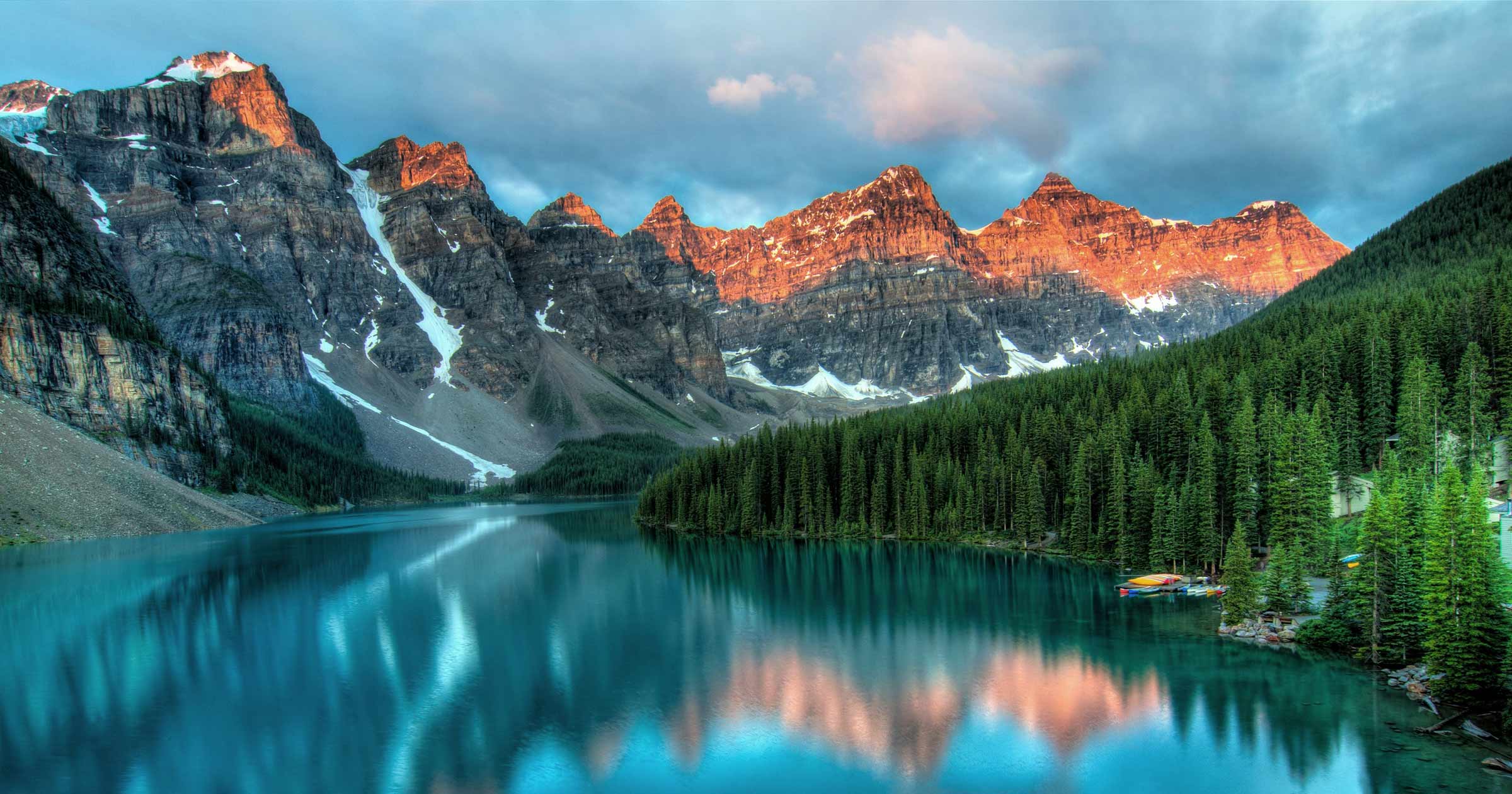
When the Bank of Canada was preparing a new twenty-dollar banknote in the late 1960s, a view of Moraine Lake and the Valley of the Ten Peaks was chosen for the back. The first engraving was made, examined, and then rejected: the mountains looked unnatural. The reason was quickly discovered. The original photograph was pieced together with scissors and tape from several photographs. They had to ask the Canadian Pacific Railway for a new, single, honest shot, and only from this was the engraving made, which in June 1970 found its way into wallets across the country.
Since then, crowds of people with cameras have flocked to this view every summer. Many photograph it as if it were a postcard: glued together, adjusted, made "even more beautiful." But you have a different job. The couple brought twenty of their closest people here not for a postcard, but for the day, which should remain exactly as it was: a cold dawn, steam pouring from their breath, the groom's mother in a down jacket over her dress.
This guide is for videographers traveling to Banff and the Canadian Rockies to shoot a wedding or elopement: Lake Louise, Moraine Lake, Icefields Parkway, and, where relevant, Jasper and Yoho. Who issues licenses, and why you might need two? How many people can you invite to a ceremony in the park? Why using a drone at a wedding is almost impossible here—even if you have all the necessary pilot's papers? How to get to Moraine Lake by dawn if the road is closed to cars? What do Canadian laws say about recording audio? Where can you get married? How can you avoid getting caught between a moose and her calf? And how can you deliver a film to a family living in Montreal, Cardiff, and Perth? We create OurStoria—a platform for delivering films to clients, and the last section is about that. Other countries and cities can be found in our guide directory.
Disclaimer. We are not lawyers or flight instructors. All information about laws, drones, and site regulations is taken from government agencies' websites and the sites themselves as of November 2026. Rules are subject to change—check before you fly.
Do You Need a Permit to Film a Wedding in Banff?
Yes. It's not called a permit, but a business license, and it's issued by Parks Canada, the federal agency that manages national parks.
The regulations for mountain national parks (Banff, Jasper, Yoho, Kootenay, and others) clearly state this: photographers who shoot in the parks with the intention of selling images or videos require a business license. The list of activities covered by this license includes a separate line item for wedding photography and videography. If you're being paid for the shoot, you're covered by this rule, regardless of where you're flying in from.
How does a license differ from a film permit? A film permit is a permit for a filming project: advertising, documentaries, travel content for blogs and social media. Weddings are not eligible. However, there's a caveat: styled shoots and "project" work may require a film permit, and Parks Canada decides this. If you're planning a separate day with portfolio models in addition to the wedding, that's a different matter, and the cost is different:
| What are you shooting | What's required | Timeframe | Cost |
|---|---|---|---|
| Wedding or special event for a couple | Parks Canada Business License | Service standard: 15 business days for a full application | Price not published on the website - email for details |
| Styled shoot, studio promotional video | A film permit may be required - Parks Canada decides | Minimum 20 business days in advance | For a group of 1-6 people: $177.25 per application + $589.25 for each day on location |
| Photos "for yourself," not for sale | Nothing | — | — |
All amounts are in Canadian dollars.
Who to write to? The park is divided into zones, each with its own email address:
- Banff area — [email protected];
- Lake Louise area, including Icefields Parkway, as well as Yoho and Kootenay — [email protected];
- Jasper — [email protected].
Parks Canada licenses are valid for one year—from April 1 to March 31 of the following year. If you shoot in Banff in October and May, these are two different license years.
The Town of Banff is a separate jurisdiction. Within the national park, there is a municipality called the Town of Banff, with its own rules. Parks Canada is clear about this: if a business operates only in the town, the town issues the license; if you're shooting in both the city and the park, you'll need both, from Parks Canada and the Town of Banff. A typical wedding day here is exactly that: getting ready at a hotel in the city, then portraits by the lake in the park. How much does a city license for visitors cost, and is a separate film permit required within the city limits? The current rules are on the Town of Banff website (https://banff.ca).
What neither license includes. Exclusive use of the location. The park is a public space, so you can't fence off the shore for an hour of filming. And something many people learn about too late: drones. More on that below.
List of "summer prohibitions." The same regulations also list locations where commercial filming projects are not considered from June 1 to September 30: Lake Louise, Moraine Lake, Bow Lake, Peyto Lake, Morant's Curve, Lake Minnewanka, Two Jack Lake, Johnson Lake, Vermilion Lakes, Johnston Canyon, and others, as well as Takakkaw Falls and Emerald Lake in Yoho. According to the regulations, this applies to commercial film projects, that is, what a film permit is issued for. This section says nothing about business licenses and weddings. Practical conclusion: a wedding at Lake Louise in July with a business license is not prohibited by this list, but an advertising styled shoot there in the same month will not be considered. If your day falls somewhere in between these terms, ask Parks Canada in writing and keep their answer.
Wedding Ceremonies in Banff National Park
Blogs by elopement photographers write about a "special use permit" for the ceremony. The original source seems both simpler and stricter: it's a registration form, not a permit. It must be signed and sent to Parks Canada no later than three days before the ceremony; there's no fee. By signing it, the organizer agrees to the terms—and these terms are what change your shoot.
No more than 20 participants. The form doesn't specify whether the photographer, videographer, and officiant are counted among the 20. It's safer to count everyone standing near the arch. Twenty people is a couple, parents, grandparents, a couple of friends, the officiant, you, and the photographer. That's all.
No sound equipment. The form explicitly prohibits PA systems, amplifiers, generators, and loud music. A guitar, flute, or harp is recommended. This means the officiant's voice won't go through a speaker, so you can't take it from a sound desk. A lav mic on the officiant (with their consent), a lav mic on the groom, and a separate recorder at the arch are the only way to get clean vows. On the shore of a mountain lake, wind is a factor. We discussed how to assemble such a setup in detail in our guide to recording audio at a wedding.
Minimal props. An arch, a table for the officiant, and one chair. No tents. Nothing should be tied to trees. Confetti of any kind is prohibited—including rice, "eco-confetti," and flower petals. If the couple dreams of a photo with petals on the exit, this should be discussed before the wedding, not on-site.
Public location. The site cannot be fenced off; tourists will be passing by. Parks Canada recommends choosing less popular locations or earlier or later times. Another detail worth checking in advance: day-use areas are officially open from 7:00 AM to 11:00 PM. If the couple wants a sunrise ceremony, check with Parks Canada to see if this applies to your location.
Entrance passes are required for everyone. A day pass in 2026 costs $12.25 per adult or $24.50 per family or group in one car; an annual Discovery Pass costs $83.50 and $167.50. This applies to both you and your guests.
Yoho — different office, different province. Emerald Lake and Yoho Falls are in British Columbia. Yoho Park has its own registration form, which is processed through the Lake Louise office. However, marriage, as we'll see below, is legally regulated by another province.
Twenty People—and the Rest of the World. The 20-Participant Rule makes most park weddings microweddings: a ceremony for the closest people, followed by a larger dinner in the evening in town. We explored this format in our microwedding study. For a videographer, the key takeaway is this: the other hundred people will only see the ceremony in your film. And the day is typically broken into three or four locations—sunrise at one lake, the ceremony at another, portraits on the Icefields Parkway, dinner in Banff. Break the film into chapters based on locations and moments: sunrise, vows, rings, first dance. In OurStoria client galleries, chapters can be imported directly from Premiere Pro or DaVinci Resolve markers or arranged manually - we described how this works in the article about wedding film chapters.
Can You Fly a Drone in Banff National Park?
The short answer: no, not at weddings.
Recreational flights are prohibited in all areas managed by Parks Canada. Commercial flights are theoretically possible, but require two documents: a Commercial Film Permit and a Restricted Activity Permit – regardless of drone size, including models lighter than 250 grams. And then comes the sentence that settles the matter: commercial flights are approved only for natural resource management, public safety, law enforcement, and park management purposes, including park education and promotional filming. The decision is made by the district superintendent. Weddings fall into none of these categories. And drones are listed separately as prohibited on the ceremony registration form.
The fine for flying without a permit is up to $25,000.
Why so strict? In 2025, a man flew an 852-gram drone near Lake Louise. The drone wasn't registered, and another visitor warned him that flying was prohibited in the park. He took off anyway. According to Parks Canada, as cited by the CBC, a helicopter carrying park staff conducting avalanche control had passed through the same area about half an hour earlier. In December, the man pleaded guilty in Canmore court and received a $2,000 fine. Parks Canada uses helicopters in Banff almost every day—avalanches, trails, rescue operations—and has counted more than 400 drone incidents since 2022, 113 of them in 2025 alone.
To the couple, this sounds like "what a pity." To you, it's a contract clause: if the couple requests aerial photography in Banff, state explicitly that it won't be available in the national park and offer an alternative.
Where drone use is permitted. Outside national park boundaries, but even there it isn't a free-for-all:
- Canmore and Kananaskis are provincial land in Alberta. Recreational flights are also prohibited in Alberta Parks, and commercial drone photography requires a Professional Film and Photography Permit. They require $2,000,000 in liability insurance and may charge a deposit of $1,000. The Alberta Parks page on drones states that an Advanced or SFOC certificate is required, and a basic certificate is "not considered."
- Private land outside park boundaries requires the owner's consent and is subject to Transport Canada regulations.
If you're a foreign pilot. Transport Canada considers anyone who is not a Canadian citizen or permanent resident to be a foreigner. For a drone over 250 grams, you need a Canadian pilot certificate—even if you fly legally at home, under Part 107, or under British and Australian regulations. Foreigners can't register a drone in Canada, so you need a SFOC-RPAS—a special flight operations certificate. For commercial use, it's issued to citizens of countries with which Canada has a free trade agreement (the list includes the United States, United Kingdom, and Australia), and the processing time is 60 business days. That's about three months, not the week before your wedding.
Another detail from Canadian regulations: with a basic certificate, you can't fly close to or over people or in controlled airspace. A wedding is all about people. So, we're talking about an Advanced certificate, and controlled airspace is checked through NAV Drone—a service from NAV CANADA.
The most realistic option for a visitor is a local pilot with Canadian documents filming outside the park. Your job is to follow the shot list and timing, theirs is to ensure legal flight. If you're accustomed to American regulations, we have an article about drones at US weddings as an example of how the FAA operates; it doesn't apply to Canada.
Visiting Lake Louise and Moraine Lake
Two of Canada's most famous lakes—and the most challenging logistics in this guide.
Moraine Lake: No Car Access. The road to Moraine Lake is closed to private vehicles year-round. It's used by Parks Canada shuttles, licensed commercial operators, and guests of Moraine Lake Lodge. The "I have a business license, I'll drive a couple myself" approach doesn't work: commercial permits for this road are only issued to vehicles with 11 seats or more, taxis are prohibited for photography and accommodation businesses, and business license holders who are not approved operators, according to Parks Canada, must reserve seats on the shuttle or transport clients through an approved operator.
Shuttles. Shuttles to Moraine Lake operate from June 1 to October 12 (weather permitting), from 6:30 AM to 5:00 PM, with the last return departure at 7:30 PM. An adult ticket in 2026 is $12.75 plus a non-refundable $3.50 online reservation fee. Reservations opened on April 15th: about 40% of seats are available immediately, the remaining 60% are available two days before departure, at 8 a.m. Mountain Time. There are no rules regarding large bags, gear cases, and tripods on the shuttle page—check with Parks Canada before your trip, not with the bus driver.
Dawn. The regular 6:30 a.m. shuttle is too late for the summer sunrise. For those arriving before sunrise, there are Alpine Start shuttles at 4:00 a.m. and 5:00 a.m. from the Lake Louise Lakeshore parking lot to Moraine Lake. Parking there is paid ($42 per day during the 2026 season), and return travel is via the Lake Connector until 6:00 p.m. There is no wheelchair-accessible transport at Alpine Start this season. If there is a grandmother with a walker in the group of twenty, this must be arranged in advance through an approved operator.
Can You Get Married at Moraine Lake?
Yes, the same rules apply as the rest of the park: registration, up to 20 participants, no speakers, no drones, everyone with an entrance pass, and everyone travels by shuttle or licensed operator. The season is short: Parks Canada lists the visiting window as early June to mid-October. The lakes typically thaw by the end of May. In winter, the road becomes a ski trail, and the lake itself is inaccessible due to avalanche danger.
Lake Louise. Parking fills up before dawn and remains full until sunset, according to Parks Canada. Lakeshore parking costs $42 per day during shuttle season. Free Park and Ride parking at the ski resort is available for those with a shuttle reservation, with entry from 6:00 AM to 8:00 PM. If the commercial parking lot is full, operators can only drop off or pick up passengers, for a maximum of 10 minutes.
Calculation on a napkin (our estimate). Jesse from Denver is shooting Élodie and Rhys at the end of August. The couple's schedule: sunrise on Moraine Lake, 11:00 AM ceremony at another lake, portraits, dinner in Banff.
- 3:40 AM — Jesse parks at Lake Louise Lakeshore ($42);
- 4:00 AM — Alpine Start shuttle with case, backpack, and tripod;
- Around 6:40 AM — sunrise (at the end of August, it's a little over an hour later than in June), the couple in wedding attire and down jackets;
- 8:30 AM — back, change, makeup artist, second camera — guests gather;
- 11:00 AM — ceremony for 20 people;
- evening — dinner in Banff, now in the city where the Town of Banff license is valid.
For Jesse, this means two licenses, shuttle spots for everyone heading out at dawn, and no extra minutes to park after 4:00 AM.
Fairmont Banff Springs Photo Shoot Policy. The castle hotel in Banff has its own published photography policy:
- Wedding and engagement shoots — only with a signed wedding or event contract at the hotel;
- "Personal" photo sessions — only for hotel guests, and not on Saturdays from May to October;
- 2-3 weeks' notice required for any shoot;
- Commercial photography may also require a permit from the Town of Banff;
- Drones — prohibited in the national park.
If a couple isn't celebrating at Banff Springs but wants "a couple of shots in front of the castle in the courtyard," the answer is likely "no." Fairmont Chateau Lake Louise on the shores of Lake Louise is a separate hotel with a separate wedding team. We didn't find any published policies for out-of-town photographers; please check with the hotel's wedding service in writing.
Icefields Parkway, Jasper and Yoho
The Icefields Parkway is a 232-kilometer road from Lake Louise to Jasper, along glaciers, Bow Lake, and Peyto Lake. Parks Canada clearly warns: services are limited, and there is no cell phone service. Gas stations are available in Lake Louise, at the Saskatchewan River Crossing (summer only), and in Jasper.
For a photo shoot, this means:
- The timeline, contacts, and offline maps should be on your phone before departure;
- Spare batteries should be charged in the evening, as there won't be a power outlet until dinner;
- An agreement should be in place stating what to do if a couple is two hours late and can't be reached.
Portraits at Peyto Lake and Bow Lake are also within the Lake Louise business license area. If a couple wants to go to a glacier or into the backcountry, Parks Canada requires an ACMG-accredited guide.
Jasper. Its own park, its own license (Jasper National Park business license), its own email address. Jasper's page contains an important detail: film permits are currently only accepted for projects until April 1, 2027; applications for later dates are not processed. This doesn't directly affect weddings with a business license, but it does demonstrate how quickly the status here changes. The city of Jasper, like Banff, has its own municipality with its own license.
Yoho and Kootenay. Emerald Lake and Takakkaw Falls are in British Columbia. The business license goes through the same Lake Louise / Yoho / Kootenay email address. However, marriage is subject to BC laws (more on that below). Also, from June 1 to September 30, Emerald Lake and Takakkaw Falls are also on the "summer" list for commercial filming projects.
Is Canada a One-Party Consent Country?
For recording conversations, yes. Section 184 of the Criminal Code of Canada makes it a crime to intentionally intercept a private communication using a device—a penalty of up to five years in prison. However, there is an exception: if the interception is done with the express or implied consent of the speaker or the recipient.
What does this mean at a wedding:
- Lavalier microphones on the groom and the officiant—they know about the microphone and consent. This is normal practice.
- A recorder left on the table at a cocktail party, recording guests' conversations when no one from your team is present, is a gray area. A private conversation between two people who were unaware of the microphone and were not speaking to either of you is precisely what the statute prohibits. Place recorders where there is public speaking: toasts, vows, speeches.
- Don't forget to turn off the lavalier microphones. A groom taking the microphone to the restroom and then to his parents' room isn't about the law, it's about trust.
Privacy. Alberta and British Columbia each have their own personal information protection laws (PIPA) for private businesses within the province, while the federal PIPEDA applies to data that crosses provincial and national borders. Sending a film to families in Montreal, Cardiff, and Perth is just such a case. We're not lawyers and won't pretend to be; the rule of thumb is simpler than any law:
- The contract with the couple — a separate clause: whether the footage can be used in portfolios and advertising, and whose images exactly — the couple, guests, children;
- Guests should be notified — a line in the invitation or on the wedding website: "photography and video will be included";
- For advertising — only the couple or those who agree. Guests remain in the film for the family.
The film doesn't have to be public. Many people are used to sharing a wedding link on YouTube or Vimeo—and a year later, the video with all the guests' faces is circulating in other people's chats. It's safer when the film with the guests is stored in a private gallery for family viewing. In OurStoria's client galleries, viewers can access the film via a link without registration; the gallery can be password-protected, and you edit the teaser for social media separately—only for those who agree to share it.
Getting Married in Alberta: Marriage Licence
For a videographer, this is a question for the script: will the film feature a real marriage registration, and who will perform it?
Alberta (Banff, Lake Louise, Icefields Parkway, Jasper)
- Marriage licenses are issued by registry agent offices. The fee is $40, plus the agent's fee, which varies from one agent to another.
- Applications must be submitted in person by both parties.
- The license is valid for three months and is only for marriages in Alberta.
- No waiting: the ceremony can take place on the same day.
- There are no residency or citizenship requirements—couples from the US, UK, and Australia can legally marry here.
- Two adult witnesses are required for the ceremony. Proxy marriages (where someone else stands in for one of the spouses) are not permitted.
British Columbia (Yoho, Emerald Lake). Different provinces have different rules: a license costs $100 and is non-refundable. It must be bought no more than three months before the wedding, in person, from a local marriage licence issuer. Two witnesses over 19 years of age are required. An Alberta license is not valid for a ceremony in Emerald Lake.
What does this mean for filming:
- Witnesses are included in the twenty-person group. At an elopement for two, the witnesses are often the photographer and videographer—agree in advance who signs and who films the signature.
- The officiant (marriage commissioner or religious representative) speaks without a microphone or speaker—there are no speakers in the park. Discuss a lapel microphone when you meet.
- If a couple is registering at home - for example, Élodie and Rhys are getting married in Montreal a week in advance, and there is a symbolic ceremony in Banff - the vows will be written by the spouses themselves, and the sound must be flawless.
Best Time of Year to Get Married in Banff
Summer is shorter than it seems. Lakes typically thaw by the end of May, and Moraine Lake is open from early June to mid-October. According to Parks Canada, mountain passes may not be snow-free until late June. And, as the park reiterates on several pages, snow is possible here any month of the year. In July, the average high in Banff is 22°C (72°F), and the average low at Lake Louise is 3.6°C (38°F). A sunrise shoot at Moraine Lake in August means steaming breath and a down jacket over your dress. The temperature drops about 1°C (1.8°F) for every 200 meters of elevation gain—Banff is at 1,397 m (4,583 ft), and Lake Louise is at 1,524 m (5,000 ft).
Winter is beautiful and harsh. January at Lake Louise averages -7.5°C (18.5°F) during the day and -21.4°C (-6.5°F) at night. Batteries lose charge in the cold: keep spares in an inside pocket, not in a top case. Don't bring a camera straight from the cold into a warm restaurant—condensation will form. And remember: Moraine Lake is closed in winter due to avalanche danger.
Wildlife. Banff is their home, you're a guest. Parks Canada requires you to stay:
- 30 meters (three bus lengths) from deer, elk, sheep, and moose;
- 100 meters (ten bus lengths) from bears, wolves, cougars, and coyotes.
Disturbing or luring wild animals is prohibited; fines can be up to $25,000. Elk are a special case, as they freely roam the streets of Banff and the lawns of hotels. The park warns: females are especially aggressive during calving season, in May and June, and males are especially aggressive during the rutting season, from late summer to late October. A September wedding with portraits on a meadow where a herd is grazing isn't a great shot, it's a risk. Use a long lens and don't put the couple between you and the animals.
Also, anything that smells—food, cake, candles, even a bag of cosmetics—shouldn't be left unattended. This requirement is included in the ceremony form.
Light. We calculated the sunset time for Banff using the standard solar position formula (local time):
| Date | Sunrise | Sunset | From +6° to -4° ("golden hour") | Sunset → end of civil twilight |
|---|---|---|---|---|
| May 15 | ~5:51 | ~21:27 | ~74 min | ~41 min |
| June 21 | ~5:26 | ~22:02 | ~82 min | ~47 min |
| July 15 | ~5:44 | ~21:52 | ~77 min | ~44 min |
| August 15 | ~6:28 | ~21:04 | ~69 min | ~37 min |
| September 15 | ~7:17 | ~19:57 | ~64 min | ~33 min |
| October 15 | ~8:05 | ~18:50 | ~67 min | ~33 min |
| December 21 | ~8:43 | ~16:37 | ~85 min | ~40 min |
This is an astronomical sunset—over a flat horizon. No one will see it in the mountains. Banff and Lake Louise are in valleys, and the sun sets behind the ridges significantly earlier than the time indicated in the chart (our estimate; the exact time for a specific location will be shown in the terrain app). But in June, the evenings are long, and twilight lasts until almost eleven.
The main conclusion for these lakes is morning. At dawn, the sun shines from behind the peaks, and the peaks above Moraine Lake and the glacier above Lake Louise glow pink while the water is still in shade and windless. In the evening, the same lakes are often in the shadow of the mountains. Daylight Saving Time in 2027 begins on March 14 and ends on November 7—after this date, sunset jumps an hour earlier.
Flying into Calgary with Camera Gear
The nearest major airport is Calgary (YYC). Banff is about 145 km away, about an hour and a half on the Trans-Canada Highway (our estimate, without traffic or a herd of elk on the side of the road).
Can you work in Canada? This is the first question, and not a customs question. IRCC defines a business visitor as someone who comes for international business without direct access to the Canadian labour market and who must prove that their primary income and principal place of business are outside of Canada. We didn't find a separate page on IRCC for wedding photographers and videographers. A couple from Montreal hiring a videographer from Denver is exactly the kind of situation where you should ask IRCC or a licensed immigration consultant before your trip, not at the border.
Equipment at customs. Canada participates in the ATA Carnet system. According to Canada Border Services Agency (CBSA) regulations, a carnet replaces national temporary import documents and a duty bond. It is issued not by the CBSA, but by the Chamber of Commerce in your country. An alternative for a one-time trip is the E29B temporary import form. Regardless of your choice, a list of your equipment with serial numbers is required at the border, and the equipment must leave with you.
Road and Car. An SUV isn't necessary, but winter tires are required in winter—Parks Canada recommends winterizing your car from November to March. When entering the park, purchase a pass for everyone in the car. And don't plan a "quick stop at Lake Louise" after 9 a.m. in July.
Delivering the Film to Montréal, Cardiff and Perth
Banff is almost never a "local" wedding. Let's get back to Élodie and Rhys. Her family is in Montreal and Quebec, and her grandmother, Lucille, speaks only French. His is in Wales, and Nain Gwen watches everything on a tablet. Rhys's cousin lives in Perth. There were twenty people at the ceremony. The remaining ninety are waiting for the film.
| Where to watch | Time difference with Banff in summer (MDT, UTC-6) |
|---|---|
| Banff, Calgary | 0 |
| Montreal, Toronto | +2 hours |
| Cardiff, London | +7 hours |
| Perth | +14 hours |
Send the link at 9 AM Banff time—it's already 4 PM in Cardiff, and 11 PM in Perth. Our simple plan: around 7-8 AM Mountain Time. This is morning in Montreal, lunch in Wales, and evening in Perth (our estimate of the "golden mean," not a rule).
What works here:
- One link that opens without registration. Grandma Lucille won't create an account for her granddaughter's wedding.
- The film, vows, dinner speeches, and photos—all right next to each other. Otherwise, the links will be scattered across three family chats, and half of them will be lost in a year.
- The interface language is for the viewer. The Quebec half of the family will understand the "Regarder" and "Télécharger" buttons faster than "Watch" and "Download."
- Anyone can watch, but the family can download. A hundred people will watch the film, and the parents will save the original.
This advice works with any tool: a cloud folder, a website page, or a separate password for the archive. Naturally, we favor our own. In the OurStoria client gallery, the film, individual clips (vows, toasts), and photos are all located under a single link with your logo; viewers don't need to register. You choose the gallery language for each project—eight languages, including French. We described how this works in the article about client gallery language. For Élodie and Rhys, you can create two galleries—a French one for Quebec and an English one for Wales and Perth. And for downloading, you can set a separate password, which only the family knows. For more details on the process, check out our guide to delivering wedding video to clients, and for general information on filming abroad, check out our destination wedding research. If you're also shooting in Iceland, Greece, or Los Angeles this season, check out our guides to Iceland, Greece, and Los Angeles.
Start a 7-day free Pro trial →
A drone that "no one will notice." A shuttle that "we'll somehow get a seat on." A meadow where "those deer are tame." All this can be solved if you find out in advance.
The Bank of Canada once threw away a beautiful composite and asked for one honest shot. Élodie will click the link for Rhys's voice, which wavered on "I do" at eight degrees Celsius. And Mémère Lucille—for the moment when the granddaughter, standing in a down jacket over lace, looked into the camera and said in French, "Grandma, this is for you."
Related articles:
- All Wedding Filming Guides for Videographers
- Filming Weddings in Greece: Santorini, Athens & the Islands — Drone Rules, Permits, Churches and Light
- Filming an Iceland Elopement: Permits, Drone Rules, Weather and Light — a Videographer's Guide
- Filming Weddings in Los Angeles: Permits, Drones, Beaches and Light (2027)
- The Micro-Wedding Revolution: How Smaller Events Changed Wedding Videography Forever
- Destination Wedding Videography: Logistics, Storytelling Challenges, and Satisfaction Data From 1,400 Events
- How to Record Audio at a Wedding: Vows, Toasts, Readings and the Kit
- Wedding Film Chapters: How to Add Them from DaVinci Resolve and Premiere Pro
- Client gallery language per project: delivering weddings in the couple's language
- How to Deliver Wedding Video to a Client: A Step-by-Step Workflow