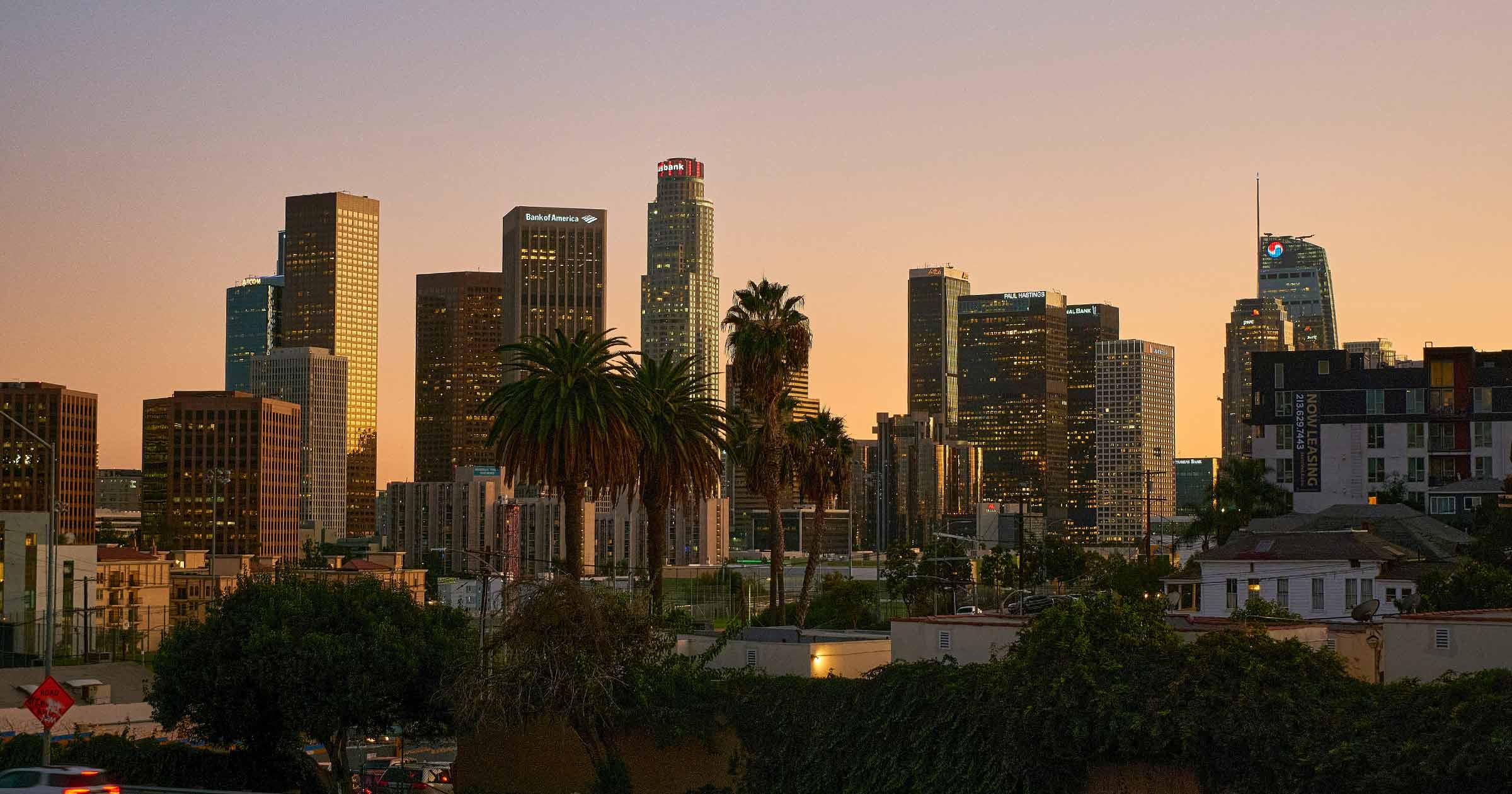
Imagine a typical Los Angeles Saturday. Getting ready at a Santa Monica hotel. First look at Zuma Beach. A ceremony at a ranch in a canyon above Malibu. Sunset portraits at Griffith Observatory. A reception in a Downtown loft.
Five locations. Four different government departments. Three types of airspace. One day.
That's the key to Los Angeles. There's no single "city" where you can learn the rules. There's the City of Los Angeles, Los Angeles County, dozens of individual cities within it (Malibu, Santa Monica, Beverly Hills, Pasadena), state beaches, city parks, county parks—and each has its own answer to the question of "can you film here?" FilmLA, a nonprofit that issues filming permits for much of the region, works with 21 jurisdictions. And even it writes very cautiously about weddings: they "often do NOT require a permit," but "exceptions apply based on location used." This guide is for videographers shooting weddings in LA: locals who want to sort out the paperwork once and for all, and out-of-state videographers who follow their couple here. Inside: when a permit is needed and how much it costs, Malibu beaches and state beaches, Griffith Observatory, drones near LAX and stadiums, California's recording law, June Gloom, Santa Ana winds, valley heat, and traffic. We run OurStoria—a platform through which videographers deliver films to clients—and at the end, we'll tell you how to deliver a film to a family living in three countries.
Rules and fees are current as of November 2026. Check the agency pages before your 2027 season; they change more frequently in LA than you might think.
LA in One Table: Who Decides Where
First, the short answer. Almost everything in Los Angeles is determined by the type of land you're standing on, not the city on the map.
| Where are you shooting | Who decides | Does the videographer need a permit | Drone |
|---|---|---|---|
| Private location (ranch, hotel, winery, loft) | Location | Usually no, unless the shoot is outdoors | Location + FAA decides |
| City of LA Parks (Griffith Park, etc.) | Recreation and Parks, Park Film Office + FilmLA | For commercial filming - yes | Prohibited in all city parks |
| LA County Parks | County via FilmLA | In some parks - yes, even for wedding portraits | Only with a permit |
| LA County Beaches (Zuma, Point Dume, Venice, Will Rogers, etc.) | County via FilmLA (+ city, e.g., Malibu) | For commercial filming - yes | Currently not permitted in any |
| Beaches and state parks (El Matador, Leo Carrillo, etc.) | California State Parks through the California Film Commission | Often yes; the park decides | Case by case, Part 107 only |
| Santa Monica (beach, parks, pier) | Film Santa Monica (since September 2025) | For commercial filming - yes | Separately through the city + FAA |
Hence the first rule of planning: break down your day by location and determine for each one whose land it is. The ranch is private. The beach beneath the ranch is most likely county or state property. The viewing platform by the road could be a park. And each answer changes both the paperwork and the drone.
Do You Need a Permit to Film a Wedding in Los Angeles?
The short answer: on private property, usually no. In public places, very often yes.
FilmLA puts it this way. They have a list of activities for which a permit is "often not required," and wedding photography and videography are on it, with the caveat "exceptions apply based on location used." It also states that in some county parks, permits are required even for wedding and portrait shots. And there are two general rules that are useful to remember verbatim:
- Weddings are a special case. Commercial photography generally requires a permit, but wedding photography and videography are among those FilmLA lists for which a permit is "often not required": filming is done for family. Exceptions vary depending on the location: in some county parks, a permit is required even for wedding photos, and the city of Newport Beach requires a permit for any paid professional filming, whether commercial or personal.
- If your shoot could ruin someone's day, a permit is most likely required. A tripod across a walkway on a pier, lights on the beach, a group of eight people on an observation deck—that's all "public impact."
How does this work in practice? Gatherings, ceremonies, and receptions on site—no permit required; the venue itself decides where you stand. But portraits like "let's run to the beach for ten minutes" are a different matter. The beach is owned by the county or state, and they have their own rules for commercial photography, their own hours, and their own fees.
Why is this important in LA? Here, filming permits are a well-established industry. At major beaches and popular parks, there are rangers and lifeguards who see film crews every day and can distinguish between a couple with a phone and a videographer with a gimbal, slider, and an assistant. The chances of being approached are higher here than in a small town.
How to distinguish "no paperwork required" from "permit required." Ask yourself three questions:
- Is this private property, and do you have the owner's permission? Then you most likely don't need a permit.
- Is this a public space, and are you there as a photographer with one camera for 15 minutes? It's a gray area: some places tolerate this, others don't. Check the specific location's page.
- Is this a public space, and do you have a tripod, lights, sound, assistants, a drone, or more than a few people? You almost certainly need a permit.
If in doubt, call FilmLA—they directly invite you to ask questions about a specific project. Five minutes of conversation is cheaper than a cancelled sunset session.
Contract. Who pays for the permits—you or the couple? Who chooses the locations for the portraits? What happens if the couple wants to "go to the beach" at the last minute? All of this should be spelled out in advance. A clause about locations and permissions can be added to our contract template.
How Much Does a FilmLA Permit Cost?
This is where the fun begins for a videographer. Prices depend not only on the location, but also on whether it's photography or video.
According to FilmLA's price list for November 2026:
| Fee | Amount | Comment |
|---|---|---|
| Still Photo Application Fee | $104 per permit | Photos only; if there are 16+ people in the group, it's priced as motion |
| Permit Application Fee (motion) | $931 per permit | Up to 5 locations, up to 7 consecutive days |
| Still Photo Rider (changes) | $31 | |
| Drone Administration Fee | $78 per location | Plus insurance and paperwork, see the drone section |
| County Beach, photos, 1-15 people | $100 per day | County Use Fee |
| County Beach, filming | $400 per day | County Use Fee |
| Lifeguard (if required) | $230 per hour, minimum 4 hours | Paid directly |
On top of this come jurisdiction-specific fees. Some cities in the FilmLA network raised their fees effective July 1, 2026, while FilmLA itself hasn't raised its fees this fiscal year.
Calculation on a napkin. A couple wants 30 minutes of portraits on Zuma before the ceremony. If you read the price list literally, the photographer will pay a photo application fee ($104) and a day's beach fee ($100), or about $200. Under the same price list, video counts as motion: an application fee of $931 plus $400 for a day's beach, or about $1,330. For the same half hour, on the same sand. And that's before the Malibu city fee: Zuma requires a double permit, from FilmLA and the city. (This is our calculation based on published prices. Please check with FilmLA to determine how a small wedding video crew is classified before quoting a couple: 213-977-8600 or [email protected].)
This six-fold difference explains what you've likely seen: many videographers in LA shoot portraits on-site or on private land, and only go to the beach with a photographer. It's not laziness. It's simple math.
What to do with this math?
- Ask about the beach at the first meeting. If the couple dreams of Malibu, it's best to choose a location with private water access or a private beach.
- If a permit is absolutely necessary, include it in the estimate as a separate line item. The couple will understand "permit to film on the county beach - $X," but won't understand why the package suddenly went up by a thousand.
- Combine locations. A motion permit covers up to five locations over seven days. If the couple also has a welcome dinner and a morning-after shoot on the beach the same weekend, one permit can cover them all.
Malibu Beach Wedding Permit
Malibu is the most common "we want to go to the beach" in LA and the most confusing from a paperwork perspective. On the same coastline, just a few minutes' drive from each other, lie beaches owned by three different owners.
County Beaches — Zuma, Westward (Point Dume), Malibu Surfrider, Nicholas Canyon, and Dan Blocker. FilmLA handles filming here, and all five require a dual permit: FilmLA and the city of Malibu. Current rules for county beaches are available on the LA County Beaches & Harbors website and at FilmLA. Important information for a wedding:
- Filming on county beaches is permitted from 6:00 AM to 10:00 PM; later shooting is only possible with prior approval and with a lifeguard;
- A beach reservation is required;
- Drones are currently not permitted on any county beaches;
- In areas near residential areas, the county may require a neighbor survey.
State Beaches — El Matador and other State Parks beaches, Leo Carrillo. FilmLA doesn't work with them at all, even if the beach is located in the city it serves. Permits are issued by the California Film Commission (CFC), and the individual park decides:
- The CFC permit itself is free, but the park charges a review fee of $100 per day for simple filming, $250 for complex filming;
- You must start by calling the Park Film Coordinator, with an application submitted at least four business days in advance;
- Whether a permit is required for "personal" filming with professional equipment is determined by the park, not the CFC;
- Drones are subject to separate review and only with a Part 107 pilot;
- If the park requires an employee observer, they are paid for at least six hours.
State parks also have their own restrictions on days and hours, especially on weekends. Check with the film coordinator before promising a couple a Saturday sunset at El Matador.
The City of Malibu issues its own permit for commercial filming within city limits. According to the city, filming is prohibited on Sundays without exception—check the current rules and fees on the City of Malibu website before scheduling a shoot.
Important difference: the ceremony and the filming are two separate permits. If a couple is getting married directly on the beach, the permit for the ceremony itself (chairs, arch, guests) is obtained by the couple or the planner. Your filming is a separate matter. Ask the couple what exactly they've been permitted to do, and don't assume their permits cover you.
Santa Monica. Since September 1, 2025, permits in Santa Monica have been issued by the new city agency Film Santa Monica, not FilmLA. A permit is required for commercial photography in any public space in the city, including Santa Monica State Beach and beach parking lots, and site approval is required at least five business days in advance. The pier has its own rules and administration. If your Santa Monica guidelines are older than fall 2025, they're out of date.
Palos Verdes. If a couple sends you a photo of the glass Wayfarers Chapel and says, "We want it like this," it's no longer there. The chapel, designed by Lloyd Wright, son of Frank Lloyd Wright, was closed in February 2024 due to the Portuguese Bend landslide, just two months after it was designated a National Historic Landmark, and was dismantled for preservation by the fall. A new location has already been selected—the former Battery Barnes military site, about a mile west, next to Rancho Palos Verdes City Hall—but construction and opening dates have not yet been announced. It's worth knowing before a couple starts looking for a "similar venue nearby."
Griffith Observatory Wedding Photography
Griffith Observatory is one of the most recognizable wedding locations in LA: the city below, the Hollywood sign on the hill, the sunset over the ocean. And it has—rarely—very clear rules, published by the observatory itself.
What is allowed. The observatory explicitly permits personal photography both inside and outside the building, and specifically states: this includes photography by a professional photographer for personal purposes—for example, a wedding photographer working for a couple.
Where staged shots are prohibited:
- inside the building;
- on the roof;
- in the telescope dome;
- in the Gottlieb Transit Corridor;
- in a way that blocks steps, sidewalks, driveways, parking lots, and roads.
Photography is prohibited entirely in theaters and the Zeiss telescope dome.
Equipment. For personal filming, a camera and "careful use of a tripod" are permitted—outdoors only. Additional lighting is not permitted. For videographers, this means a gimbal and camera in hand, no on-camera panels or stands. If you're used to backlighting faces at sunset, here you'll have to work with what you have and choose an angle to the sun. A gimbal that won't tire your hand after twenty minutes is in our gimbal guide.
When a city permit is needed. Any commercial filming at the observatory requires a city permit and prior approval from the observatory staff; processing is handled through the Park Film Office and FilmLA. The observatory explains the line between "wedding photographer for a couple" and "commercial filming" using a photographer as an example. If you have a crew of three cameramen with sound and an assistant, it's wise to call the Park Film Office in advance.
Drone. No. The observatory specifically states that any drones or radio-controlled vehicles are prohibited in all city parks. Griffith Park is a city park.
Practical. At sunset, the observatory is crowded with tourists, especially on weekends. The best wedding shots are taken on weekdays or on the park trails below the building, where there are fewer people. But the trails and tunnel are owned by Griffith Park and the Park Film Office, not the observatory, and the observatory's rules do not apply to them.
Can You Fly a Drone in Los Angeles?
Yes, it's possible. But in LA, this is the most complex issue of all. We covered the general rules—Part 107, flying over guests, twilight, Remote ID, LAANC—in a long article about wedding drones. Here are just the things Los Angeles adds. And it adds a lot.
Layer 1: Air. Los Angeles is surrounded by airports. Around LAX is Class B airspace, the most restrictive, and at the airport itself, it begins at the ground. Below and nearby are Santa Monica (Class D under Class B), Hollywood Burbank (Class C), Van Nuys and Long Beach (Class D), plus several smaller airports. For a videographer, this means: in Playa del Rey, El Segundo, Inglewood, Westchester, the valley near Burbank, and Van Nuys, a drone cannot take off without LAANC permission, and near LAX, many LAANC grid cells have a zero-foot ceiling. Check the takeoff point in the app, not the city, a week in advance, and again on the morning of the shoot.
Layer 2: Stadiums. There are four major stadiums in LA with restricted airspace during games: SoFi in Inglewood, the LA Coliseum at Exposition Park, Dodger Stadium at Elysian Park, and the Rose Bowl in Pasadena. During MLB, NFL, and NCAA college football games, a three-nautical-mile radius restriction applies from one hour before kickoff to one hour after the game ends. A wedding at a Pasadena mansion on a Saturday in the fall is a classic case where you need to check the football schedule before the weather forecast.
Layer 3: Ground. Even if the sky is open, you need to take off from somewhere:
- City of LA parks — drones are prohibited in all of them;
- LA County beaches — drones are currently not allowed at any of them;
- State parks and beaches — only by separate review, with a Part 107 pilot and an application at least four business days in advance;
- Private venue — the venue decides, and many in LA say "no" by default.
It turns out that in Los Angeles, the best place for a drone at a wedding is private land outside of airport zones. Ranches in the canyons of Malibu, wineries, and estates in the foothills — these are where aerial photography is possible.
Layer 4: FilmLA documents. If the drone is flying under a FilmLA permit, a separate set of documents is required:
| Document | Important Information |
|---|---|
| Drone Questionnaire | FilmLA Questionnaire |
| Pilot Certificate | For flights earlier than 30 minutes before sunrise or later than 30 minutes after sunset, a test or certificate dated April 21, 2021, or later; old night waivers are no longer valid |
| Commercial Drone Registration | |
| Activity Plan with maps | Takeoff, landing, and flight paths |
| Airspace Permit | If the point is in controlled airspace |
| Insurance | Two $2 million aviation certificates—one for FilmLA and one for the jurisdiction |
| Hold Harmless (City of LA) | For both the production company and the company operating the drone |
Documents must arrive at FilmLA by noon on the application deadline for the given jurisdiction. Incomplete packages will not be accepted; the drone will simply be removed from the permit. Plus a $78 fee for each drone location and, if the jurisdiction so decides, a firefighter or police officer on site.
What does this mean for your package? "Drone included" in LA is a promise you can't always keep. State in the contract that aerial photography is subject to the site's approval, open airspace, and weather conditions, and what you will do instead if a flight is not possible. And verify the location address with LAANC before the couple signs the contract, not a week before the wedding.
Is California a Two-Party Consent State?
Yes—although lawyers prefer to say "all-party consent." And for a wedding videographer with lapel microphones, this is more important than it seems.
In the late 1960s, California legislators passed the Invasion of Privacy Act and wrote in its preamble that "advances in science and technology have led to the development of new devices and methods of eavesdropping." They were talking about bugs and tape recorders. Today, such a device is a fingernail-sized lapel microphone that you attach to the groom at 2:00 PM and remove at 11:00 PM.
What the law says. California Penal Code Section 632 prohibits recording a confidential conversation without the consent of all participants. A conversation is considered confidential if it occurs under circumstances where it is reasonable to understand that one of the participants wants only the other participants to hear it. And most importantly for weddings: the law explicitly excludes conversations at a public gathering and in situations where the participants could reasonably expect to be overheard or recorded.
What does this mean at a wedding?
- A toast into a microphone in front of one hundred and fifty guests is not a confidential conversation. Everyone is recording it, including guests with phones.
- Vows at the ceremony – also not.
- Whispers between the groom and his father in the hallway ten minutes before the wedding, while the groom is still wearing your lapel microphone – that could be a confidential conversation. The father never agreed to anything. He doesn't even know the microphone is on.
- A conversation in the bride's room, where the bridesmaid is wearing a recorder and the camera has long since been turned off – the same story.
Why this isn't a formality. Violating §632 carries a fine of up to $2,500 for each violation, and under the related §637.2, the victim can file a civil suit – $5,000 per violation or treble damages. In practice, a wedding videographer is unlikely to end up in court. But imagine a divorce three years later and a recording of one of their relatives saying something out of place in the hallway. The file is on your hard drive. You recorded it.
How to work calmly.
- Tell the person wearing the lavalier microphone that it's recording all the time. One phrase during setup: "It's recording until I take it off." This is both honest and protects you.
- Pause the recorder between key moments or remove the lavalier microphone after the ceremony if it's no longer needed.
- Listen and clean. If you stumble upon a clearly private conversation while syncing, it won't be included in the film or archived.
- Specify in the contract that the couple will notify guests wearing microphones that they will be recording.
This is not legal advice. If you have a unique case, consult a California lawyer.
How to set up lavalier microphones, recorders, and capture audio from a DJ booth is in our article on recording audio at a wedding. And the split is simple: toasts and vows are the public part of the day, and families want to watch them over and over again. In OurStoria's client galleries, it's convenient to display them as separate clips next to the film—the father's toast, the bridesmaid's speech, the vows—so Grandma can find the right speech in a second. And everything said in the hallway stays where it belongs: nowhere.
June Gloom, Santa Ana Winds and Valley Heat
Visiting videographers often expect perpetual sunshine in LA. Locals know: the local light has three personalities, each changing the course of the day.
June Gloom. In May and June (sometimes until August), the coast is blanketed in low gray clouds—the so-called marine layer—in the mornings. Cool, moist air over the ocean is trapped beneath a warm layer above, and the clouds hang over the shore like a lid. They usually clear somewhere between mid-morning and early afternoon—the farther from the water, the earlier. It can be gray on the beach in Santa Monica until 2 PM, while in Pasadena, the sun is already blazing.
This isn't always bad for video. The gray sky is a giant softbox: soft shadows, even skin, no squinting. Getting ready and first looks on the coast often look better in June than in July. The problem is something else: sunset. If the marine layer returns in the evening, golden hour on the beach may not exist at all.
Interestingly, June Gloom is weakening—and it seems to be due to the city itself. Climatologist Park Williams of Columbia University's Lamont-Doherty Earth Observatory, along with colleagues from Scripps, NASA, and the University of California, Santa Barbara, analyzed hourly observations of 24 coastal airfields from the late 1940s to 2014. The results, published in Geophysical Research Letters, show a 63% reduction in fog in the Los Angeles Basin, and an 87% reduction in fog in Ontario, forty miles inland. The reason is the urban heat island: asphalt and concrete release accumulated heat at night, causing clouds to rise higher or not form at all. And on the undeveloped Channel Islands, fog has even increased over the same period.
This leads to a simple conclusion: the denser the area, the less gray the sky. A June wedding on the beach in Malibu and a similar one in Downtown are two different forecasts of light.
Santa Ana. In the fall and winter, the opposite situation occurs. A dry, hot wind descends from the deserts to the coast—the National Weather Service describes it as "strong, hot, and dust-laden." On such days in LA, the air is clear, the mountains are visible, and the sunsets are sharp and warm. However:
- drone—gusts in the canyons and ridges can be much stronger than at the site below; a light drone over Malibu Canyon during a Santa Ana is a bad idea;
- sound—wind in a lavalier microphone and on-camera mic; wind protection is required;
- dust—change lenses in the car, not outside;
- fire—on Red Flag Warning days, when the weather service warns of the risk of rapid fire spread, venues may prohibit open flames, sparklers, and candles outside. Ask the venue in advance if they have such a rule, and have a "no sparks" exit plan in mind.
Heat in the Valleys. Between the coast and the valleys—the San Fernando Valley, San Gabriel Valley, and Santa Clarita—the temperature difference on a single day can be dramatic. On September 6, 2020, during Labor Day weekend, a station at Pierce College in Woodland Hills recorded 121°F—the highest temperature ever recorded in Los Angeles County.
How to cope with the heat: Cameras with internal 4K and 10-bit recording overheat in the sun—keep them in the shade between scenes, bring a fan or umbrella; batteries also don't like 100°F+. Reschedule portraits for the last hour before sunset. And be mindful of your guests: if the ceremony is in the valley at 3:00 PM in September, the couple should be aware that the grandmothers in the front row will be sitting in the sun.
Getting Around: Traffic Between Locations
In Los Angeles, distance isn't measured in miles, but in time. According to INRIX, the average LA driver lost 87 hours in traffic in 2025—almost double the U.S. average of 49. That's fourth-longest in the country.
For a wedding day, this means a timeline that looks perfect on paper falls apart at the first intersection.
How to plan.
- Reduce the number of locations. Five locations in a day in LA doesn't equal five stages; it equals three hours in the car. The best timelines here are those where the preparations, ceremony, and reception are all in the same venue or in adjacent buildings.
- Allow a buffer. Our rule of thumb for Friday nights and Saturdays: if your GPS shows 30 minutes, plan for 60, and between 4:00 PM and 7:00 PM on weekdays, even more. (This is our practical estimate, not statistics.)
- Check events. Games at SoFi and Dodger Stadium, concerts at the Hollywood Bowl, a marathon, and awards shows all close streets and clog highways. Check the local calendar for your wedding date.
- Parking is part of the plan. In downtown and near beaches, parking can cost money and time. Ask the venue where to unload, and send a second cameraman ahead if relocation is unavoidable.
- Split the crew. If the couple still wants portraits on the other side of town, have one cameraman travel with the couple, while the second remains at the venue and captures details and the guests' arrival.
Add relocations directly to the timeline template — as separate lines, not "along the way."
If you're visiting. For a videographer flying to LA to shoot a wedding from out of state, all the previous sections boil down to one piece of advice: start with the location address. This will tell you whose land it is, what airspace is above it, how long it takes to get to the beach, and what kind of light there will be. We wrote about when it's more cost-effective to hire a local videographer and when to bring your own in our destination wedding research. If you're flying on from LA, we have similar guides for Sydney, Melbourne, and Bali.
Delivering the Film to Families Across Countries
Los Angeles is a city where many families have half their relatives living in another country. Mexico, El Salvador, the Philippines, Korea, Armenia, Iran. A wedding in LA is often the only day in many years when everyone gets together. And then the film will be watched on three continents.
Real scenario. Valeria and Jordan got married in October at a ranch in Malibu. Valeria's grandmother, Carmen, flew in from Guadalajara and is eager to show the film to the neighbors. Cousin Lucía, from Madrid, couldn't make it and watched the wedding via video call on a friend's phone. Jordan's parents are in Sacramento. The videographer shared the film with a link to a cloud folder: thirty files with English titles, a "Download all" button, and a warning about the archive size. Valeria forwarded the link to the family chat. A day later, her grandmother asked why "nothing plays" on her phone, and Lucía downloaded the 40 GB archive to her phone and couldn't watch it. (Illustrative scenario.)
Nothing terrible happened. But the first impression of the film you've been working on for six weeks is "it doesn't play."
How to deliver it so everyone can watch.
- One link that opens in the browser. No registration, no apps, no "download the archive first." Grandma in Guadalajara clicks—and the film plays.
- Speeches separately. Father's toast in English, Grandma's words in Spanish—in separate clips next to the film, so they can be found and shared.
- Interface language. If the main audience speaks Spanish, the buttons, download window, and password form should also be clear.
- Downloading is only for those who need it. Everyone can watch, and only a few can pick up the originals.
This is exactly how OurStoria's client galleries are structured. The film, speech clips, and photos are all on one page, all via a single link with your logo, with no registration required for viewers. You choose the gallery language in the project settings—there are eight languages, including Spanish—and everyone who opens the link will see the download buttons and window in that language (how it works). And to ensure family members can watch without downloading gigabytes, you can set a separate download password that only the couple knows (more about passwords). Try it with your latest wedding: upload the film and toasts, switch the gallery language, and open the link on your phone the way grandma would.
Start a 7-day free Pro trial →
The entire delivery process—from export to the email to the couple a week later—is covered in our guide on how to deliver a wedding film to a client.
The City Behind the Couple
Los Angeles is one of the most filmed cities in the world. Palm trees, the ocean, the lights in the valley from the hill—viewers have seen it all a thousand times, in TV series and commercials.
But none of these films feature Grandma Carmen, who saw the Pacific Ocean for the first time on her granddaughter's wedding day. No father who didn't finish his toast because his voice broke. No wind on Zuma that blew the veil off a minute before sunset.
Permits, airspace classes, the marine layer, and traffic jams—all this ensures that you're standing in the right place with your camera rolling at the right moment. The city is the backdrop. The most famous backdrop in the world.
And the film is about the two people in front of it.
Related articles:
- All Wedding Filming Guides for Videographers
- Wedding Drone Videography: FAA Part 107 Rules, Venues and Gear (2026)
- How to Record Audio at a Wedding: Vows, Toasts, Readings and the Kit
- How to Deliver Wedding Video to a Client: A Step-by-Step Workflow
- Client gallery language per project: delivering weddings in the couple's language
- Download Passwords for Wedding Galleries: Guests Watch, the Couple Downloads
- Destination Wedding Videography: Logistics, Storytelling Challenges, and Satisfaction Data From 1,400 Events
- Best Gimbal for Wedding Videography: When You Need One, Which to Buy, How to Use It